
Short answer: Vulnerability disclosure is the process by which security flaws found by outsiders are reported to the organization that can fix them, and later made public in a controlled way. A vulnerability disclosure policy (VDP) tells researchers where to report, what they may test, and how you will respond, so reports reach you before attackers do.
Related guides: Vulnerability management policy · Vulnerability scanning frequency · EU Cyber Resilience Act
Key takeaways
- A vulnerability disclosure policy is a public promise: where to report, what is in scope, what testing is authorized and how fast you will respond.
- Coordinated vulnerability disclosure is the model most organizations adopt: the reporter and the vendor agree on timing so a fix is ready before details are published.
- You do not need a bug bounty to have a VDP. A VDP is the baseline; paid rewards are optional and come later.
- The EU Cyber Resilience Act requires manufacturers of products with digital elements to have a coordinated vulnerability disclosure policy, and frameworks such as SOC 2 and ISO 27001 expect a working way to receive and act on external reports.
- The policy is only as good as the intake and triage process behind it. A mailbox nobody reads is worse than no policy.
What is vulnerability disclosure?
Vulnerability disclosure is how information about a security flaw moves from the person who found it to the people who can fix it, and then to the people who need to protect themselves.
Three parties are usually involved. The reporter (often called a finder or security researcher) discovers the flaw. The vendor or system owner is responsible for the fix. Users need to know when a patch or mitigation is available. In more complex cases a coordinator, such as a national CSIRT, helps when several vendors are affected or the vendor cannot be reached.
The term covers two different things that are easy to mix up:
- Receiving reports about your own product or infrastructure from external people. This is what a vulnerability disclosure policy governs.
- Publishing advisories to your customers once a flaw is fixed, for example a security bulletin with affected versions and a CVE identifier.
A complete program does both. The international standards for this are ISO/IEC 29147 (vulnerability disclosure) and ISO/IEC 30111 (vulnerability handling processes). You do not need to buy the standards to start, but their split is useful: one process faces outward, the other runs inside engineering.
Which disclosure model should you use?
Most organizations should use coordinated vulnerability disclosure, because it gives users a fix before details become public while still holding the vendor to a deadline.
| Model | How it works | Trade-off |
|---|---|---|
| Coordinated disclosure | Reporter tells the vendor privately. Both agree on a publication date, usually after a fix ships. | Balanced. Depends on the vendor responding in good faith. |
| Full disclosure | Reporter publishes details immediately, with or without telling the vendor. | Users learn fast, but so do attackers, and no patch exists yet. |
| Private or non-disclosure | Vendor fixes quietly and details are never published. | Users cannot assess their exposure. Erodes researcher trust. |
| Bug bounty | Coordinated disclosure plus monetary rewards under program rules. | Attracts more testing. Needs budget and triage capacity. |
Coordinated disclosure normally runs to a deadline. Many researchers and coordinators publish after a fixed period, commonly somewhere between 45 and 90 days, whether or not a fix exists. Your policy should say what timeline you aim for and ask reporters to give you a reasonable period before publishing.
What should a vulnerability disclosure policy include?
A vulnerability disclosure policy needs six things: scope, authorization, reporting instructions, response commitments, disclosure terms and recognition.
| Section | What to write | Example wording |
|---|---|---|
| Scope | Domains, apps and products covered, and what is excluded | "All services under example.com. Third-party hosted services are out of scope." |
| Rules of testing | Allowed and prohibited methods | "No denial of service, social engineering or physical testing. Stop and report if you reach user data." |
| Authorization (safe harbor) | A statement that good-faith research under the policy is authorized | "We will not pursue legal action for research that follows this policy." |
| How to report | Channel, required details, encryption option | "Email security@example.com with steps to reproduce, affected URL and impact." |
| What to expect | Acknowledgment and update timelines | "We acknowledge within 3 business days and update you at least every 14 days." |
| Disclosure and credit | Publication timing, whether you credit reporters, whether rewards exist | "We ask for 90 days before publication. We credit reporters who wish to be named." |
Two practical points make the policy findable and usable:
- Publish a
security.txtfile. RFC 9116 defines a small text file at/.well-known/security.txtthat lists your security contact and a link to your policy. TheContactandExpiresfields are required, so set a reminder to refresh the file before it expires. - Use a role mailbox or form, not a person. Reports sent to an individual who has left the company are lost.
For HealthTech teams, add one line telling reporters to stop testing and report immediately if they encounter patient data, and never to download or retain it. If a researcher did access protected health information, you still have to assess the event under the HIPAA Breach Notification Rule, whatever their intent was.
How do you handle a vulnerability report?
Handle every report through the same six stages: receive, triage, fix, check for impact, close with the reporter and publish.
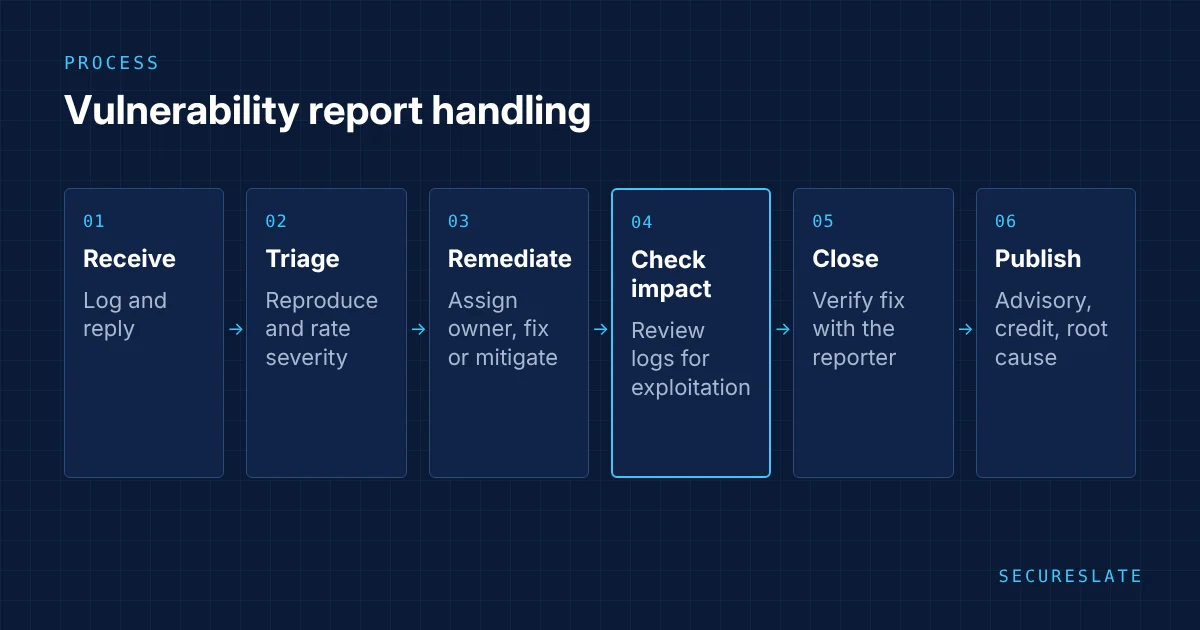
- Receive and acknowledge. Log the report in a ticket the moment it arrives and reply to the reporter within the time your policy promises. Even a short "received, we are looking" keeps the reporter patient.
- Triage and validate. Reproduce the issue, confirm it is in scope and rate severity using your normal scale, for example CVSS plus business context. Check for duplicates. Tell the reporter the outcome, including when you judge the issue not to be a vulnerability, and explain why.
- Assign and remediate. Route the fix to the owning team under the remediation timelines in your vulnerability management policy. Apply a temporary mitigation if the fix will take time.
- Check for impact. Review logs for signs that the flaw was exploited before it was reported. If personal data or customer data was exposed, hand the case to your incident response process, because notification duties may apply.
- Verify and close with the reporter. Confirm the fix works, ideally inviting the reporter to retest, and agree what will be published and when.
- Publish and learn. Issue an advisory or release note where customers need to act, request a CVE identifier for product vulnerabilities, credit the reporter if they want it, and record the root cause so the same class of bug is caught earlier next time.
Is vulnerability disclosure required?
For many companies a vulnerability disclosure policy is not legally mandatory, but several regulations require it for specific groups and most security frameworks expect a way to receive external reports.
| Rule or framework | Who it covers | What it expects |
|---|---|---|
| EU Cyber Resilience Act | Manufacturers of products with digital elements sold in the EU | A coordinated vulnerability disclosure policy and a contact address for reports (Annex I, Part II). Reporting of actively exploited vulnerabilities applies from 11 September 2026. |
| NIS 2 Directive | Essential and important entities in the EU | Risk management measures that include vulnerability handling and disclosure (Article 21). Member States designate a CSIRT to coordinate disclosure (Article 12). |
| CISA BOD 20-01 | US federal civilian executive branch agencies | Each agency must publish a vulnerability disclosure policy and maintain handling procedures. |
| ISO 27001 | Certified organizations | Annex A 8.8 covers management of technical vulnerabilities, which includes acting on information from external sources. |
| SOC 2 | Service organizations | The Trust Services Criteria expect channels for external parties to report concerns (CC2.3) and procedures to detect vulnerabilities (CC7.1). |
A few details on the Cyber Resilience Act, as of November 2026. Under the European Commission's reporting guidance, manufacturers report actively exploited vulnerabilities through a single reporting platform operated by ENISA: an early warning within 24 hours of becoming aware, a fuller notification within 72 hours, and a final report no later than 14 days after a corrective measure is available. The remaining product obligations, including the disclosure policy itself, apply from 11 December 2027.
BOD 20-01 binds agencies, not private companies. It still matters to vendors because it set the pattern that public sector buyers now expect from suppliers. In our experience, security questionnaires from enterprise and government customers increasingly ask whether you have a published disclosure policy.
VDP vs bug bounty: which do you need?
Start with a vulnerability disclosure policy. Add a bug bounty only when you can triage and fix the volume of reports it will produce.
A VDP is passive: it tells anyone who happens to find a flaw how to report it, and offers thanks and legal clarity rather than money. A bug bounty is active: it invites testing and pays for valid findings according to severity. That brings more coverage, and also more duplicates, low-quality submissions and negotiation over rewards.
Signs you are ready for a bounty:
- Your scanner backlog is under control and critical findings are fixed within your own timelines.
- You have run at least one external penetration test and fixed what it found.
- Someone owns triage as part of their job, not as a favor.
If those are not true yet, a clear VDP plus regular scanning, patching and periodic penetration testing gives better value.
How SecureSlate helps
SecureSlate is a compliance automation platform, so it does not replace your bug tracker or a bounty platform. It helps you show that disclosure and vulnerability handling work as written:
- Multi-framework control mapping links your vulnerability handling controls to SOC 2, ISO 27001, NIS 2, PCI DSS and other built-in frameworks, so one process supplies evidence for several audits. Requirements without a built-in framework can be set up as a custom framework.
- Agentless, read-only cloud integrations and code security and secrets detection surface misconfigurations and exposed credentials early, which reduces what outsiders find first.
- Risk management records accepted vulnerabilities with an owner and review date.
- A trust center gives you a place to publish your security contact and policy for customers, and security questionnaire automation helps answer disclosure-related questions consistently.
- Audit management keeps policy versions, tickets and remediation evidence together for your auditor.
SecureSlate does not perform audits or issue certifications. You can start a free trial to see how the control mapping works with your stack.
FAQ
What is the difference between a vulnerability disclosure policy and a vulnerability disclosure program?
The policy is the published document that sets scope, rules and commitments. The program is everything behind it: the intake channel, triage roles, remediation workflow, advisories and metrics. People often use VDP for both, but an auditor will want to see the program operating, not just the page.
How quickly should we respond to a report?
Set targets you can actually meet. Many teams acknowledge within a few business days, give a triage decision within one to two weeks and send regular updates until the fix ships. Consistency matters more than speed: publish the targets and track whether you hit them.
Do we need to pay researchers who report vulnerabilities?
No. A VDP without rewards is normal and widely accepted. Public thanks, a hall of fame entry or company merchandise are common forms of recognition. State clearly that no payment is offered so expectations are aligned from the first email.
Should we request a CVE for vulnerabilities in a SaaS product?
CVE identifiers are most useful when customers must take action, such as upgrading installed software, agents, SDKs or on-premises components. For flaws in a hosted service that you fix centrally, a CVE is often unnecessary, though a customer notice may still be appropriate if data was at risk.
Disclaimer (legal note)
This article is for general information only and is not legal, regulatory, or professional advice. Requirements vary by framework, industry, and jurisdiction. Consult qualified advisors for your specific obligations.
Need compliance without the complexity?
SecureSlate automates ISO 27001, SOC 2, GDPR, HIPAA, and more. Built for growing teams. See it in action.
Find compliance gaps in 30 seconds