
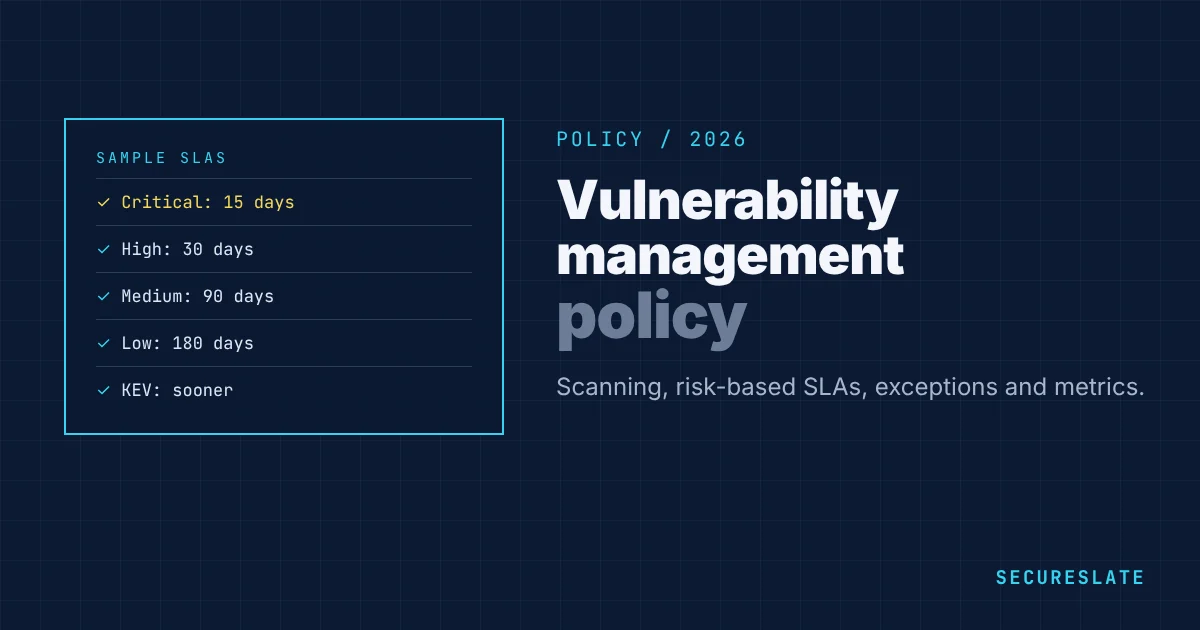
A vulnerability management policy defines how your organization finds, prioritizes, fixes and tracks security weaknesses in its systems, applications and dependencies. It sets scanning frequencies, remediation timelines by severity, who is responsible and how exceptions are handled. Auditors for SOC 2, ISO 27001, PCI DSS, HIPAA and CMMC all expect a documented process with evidence that it works. This guide covers what to include, sample remediation SLAs, a template and best practices for prioritizing the vulnerabilities that matter most.
Related guides: Risk vs vulnerability scanning · Penetration testing best practices · Open source software risks · Incident management policy
Key takeaways
- Cover infrastructure, cloud, endpoints, applications, containers and open-source dependencies.
- Set remediation timelines by severity, such as 15 days for critical and 30 days for high.
- Prioritize using CVSS plus exploitability, including CISA's Known Exploited Vulnerabilities catalog and EPSS scores.
- Require documented exceptions with compensating controls and expiry dates.
- Track metrics such as overdue vulnerabilities and mean time to remediate.
What the policy should cover
| Asset type | How vulnerabilities are found |
|---|---|
| Servers and virtual machines | Authenticated network and host scanning |
| Cloud configuration | Cloud security posture management |
| Endpoints | Device management and endpoint agents reporting OS and app versions |
| Web applications and APIs | Dynamic application security testing (DAST) and penetration testing |
| Source code | Static analysis (SAST) and secrets scanning |
| Open-source dependencies | Software composition analysis (SCA) |
| Containers and images | Image scanning in registries and CI pipelines |
| SaaS applications | Vendor advisories and configuration reviews |
| External attack surface | External scanning of domains and IPs |
Severity and prioritization
Most organizations start with the Common Vulnerability Scoring System (CVSS), maintained by FIRST. CVSS v4.0 was released in 2023, though many tools still report v3.1 scores. CVSS measures technical severity but not likelihood of exploitation in your environment, so add context:
| Factor | Why it matters |
|---|---|
| Known exploitation | Vulnerabilities in CISA's KEV catalog are being exploited in the wild |
| EPSS score | The Exploit Prediction Scoring System estimates the probability of exploitation in the next 30 days |
| Internet exposure | Internet-facing systems are reachable by more attackers |
| Data sensitivity | Systems holding Restricted data deserve faster fixes |
| Compensating controls | WAF rules or network isolation may reduce urgency |
| Asset criticality | Production versus test environments |
Sample remediation SLAs
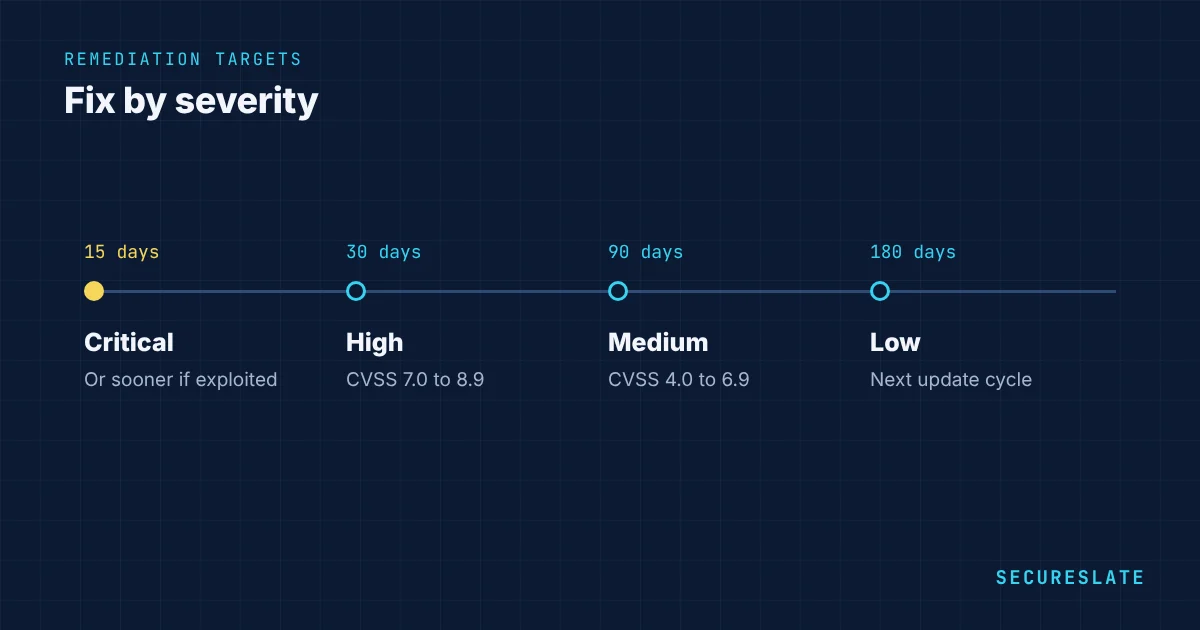
| Severity | Definition | Remediation target |
|---|---|---|
| Critical | CVSS 9.0 to 10.0, or any KEV-listed vulnerability on an exposed system | 15 days, or sooner if actively exploited |
| High | CVSS 7.0 to 8.9 | 30 days |
| Medium | CVSS 4.0 to 6.9 | 90 days |
| Low | CVSS 0.1 to 3.9 | 180 days or next scheduled update |
For reference, CISA's Binding Operational Directive 22-01 requires US federal agencies to remediate KEV-listed vulnerabilities within set deadlines, often two weeks. PCI DSS v4.0.1 requires critical security patches to be installed within one month of release and quarterly internal and external vulnerability scans, with external scans performed by an Approved Scanning Vendor.
Vulnerability management policy template
1. Purpose
Reduce the risk of exploitation by identifying and remediating vulnerabilities in a timely, risk-based manner.
2. Scope
All company-owned or managed systems, cloud environments, endpoints, applications, code, containers and third-party components used in production.
3. Roles
| Role | Responsibility |
|---|---|
| Security team | Runs scanning, triages findings, tracks metrics, approves exceptions |
| System and application owners | Remediate vulnerabilities in their assets |
| Engineering | Fixes code and dependency vulnerabilities |
| IT | Patches endpoints and corporate systems |
| Leadership | Approves risk acceptance for overdue critical items |
4. Asset inventory
Maintain an inventory of in-scope assets with owners. Assets not in the inventory cannot be scanned reliably.
5. Scanning frequency
- Infrastructure and cloud: continuous or at least weekly
- Endpoints: continuous through device management
- Code and dependencies: on every pull request and build
- Containers: on build and in registries
- External attack surface: at least weekly
- Penetration testing: at least yearly and after major changes
6. Triage and prioritization
Security triages new findings, confirms severity and assigns owners, considering exploitability, exposure and data sensitivity.
7. Remediation timelines
Follow the SLA table. Time starts when the vulnerability is detected or published, whichever is later.
8. Patch management
Apply vendor patches through tested processes; use automatic updates for endpoints and browsers where possible; replace end-of-life software.
9. Exceptions and risk acceptance
If remediation is not possible within the SLA, the owner requests an exception explaining why, compensating controls and a new date. Security approves; leadership approves for critical items. Exceptions expire and are reviewed.
10. Verification
Rescan or retest to confirm fixes before closing.
11. Metrics and reporting
Report monthly on open vulnerabilities by severity, overdue items, mean time to remediate and exceptions.
12. Review
Review the policy yearly.
Metrics
| Metric | Target example |
|---|---|
| Critical and high vulnerabilities past SLA | Zero |
| Mean time to remediate critical | Under 15 days |
| Percentage of assets scanned in the last 7 days | Above 95% |
| End-of-life software in production | Zero |
| Open exceptions past expiry | Zero |
| KEV-listed vulnerabilities open | Zero |
Framework mapping
| Framework | Relevant requirement |
|---|---|
| SOC 2 | CC7.1 detection of configuration changes and vulnerabilities; CC8.1 change management |
| ISO 27001:2022 | Annex A 8.8 management of technical vulnerabilities; 8.19 software installation; 5.7 threat intelligence |
| PCI DSS v4.0.1 | Requirement 6.3 security vulnerabilities identified and addressed; 11.3 vulnerability scans; 11.4 penetration testing |
| HIPAA | Risk analysis and risk management; protection from malicious software |
| CMMC Level 2 | RA.L2-3.11.2 vulnerability scanning; SI.L2-3.14.1 flaw remediation |
Best practices
- Scan authenticated rather than unauthenticated where possible, for more accurate results.
- Fix classes of problems, such as base images or shared libraries, instead of one host at a time.
- Automate dependency updates with pull requests and good test coverage.
- Track end-of-life dates and plan upgrades before support ends.
- Feed vulnerabilities into the risk register when they cannot be fixed quickly.
- Share a monthly dashboard with engineering leaders.
Handling vulnerabilities in third-party and SaaS products
Some vulnerabilities sit in products you cannot patch yourself, such as SaaS applications, appliances or vendor-managed services. The policy should require owners to track vendor advisories for critical products, apply vendor updates or configuration changes promptly, ask vendors for timelines when no fix is available and add compensating controls such as restricting access or disabling vulnerable features. Record these in the same tracking system so they appear in metrics and are not forgotten.
How SecureSlate helps
SecureSlate brings vulnerability management into your compliance program. It scans your code and dependencies, monitors your external attack surface, flags outdated and end-of-life software, checks open-source licenses and tracks findings against your SLAs, with evidence mapped to SOC 2, ISO 27001 and other frameworks, all at SMB-friendly pricing.
FAQ
What is a vulnerability management policy?
A policy that defines how an organization finds, prioritizes, remediates and tracks security vulnerabilities, including scanning frequency, SLAs and exceptions.
What are typical vulnerability remediation timelines?
Common targets are 15 days for critical, 30 days for high, 90 days for medium and 180 days for low, with faster action for actively exploited vulnerabilities.
What is the CISA KEV catalog?
A list maintained by CISA of vulnerabilities known to be exploited in the wild, used to prioritize urgent remediation.
How often should vulnerability scans run?
Continuously or at least weekly for infrastructure and external assets, on every build for code and dependencies, and quarterly at minimum where PCI DSS applies.
Is a vulnerability management policy required for SOC 2?
SOC 2 does not require a specific document, but auditors expect a defined vulnerability management process with evidence, so most companies write a policy.
What is EPSS?
The Exploit Prediction Scoring System, run by FIRST, estimates the probability that a vulnerability will be exploited in the next 30 days, helping teams prioritize beyond CVSS severity.
Disclaimer (legal note)
This article is for general information only and is not legal, regulatory, or professional advice. Requirements vary by framework, industry, and jurisdiction. Consult qualified advisors for your specific obligations.
Need compliance without the complexity?
SecureSlate automates ISO 27001, SOC 2, GDPR, HIPAA, and more. Built for growing teams. See it in action.
Find compliance gaps in 30 seconds