
An incident management policy defines how your organization detects, reports, responds to and learns from security incidents. When a laptop is stolen, an account is compromised or ransomware hits a server, the policy tells people what to do, who decides and who must be notified, often within strict legal deadlines. It is required or expected by SOC 2, ISO 27001, HIPAA, GDPR, PCI DSS, NIS 2 and DORA. This guide covers the phases of incident management, severity levels, roles, notification rules and a template you can adapt.
Related guides: Access control policy · Vulnerability management policy · HIPAA breach notification rule · Cyber security report example
Key takeaways
- The policy covers preparation, detection, analysis, containment, eradication, recovery and lessons learned.
- Define severity levels with clear examples and response times.
- Name an incident commander and a response team with backups.
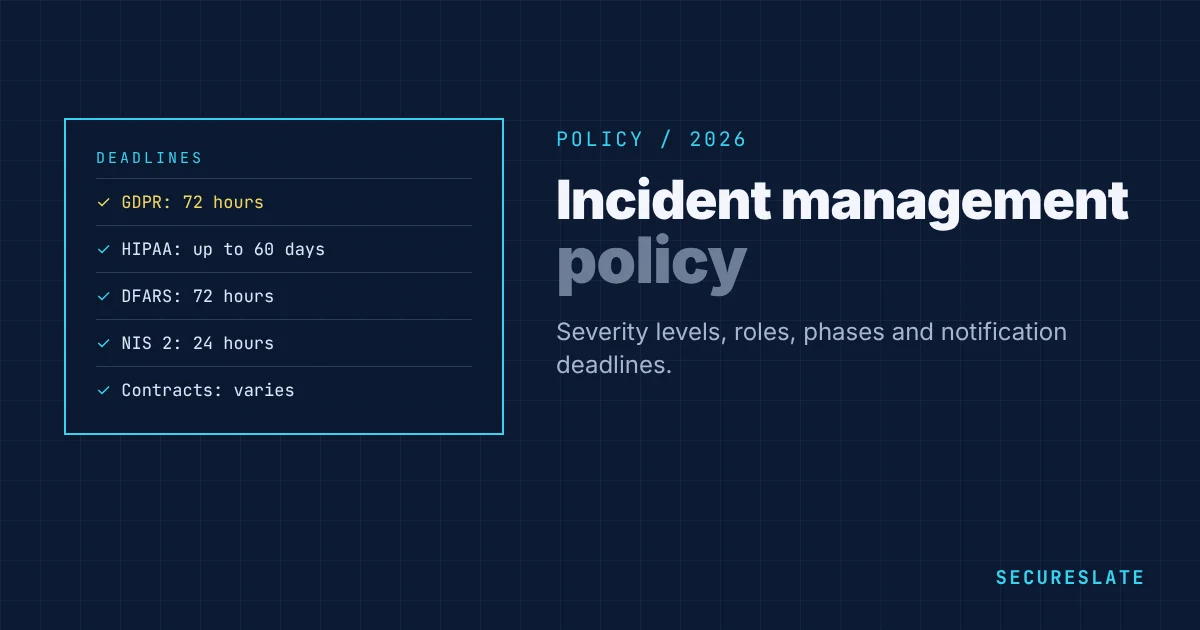
- Know your notification deadlines: GDPR 72 hours to the regulator, HIPAA up to 60 days, DFARS 72 hours, NIS 2 early warning within 24 hours, plus customer contract terms.
- Test the plan at least yearly and record lessons learned.
Incident vs event vs breach
| Term | Meaning | Example |
|---|---|---|
| Event | Any observable occurrence | A failed login |
| Incident | An event that harms or threatens confidentiality, integrity or availability | Successful phishing leading to account access |
| Data breach | An incident that leads to unauthorized access to or disclosure of protected data | Customer records downloaded by an attacker |
Not every incident is a breach, but every breach is an incident. Legal definitions vary, so the policy should tell staff to report anything suspicious and let the response team decide.
Phases of incident management
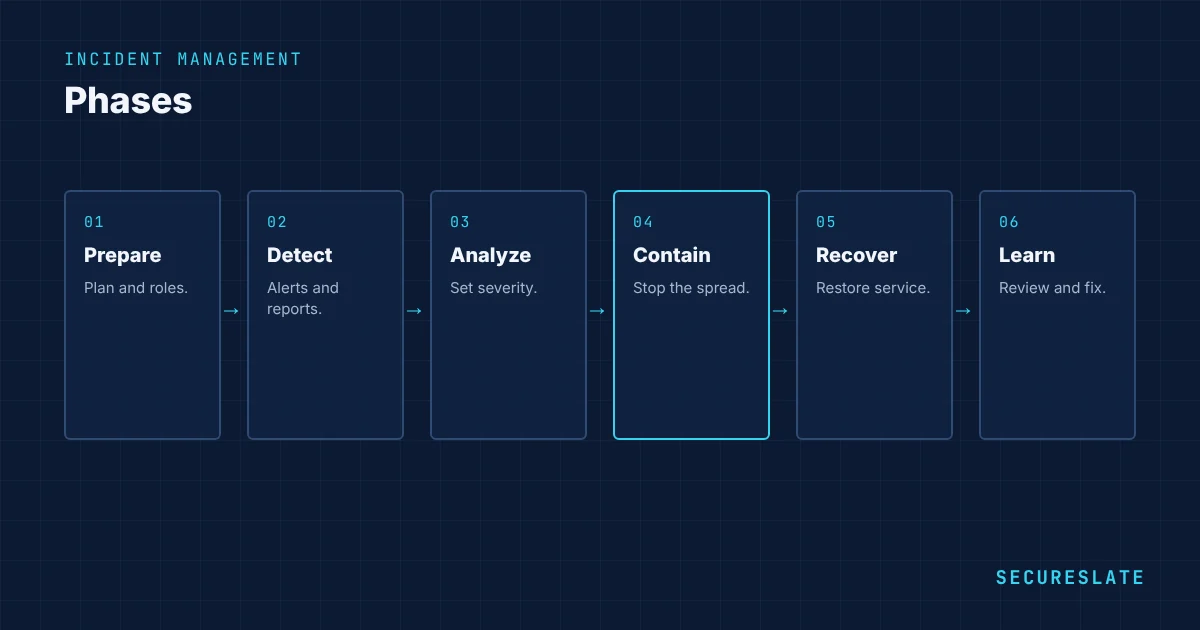
NIST SP 800-61 has long described incident handling as preparation; detection and analysis; containment, eradication and recovery; and post-incident activity. NIST's 2025 revision (Rev. 3) aligns incident response with the NIST CSF 2.0 functions, but the practical steps remain similar:
- Prepare: plan, roles, tools, logging, contact lists and training.
- Detect and report: monitoring alerts, user reports and vendor notifications.
- Analyze and classify: confirm the incident, assess scope and set severity.
- Contain: stop the spread, such as isolating devices or disabling accounts.
- Eradicate: remove the cause, such as malware or a vulnerable service.
- Recover: restore systems and confirm normal operation.
- Notify: regulators, customers, partners and individuals as required.
- Learn: post-incident review, root cause and improvements.
Severity levels
| Severity | Description | Examples | Response target |
|---|---|---|---|
| SEV 1 Critical | Major impact on customers, data or operations | Ransomware on production, confirmed breach of customer data | Respond immediately, 24/7, leadership notified within 1 hour |
| SEV 2 High | Significant impact contained to some systems or data | Compromised admin account, malware on multiple devices | Respond within 4 hours |
| SEV 3 Medium | Limited impact, no confirmed data exposure | Single compromised user account, lost encrypted laptop | Respond within 1 business day |
| SEV 4 Low | Minor issues or policy violations | Phishing email reported but not clicked | Respond within 3 business days |
Incident management policy template
1. Purpose
Ensure security incidents are handled quickly and consistently to limit harm and meet legal and contractual duties.
2. Scope
All systems, data, employees, contractors and vendors handling company data.
3. Definitions
Event, incident, breach and severity levels as above.
4. Roles
| Role | Responsibility |
|---|---|
| Incident commander | Leads the response, makes decisions, coordinates teams |
| Security or IT responders | Investigate, contain, eradicate and recover |
| Communications lead | Internal and external communication |
| Legal and privacy | Assess notification obligations, regulator contact |
| Executive sponsor | Business decisions, resources, public statements |
| All staff | Report suspected incidents immediately |
5. Reporting
Staff report suspected incidents through a defined channel, such as a security email, chat channel or ticket form, without delay. Reports can be made without fear of blame.
6. Response procedure
Follow the phases above, with runbooks for common incident types such as phishing, malware, lost devices, account compromise and data leaks.
7. Evidence handling
Preserve logs, images and other evidence, record a timeline and maintain chain of custody where legal action is possible.
8. Notification
Legal and privacy assess duties for each incident:
| Requirement | Deadline |
|---|---|
| GDPR personal data breach to supervisory authority | Within 72 hours of becoming aware, unless unlikely to result in risk |
| GDPR notice to individuals | Without undue delay if high risk |
| HIPAA breach of unsecured PHI to individuals | Without unreasonable delay, no later than 60 days after discovery |
| DFARS 252.204-7012 cyber incident | Within 72 hours to DoD |
| NIS 2 significant incident | Early warning within 24 hours, notification within 72 hours, final report within one month |
| DORA major ICT-related incident | Initial, intermediate and final reports on defined timelines |
| Customer contracts | As specified, often 24 to 72 hours |
| US state breach laws | Vary by state |
9. Post-incident review
For SEV 1 and SEV 2 incidents, hold a blameless review within two weeks, document root cause and assign corrective actions.
10. Testing and training
Run a tabletop exercise at least yearly and train responders on runbooks.
11. Records
Keep incident records, decisions and notifications for the defined retention period.
12. Review
Review the policy yearly and after major incidents.
Framework mapping
| Framework | Relevant requirements |
|---|---|
| SOC 2 | CC7.3 to CC7.5 evaluate, respond to and recover from incidents |
| ISO 27001:2022 | Annex A 5.24 to 5.28: planning, assessment, response, learning and evidence collection; 6.8 event reporting |
| HIPAA | Security incident procedures and Breach Notification Rule |
| PCI DSS v4.0.1 | Requirement 12.10 incident response plan |
| NIS 2 | Article 23 reporting obligations |
Common mistakes
- No clear reporting channel, so incidents are discussed in private messages and lost
- Severity levels with no examples, leading to inconsistent decisions
- Contact lists out of date
- Never testing the plan
- Forgetting vendor-caused incidents and contractual notification duties
- No lessons learned, so the same incident repeats
Common incident runbooks
| Incident type | First actions |
|---|---|
| Phishing with credential entry | Reset password, revoke sessions, check MFA and mailbox rules, search for similar emails |
| Malware on a laptop | Isolate the device with the endpoint tool, collect evidence, reimage, check for lateral movement |
| Lost or stolen device | Confirm encryption, remotely lock or wipe, revoke tokens, record the incident |
| Exposed secret in code | Revoke and rotate the secret, review usage logs, remove it from history |
| Public storage exposure | Restrict access, review access logs for downloads, assess data affected |
| Vendor breach notice | Confirm what data the vendor holds, rotate shared credentials, assess notification duties |
Short runbooks like these help responders act quickly and consistently, especially at night or when the usual responder is away.
How SecureSlate helps
SecureSlate includes an incident management policy template mapped to SOC 2, ISO 27001 and HIPAA, tracks employee acknowledgment, records incidents with timelines and corrective actions, and schedules tabletop exercises. Continuous monitoring of cloud, identity and dark web exposure helps detect issues early, and records are ready for auditors.
FAQ
What is an incident management policy?
A policy that defines how security incidents are reported, classified, handled, communicated and reviewed.
What is the difference between incident management and incident response?
Incident management is the overall program including preparation and improvement. Incident response is the active handling of a specific incident.
How often should the incident response plan be tested?
At least yearly through a tabletop exercise, and after significant changes to systems or the team.
Who should be on the incident response team?
An incident commander, technical responders, communications, legal or privacy and an executive sponsor, with backups for each.
What are the GDPR breach notification rules?
Notify the supervisory authority within 72 hours of becoming aware of a personal data breach unless it is unlikely to result in risk, and notify individuals without undue delay if the risk is high.
Disclaimer (legal note)
This article is for general information only and is not legal, regulatory, or professional advice. Requirements vary by framework, industry, and jurisdiction. Consult qualified advisors for your specific obligations.
Need compliance without the complexity?
SecureSlate automates ISO 27001, SOC 2, GDPR, HIPAA, and more. Built for growing teams. See it in action.
Find compliance gaps in 30 seconds