
Short answer: Security incident management is the end-to-end process an organization uses to prepare for, detect, assess, contain, resolve and learn from security incidents. It covers more than technical response: it also defines who decides, how severity is set, who must be notified and by when, and what records are kept as evidence.
Related guides: Incident management policy · Incident response plan template · SOC 2 incident response
Key takeaways
- Incident management is a lifecycle, not a single response: prepare, detect and analyze, contain, eradicate and recover, then review.
- A severity scale agreed in advance removes the hardest decision from the first hour of an incident.
- Name an incident commander. One person coordinating is more effective than several people fixing in parallel.
- Notification clocks start early. GDPR gives 72 hours to notify the supervisory authority, and HIPAA gives up to 60 days to notify affected individuals.
- Auditors test whether the process ran as written: tickets, timelines, decisions and post-incident reviews.
What is security incident management?
Security incident management is the structured way an organization handles events that threaten the confidentiality, integrity or availability of its information and systems, from first report to closure.
Three terms are often confused, and the distinction matters because legal duties attach to some and not others:
| Term | Meaning | Example |
|---|---|---|
| Security event | Any observable occurrence relevant to security | A failed login, a blocked malware download |
| Security incident | An event, or series of events, that compromises or threatens information or systems and needs a response | A stolen laptop, a compromised admin account |
| Data breach | An incident in which protected data is accessed, disclosed, altered or lost without authorization | Customer records downloaded by an attacker |
Every breach is an incident, but most incidents are not breaches. Part of the process is deciding, with evidence, which category applies.
What are the stages of the incident management process?
The widely used model has four stages: preparation; detection and analysis; containment, eradication and recovery; and post-incident activity.
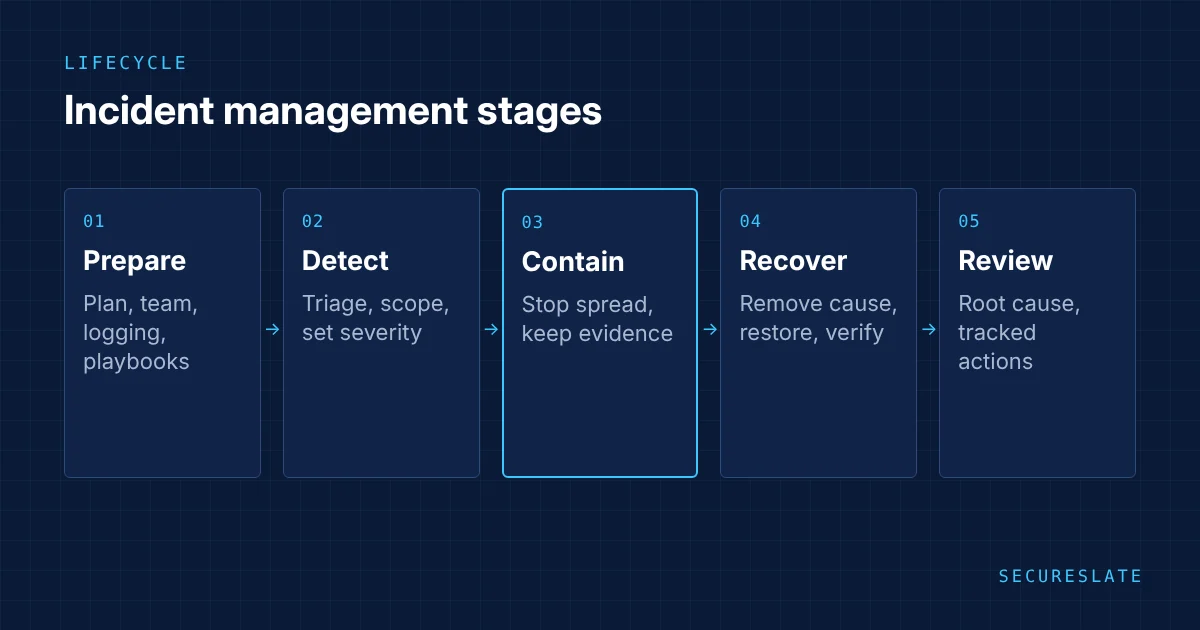
The diagram splits the third stage into two steps, Contain and Recover, so each one is visible.
This lifecycle was set out in NIST SP 800-61 Revision 2. NIST replaced that document in 2025 with SP 800-61 Revision 3, which reorganizes incident response around the six functions of the NIST Cybersecurity Framework 2.0 (Govern, Identify, Protect, Detect, Respond and Recover). The four-stage model remains a clear way to structure day-to-day work.
1. Preparation
Write the policy and plan, form the team, define severity levels, set up communication channels and make sure logging is in place before you need it. Prepare short playbooks for the scenarios most likely to affect you, such as a compromised account, ransomware, a lost device, a leaked credential and a vendor breach.
2. Detection and analysis
Incidents arrive from monitoring alerts, employee reports, customers, vendors and outside researchers. Give people one obvious place to report. Then triage: confirm whether it is a real incident, determine the scope, assign a severity and open a record. Start a timeline immediately and write down every decision with the time it was made.
3. Containment, eradication and recovery
Contain first to stop the damage spreading: disable accounts, revoke tokens, isolate hosts, block addresses. Preserve evidence before wiping anything. Then remove the cause, such as malware, a vulnerable component or an attacker's persistent access. Finally, restore systems from known-good sources, verify they are clean and monitor closely for recurrence.
4. Post-incident activity
Hold a blameless review within a set time of closure. Establish the root cause, what worked, what slowed the response and which actions will prevent a repeat. Assign owners and due dates, and track the actions to completion. Our incident postmortem template gives a format you can reuse.
How do you classify incident severity?
Classify severity by the impact on data, customers and operations, using a small scale with clear criteria and a response expectation for each level.
The following is an example scale. The response times are illustrations to adapt, not a standard.
| Level | Criteria | Examples | Typical response |
|---|---|---|---|
| SEV 1, Critical | Confirmed or likely compromise of sensitive data, or a major outage of a core service | Production database accessed by an attacker, ransomware in production | Immediate, all hands, executives informed, legal engaged |
| SEV 2, High | Significant security impact contained to limited systems or users | Compromised employee account with access to internal data | Same day, incident commander assigned |
| SEV 3, Medium | Limited impact, no evidence of sensitive data exposure | Malware on a single laptop caught by endpoint protection | Within the next business day |
| SEV 4, Low | Minor policy violation or event needing follow-up | Phishing email reported and not clicked | Handled through normal ticket queue |
Rules that make a scale work:
- Classify on what you know now, and reclassify as facts change. Starting high and downgrading is safer than the reverse.
- Tie severity to actions: who is paged, who is informed and whether legal review is triggered.
- Add a data question to every triage. If personal data or protected health information may be involved, a breach assessment starts regardless of the technical severity.
Who does what during an incident?
One person leads, and others take defined roles for technical work, communication, legal assessment and record keeping.
- Incident commander: owns the incident, sets priorities, makes or escalates decisions and keeps everyone coordinated. Does not do the hands-on fixing.
- Technical lead: directs investigation, containment and recovery.
- Scribe: maintains the timeline, decisions and action list.
- Communications lead: handles internal updates, customer messages and, where needed, public statements.
- Legal and privacy lead: assesses notification duties, contractual obligations and evidence handling. Often outside counsel for small companies.
- Executive sponsor: approves significant decisions such as taking a service offline or notifying customers.
In a small company one person may hold several roles. What matters is that the roles are assigned by name in advance, with a backup for each, and that the contact list works out of hours.
When do you have to report a security incident?
Reporting deadlines depend on the law or contract that applies, and several run from the moment you become aware of the incident, so the assessment has to begin early.
| Regime | Who is notified | Deadline |
|---|---|---|
| GDPR Article 33 | Supervisory authority, for a personal data breach unless it is unlikely to result in a risk to individuals | Without undue delay and, where feasible, within 72 hours of becoming aware |
| GDPR Article 34 | Affected individuals, when the breach is likely to result in a high risk to them | Without undue delay |
| GDPR Article 33(2) | The controller, when you are a processor | Without undue delay after becoming aware |
| HIPAA Breach Notification Rule, 45 CFR 164.404 | Affected individuals, for a breach of unsecured protected health information | Without unreasonable delay and no later than 60 calendar days after discovery |
| HIPAA, 45 CFR 164.408 | US Department of Health and Human Services | For breaches affecting 500 or more individuals, at the same time as individual notice. For fewer than 500, within 60 days after the end of the calendar year |
| HIPAA, 45 CFR 164.410 | The covered entity, when you are a business associate | Without unreasonable delay and no later than 60 calendar days after discovery |
| NIS 2 Directive Article 23 | National CSIRT or competent authority, for a significant incident at an essential or important entity | Early warning within 24 hours, incident notification within 72 hours, final report within one month |
Three practical points:
- Contracts are often stricter than law. Customer agreements and business associate agreements commonly set shorter notice periods than the statutory maximum. Keep a list of these commitments.
- US state laws and sector rules add further duties. Requirements vary by jurisdiction and change over time, so confirm current obligations with counsel.
- Document the decision either way. If you conclude that notification is not required, record the reasoning and the evidence behind it.
For detail, see our guides to GDPR data breach notification requirements and the HIPAA Breach Notification Rule.
What do compliance frameworks require?
Every major framework requires a documented incident process, evidence that it is followed and evidence that lessons are applied.
- SOC 2: In the Trust Services Criteria, CC7.3 covers evaluating security events, CC7.4 covers responding to identified incidents through a defined program, and CC7.5 covers recovery.
- ISO 27001:2022: Annex A controls 5.24 to 5.28 cover planning and preparation, assessment and decision on events, response, learning from incidents and collection of evidence. Control 6.8 covers reporting of security events by personnel.
- HIPAA Security Rule: 45 CFR 164.308(a)(6) requires security incident procedures, including identifying and responding to suspected or known incidents, mitigating harmful effects and documenting incidents and their outcomes. Our HIPAA incident response plan guide covers this for HealthTech teams.
- PCI DSS v4.0.1: Requirement 12.10 requires an incident response plan that is ready to be activated, tested and supported by trained personnel.
Incident readiness checklist
Use this to check whether the process would hold up tomorrow.
- An approved incident management policy and response plan, reviewed in the last year.
- A named incident commander and backups, with out-of-hours contact details stored somewhere that works if primary systems are down.
- A severity scale with criteria and required actions for each level.
- One well-known channel for employees to report suspected incidents.
- Logging enabled and retained for identity, cloud, endpoint and key applications.
- Playbooks for your most likely scenarios.
- A list of legal and contractual notification duties, with deadlines and contacts.
- Agreements in place with outside counsel and, if needed, a forensic provider.
- Tested backups and a documented recovery procedure.
- An incident record template that captures timeline, scope, decisions, evidence and notification assessment.
- A tabletop exercise at least once a year, with findings tracked.
- A post-incident review process with actions assigned and followed to closure.
How SecureSlate helps
SecureSlate supports the governance side of incident management so that the process is documented, mapped and provable.
- Multi-framework control mapping: map incident controls once across SOC 2, ISO 27001, HIPAA, GDPR, PCI DSS, NIS 2 and other built-in frameworks.
- Audit management: keep policies, incident records, exercise results and post-incident reviews together as evidence.
- Risk management: turn lessons from incidents into tracked risks and treatment actions.
- Vendor risk management: keep vendor contacts, contracts and reviews at hand for incidents that start with a supplier.
- Agentless, read-only cloud integrations and device agent: surface misconfigurations and endpoint gaps that are common causes of incidents.
- Trust center: share your security practices with customers in one place.
SecureSlate is not an incident response service or a monitoring operations center, and it does not perform audits or issue certifications. Start a free trial to see how your incident controls map.
FAQ
What is the difference between incident management and incident response?
Incident response is the tactical work of investigating, containing and recovering from a specific incident. Incident management is the wider program around it: policy, roles, classification, communication, legal reporting, record keeping and continuous improvement. Response is one part of management.
What counts as a security incident?
Any event that actually or potentially compromises the confidentiality, integrity or availability of information or systems, or that violates security policy. Examples include unauthorized access, malware infection, lost or stolen devices, misdirected data, leaked credentials and denial of service. Your policy should define the term for your organization.
How quickly must a data breach be reported under GDPR?
A controller must notify the competent supervisory authority without undue delay and, where feasible, within 72 hours of becoming aware of a personal data breach, unless the breach is unlikely to result in a risk to individuals. If notification is later than 72 hours, the reasons for the delay must be given.
How often should the incident response plan be tested?
At least once a year, and after major changes to systems, team or the plan itself. A tabletop exercise that walks the team through a realistic scenario is the usual method. Record who attended, what was tested and which improvements were identified.
Disclaimer (legal note)
This article is for general information only and is not legal, regulatory, or professional advice. Requirements vary by framework, industry, and jurisdiction. Consult qualified advisors for your specific obligations.
Need compliance without the complexity?
SecureSlate automates ISO 27001, SOC 2, GDPR, HIPAA, and more. Built for growing teams. See it in action.
Find compliance gaps in 30 seconds