
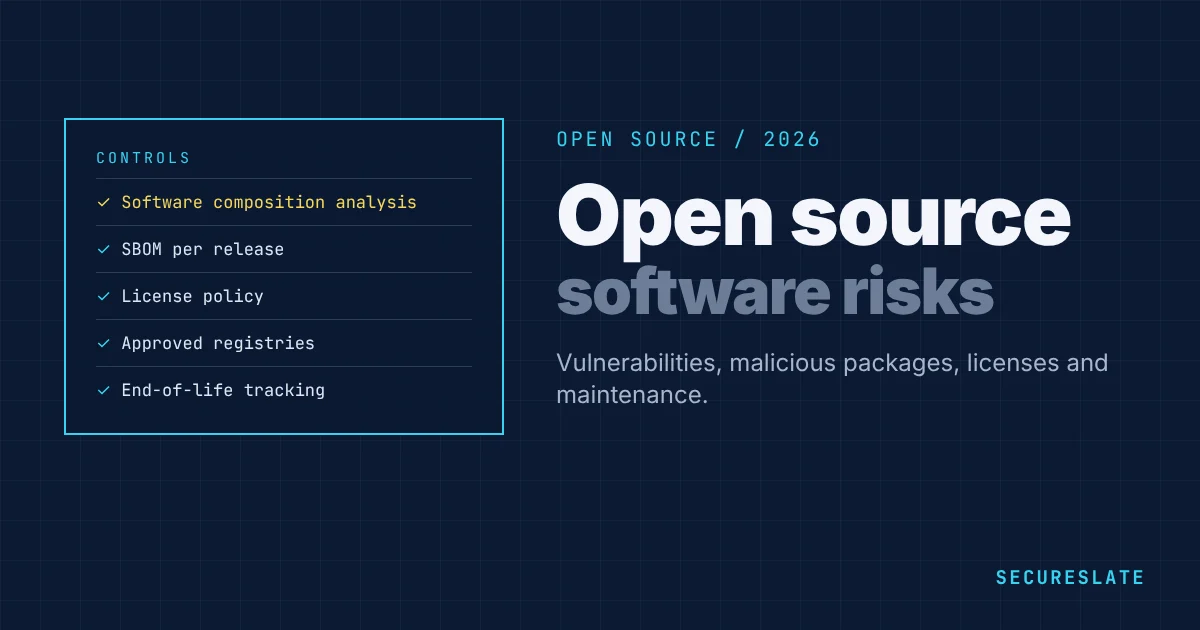
Open source software risks affect almost every company, because modern applications are built mostly from open-source components. Open source brings speed, quality and community support, but it also brings known vulnerabilities, malicious packages, license obligations, abandoned projects and a complex supply chain of transitive dependencies. Incidents such as Log4Shell in 2021 and the XZ Utils backdoor attempt in 2024 showed how one component can affect thousands of organizations. This guide explains the main risks and the practical controls that keep open source use safe.
Related guides: Supply chain security · Vulnerability management policy · Compliance as code · Penetration testing best practices
Key takeaways
- Most risk comes from dependencies you did not choose directly, the transitive ones.
- Main risk areas: vulnerabilities, malicious packages, licenses, maintenance and operational risk.
- Use software composition analysis (SCA) and SBOMs to know what you run.
- Set policies for approved licenses, update practices and package sources.
- Treat open source as part of your software supply chain program.
Main open source risks
1. Known vulnerabilities
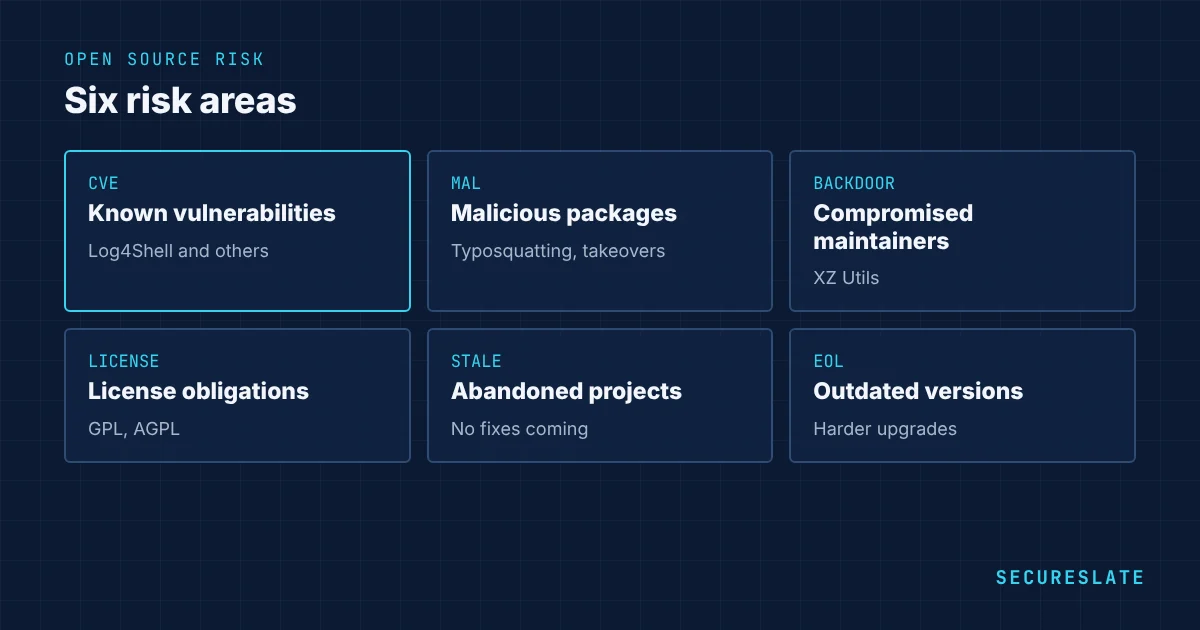
Open-source components often contain vulnerabilities published as CVEs. Because dependencies are shared widely, one flaw can affect many products. Log4Shell (CVE-2021-44228) in the Log4j logging library allowed remote code execution and affected a huge number of Java applications.
2. Malicious packages
Attackers publish packages with names similar to popular ones (typosquatting), take over abandoned packages, compromise maintainer accounts or exploit dependency confusion between internal and public package names. Package registries regularly remove malicious packages, but some are downloaded before detection.
3. Compromised maintainers and backdoors
The 2024 XZ Utils incident involved a contributor who gained trust over time and inserted a backdoor into a widely used compression library, discovered shortly before reaching many stable Linux distributions.
4. License compliance
Open-source licenses come with conditions:
| License type | Examples | Key obligations |
|---|---|---|
| Permissive | MIT, BSD, Apache 2.0 | Keep copyright and license notices; Apache 2.0 includes a patent grant and notice requirements |
| Weak copyleft | LGPL, MPL 2.0 | Share changes to the licensed component, with conditions on linking or files |
| Strong copyleft | GPL v2, GPL v3 | Distributing software that includes GPL code may require releasing source under GPL |
| Network copyleft | AGPL v3 | Offering modified software over a network may require providing source to users |
| Source-available | Business Source License, Server Side Public License | Not open source by OSI definition; usage restrictions may apply |
Violations can lead to legal claims, forced disclosure of code or problems during due diligence for funding or acquisitions.
5. Abandoned or poorly maintained projects
Projects with one maintainer, slow responses to security issues or no recent releases increase risk. When a project is abandoned, vulnerabilities may never be fixed.
6. Outdated and end-of-life components
Old versions accumulate vulnerabilities, and upgrading across major versions becomes harder the longer you wait.
7. Operational risks
Breaking changes, removed packages and registry outages can break builds.
Controls to manage open source risk
| Control | What it does |
|---|---|
| Software composition analysis | Identifies components, versions, vulnerabilities and licenses |
| SBOM generation | Lists all components in SPDX or CycloneDX format for each release |
| Dependency update automation | Opens pull requests for updates, so fixes are applied quickly |
| Version pinning and lockfiles | Ensures builds use known versions |
| Approved registries and proxies | Controls where packages come from and blocks known malicious ones |
| License policy | Lists allowed, review-required and prohibited licenses |
| Project health checks | Uses signals such as OpenSSF Scorecard to assess maintenance and security practices |
| Secrets and code scanning | Prevents leaked credentials and insecure code |
| Signing and provenance | Verifies artifacts were built from expected sources |
| End-of-life tracking | Flags components and runtimes past support dates |
Open source policy essentials
- Approval: criteria for adding new dependencies, including license, maintenance and security history.
- Licenses: allowed licenses, those needing legal review and prohibited ones for your distribution model.
- Sources: approved package registries and internal mirrors.
- Updates: remediation timelines for vulnerable dependencies aligned with your vulnerability management policy.
- Inventory: SBOM for every release, stored and searchable.
- Contributions: rules for employees contributing to open source.
- Incidents: steps to follow when a major open-source vulnerability is announced.
Responding to a major open-source vulnerability
- Search SBOMs and SCA results for the affected component and versions.
- Identify exposed systems, starting with internet-facing ones.
- Apply patches or mitigations from maintainers or vendors.
- Hunt for signs of exploitation in logs.
- Ask critical vendors whether they are affected.
- Communicate status to customers if needed.
Regulations and expectations
- US federal software attestation requirements reference NIST SSDF practices, including managing third-party components.
- The EU Cyber Resilience Act requires manufacturers of products with digital elements to identify and document components, including open source, with obligations phasing in through 2027.
- ISO 27001:2022 Annex A 8.28 secure coding and 5.21 ICT supply chain controls apply to open-source use.
- Customers increasingly request SBOMs and evidence of dependency management in security reviews.
Example open source license policy
| Category | Licenses | Rule |
|---|---|---|
| Allowed | MIT, BSD-2-Clause, BSD-3-Clause, Apache-2.0, ISC | Use freely; keep notices |
| Review required | LGPL, MPL-2.0, EPL-2.0 | Legal or engineering lead approval with notes on how the component is linked and distributed |
| Restricted | GPL-2.0, GPL-3.0 | Not allowed in distributed products without legal approval |
| Prohibited for SaaS | AGPL-3.0, SSPL | Not allowed in production services without legal approval |
| Unknown or no license | None | Do not use until clarified |
Adjust categories to your distribution model. A company that ships on-premises software has different obligations from one that only offers SaaS.
Metrics to track
| Metric | Why it matters |
|---|---|
| Critical and high dependency vulnerabilities open | Exposure |
| Mean time to update vulnerable dependencies | Responsiveness |
| Components with restricted or unknown licenses | Legal risk |
| Components past end of life | Future exposure |
| Percentage of releases with an SBOM | Visibility |
| Dependencies with low project health scores | Maintenance risk |
Contributing back
Supporting the open-source projects you depend on reduces risk. Options include reporting and fixing bugs, contributing security improvements, sponsoring maintainers and participating in foundations such as the OpenSSF. Healthier projects respond faster to vulnerabilities and are less likely to be abandoned.
How SecureSlate helps
SecureSlate manages open source risk for small and mid-size engineering teams. Code security finds vulnerable dependencies, open-source license risk flags problematic licenses, outdated and end-of-life software tracking highlights aging components and secrets detection stops credential leaks, with findings mapped to SOC 2 and ISO 27001.
FAQ
What are the main risks of open source software?
Known vulnerabilities, malicious packages, license compliance issues, abandoned projects, outdated components and supply chain compromise.
What is software composition analysis?
Tools that identify open-source components in your code and report vulnerabilities and licenses.
Is GPL software risky for commercial companies?
It depends on how you use and distribute it. GPL can require releasing source code when distributing combined works. Get legal advice for your situation.
What is an SBOM?
A software bill of materials listing the components and versions in a piece of software.
How do I know if an open-source project is well maintained?
Look at release frequency, number of active maintainers, response to security issues and signals such as OpenSSF Scorecard results.
How quickly should vulnerable dependencies be updated?
Follow your vulnerability management SLAs, such as 15 days for critical and 30 days for high, with faster action for actively exploited flaws.
Do we need an SBOM for every product?
It is good practice for any software you ship or operate, and increasingly expected by customers and regulators. Generate it automatically in your build pipeline.
What is OpenSSF Scorecard?
An automated tool that checks open-source projects for security practices such as code review, branch protection, dependency updates and signed releases.
What is typosquatting?
Publishing a malicious package with a name similar to a popular one, hoping developers install it by mistake. Approved registries and dependency review reduce the risk.
Are commercial products safer than open source?
Not necessarily. Commercial products also contain open-source components and vulnerabilities. What matters is visibility, maintenance and how quickly issues are fixed.
Disclaimer (legal note)
This article is for general information only and is not legal, regulatory, or professional advice. Requirements vary by framework, industry, and jurisdiction. Consult qualified advisors for your specific obligations.
Need compliance without the complexity?
SecureSlate automates ISO 27001, SOC 2, GDPR, HIPAA, and more. Built for growing teams. See it in action.
Find compliance gaps in 30 seconds