
Supply chain security protects an organization from threats that enter through the products, services and software it depends on. Attackers increasingly compromise one supplier to reach many targets: a poisoned software update, a breached managed service provider, a malicious open-source package or a hacked file transfer tool. This guide explains the types of supply chain attacks, lessons from major incidents, the controls that matter for both software and vendor supply chains, and frameworks such as SBOM, SLSA and NIST SSDF.
Related guides: Supply chain risk management best practices · Open source software risks · Cyber threat analysis tutorial · Vendor tiering model
Key takeaways
- Supply chain attacks exploit trust in suppliers, such as signed updates, vendor access or popular libraries.
- Defend both the software supply chain (code, dependencies, build systems) and the vendor supply chain (services and access).
- SBOMs show what is inside software; SLSA and SSDF describe how to build it securely.
- Limit the blast radius with least privilege, segmentation and monitoring of supplier access.
- Have a plan to respond quickly when a supplier announces a breach or vulnerability.
Types of supply chain attacks
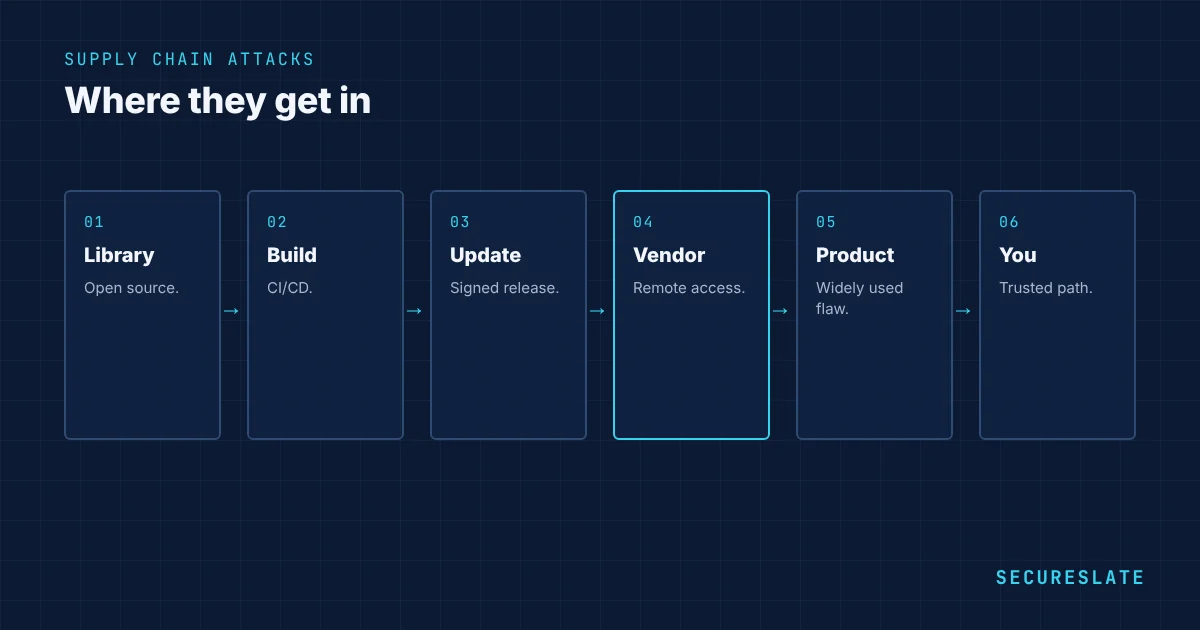
| Type | How it works | Example |
|---|---|---|
| Compromised software update | Attackers insert malicious code into a vendor's build, shipped through normal updates | SolarWinds Orion (2020) |
| Managed service provider compromise | Attackers use a provider's remote management tools to reach its customers | Kaseya VSA ransomware (2021) |
| Vulnerable widely used product | A flaw in a common product is exploited at scale to steal data | MOVEit Transfer data theft (2023) |
| Compromised application installer | A legitimate app is trojanized through its own supply chain | 3CX desktop app (2023) |
| Malicious or hijacked open-source package | Attackers publish lookalike packages or take over maintainers | XZ Utils backdoor attempt (2024), typosquatting on package registries |
| Vulnerable dependency | A flaw in a widely used library affects thousands of products | Log4Shell in Log4j (2021) |
| Hardware or firmware tampering | Components modified before delivery | Rarer, but a concern in critical sectors |
Lessons from major incidents
- Trusted channels can deliver malware. Signed updates are not proof of safety if the build system is compromised.
- Visibility matters. Organizations that knew where Log4j or MOVEit ran responded in hours; others took weeks.
- Vendor access is powerful. Remote management tools and admin access can be turned against customers.
- Open source depends on people. Maintainer burnout and social engineering created the XZ Utils risk.
- Speed of response is key. Patching and hunting quickly reduced harm for many victims.
Software supply chain controls
| Control | What it does |
|---|---|
| Software composition analysis | Identifies open-source components and known vulnerabilities |
| SBOM generation and consumption | Lists components in your software and supplier software, often in SPDX or CycloneDX formats |
| Dependency pinning and verification | Uses exact versions and checks hashes or signatures |
| Private registries or proxies | Controls which packages developers can install |
| Secure build pipelines | Isolated, hardened CI/CD with least privilege and audit logs |
| Artifact signing | Signs builds and verifies signatures before deployment, for example with Sigstore |
| Provenance | Records how and where artifacts were built, as described by SLSA |
| Code review and branch protection | Prevents unreviewed changes |
| Secrets scanning | Stops credentials leaking into code |
Vendor supply chain controls
| Control | What it does |
|---|---|
| Vendor inventory and tiering | Focuses effort on critical suppliers |
| Security due diligence | Reviews SOC 2, ISO 27001 and other evidence |
| Contract terms | Security requirements, breach notification, audit rights |
| Least-privilege vendor access | Named accounts, MFA, time-limited access |
| Network segmentation | Limits what a compromised vendor tool can reach |
| Monitoring vendor activity | Alerts on unusual actions by vendor accounts or tools |
| Continuous vendor monitoring | Tracks breaches and security posture changes |
| Exit and contingency plans | Prepares for vendor failure |
Frameworks and standards
| Framework | Focus |
|---|---|
| SLSA (Supply-chain Levels for Software Artifacts) | Levels of build integrity and provenance |
| NIST SSDF (SP 800-218) | Secure software development practices; basis for US federal software attestation |
| NIST SP 800-161 Rev 1 | Cybersecurity supply chain risk management for organizations |
| SBOM formats: SPDX and CycloneDX | Standard ways to list software components |
| OpenSSF Scorecard | Automated checks of open-source project security practices |
| ISO 27001:2022 | Supplier controls in Annex A 5.19 to 5.23, secure development in 8.25 to 8.31 |
| EU Cyber Resilience Act | Security requirements for products with digital elements, with obligations phasing in through 2027 |
Responding to a supplier incident
- Confirm exposure. Check your inventory and SBOMs for the affected product or vendor.
- Contain. Disable integrations, rotate credentials and block indicators.
- Patch or mitigate. Apply fixes or workarounds.
- Hunt. Search logs for indicators of compromise.
- Communicate. Inform leadership, customers and regulators if required.
- Follow up with the vendor. Request root cause and remediation details.
- Learn. Update contracts, controls and inventories.
Getting started
For a small company, a practical first quarter looks like this: build a vendor inventory from SSO and finance data, tier vendors, collect SOC 2 reports for critical ones, turn on dependency and secrets scanning in your repositories, generate an SBOM for your main product, lock down vendor access with MFA and write a short supplier incident playbook.
Supply chain security checklist
Software
- Dependency and container scanning on every build
- SBOM generated for each release
- Dependencies pinned and sourced from approved registries
- Build pipeline hardened with least privilege and protected secrets
- Releases signed and signatures verified before deployment
- Branch protection and required code review
Vendors
- Complete vendor inventory with tiers and owners
- Security evidence reviewed for critical vendors
- Contracts include security and breach notification terms
- Vendor access through named accounts with MFA and logging
- Exit plans for critical vendors
Response
- Supplier incident playbook written and tested
- Ability to search inventories and SBOMs for an affected component within hours
Regulations driving supply chain security
Regulators increasingly expect supply chain controls. In the US, federal agencies require software producers to attest to secure development practices based on NIST SSDF. In the EU, NIS 2 requires essential and important entities to address supply chain security, DORA sets detailed ICT third-party rules for financial entities, and the Cyber Resilience Act will require manufacturers of products with digital elements to manage vulnerabilities and components over the product lifecycle. Customers also add supply chain questions to security reviews, so evidence of these controls helps sales.
How SecureSlate helps
SecureSlate covers both sides of supply chain security for small and mid-size teams. Code security, secrets detection, open-source license risk and outdated software monitoring protect your software supply chain, while vendor risk management handles inventory, tiering, questionnaires and reviews, with evidence mapped to SOC 2, ISO 27001 and NIS 2.
FAQ
What is a supply chain attack?
An attack that compromises a supplier, software component or service provider to reach the organizations that depend on it.
What is an SBOM?
A software bill of materials: a list of components, libraries and versions in a piece of software, used to track vulnerabilities and licenses.
What is SLSA?
Supply-chain Levels for Software Artifacts, a framework that defines levels of build integrity and provenance to prevent tampering.
How can small companies improve supply chain security?
Inventory and tier vendors, collect security evidence from critical ones, enable dependency and secrets scanning, limit vendor access and prepare an incident playbook.
What was the SolarWinds attack?
A 2020 supply chain compromise in which attackers inserted malicious code into SolarWinds Orion software updates, which were then installed by thousands of customers.
What is dependency confusion?
An attack where a malicious public package uses the same name as a company's internal package, so build tools fetch the attacker's version. Scoped names and private registries prevent it.
How quickly should we respond to a supplier breach notice?
Start the assessment the same day: confirm exposure, rotate shared credentials and decide on containment within hours for critical suppliers.
Disclaimer (legal note)
This article is for general information only and is not legal, regulatory, or professional advice. Requirements vary by framework, industry, and jurisdiction. Consult qualified advisors for your specific obligations.
Need compliance without the complexity?
SecureSlate automates ISO 27001, SOC 2, GDPR, HIPAA, and more. Built for growing teams. See it in action.
Find compliance gaps in 30 seconds