
Cyber threat analysis is the process of turning raw information about attackers, techniques and incidents into decisions your organization can act on. A good analysis answers: who might attack us or our suppliers, how would they do it, what would they want, and what should we change? This tutorial walks through the threat intelligence cycle, the main analysis frameworks such as MITRE ATT&CK, the Cyber Kill Chain and the Diamond Model, then works through a third-party breach example step by step. It ends with best practices for small security and risk teams.
Related guides: Third-party cyber threat assessment · Cyber threat intelligence tools · Supply chain security
Key takeaways
- Threat analysis follows a cycle: direction, collection, processing, analysis, dissemination and feedback.
- MITRE ATT&CK describes attacker tactics and techniques; the Kill Chain describes attack stages; the Diamond Model links adversary, capability, infrastructure and victim.
- Good analysis ends with specific recommendations: detections to add, controls to fix, vendors to review.
- For TPRM, analysis helps decide which vendors to reassess when new threats or breaches appear.
- Keep analysis focused on your environment, not on every headline.
The threat intelligence cycle
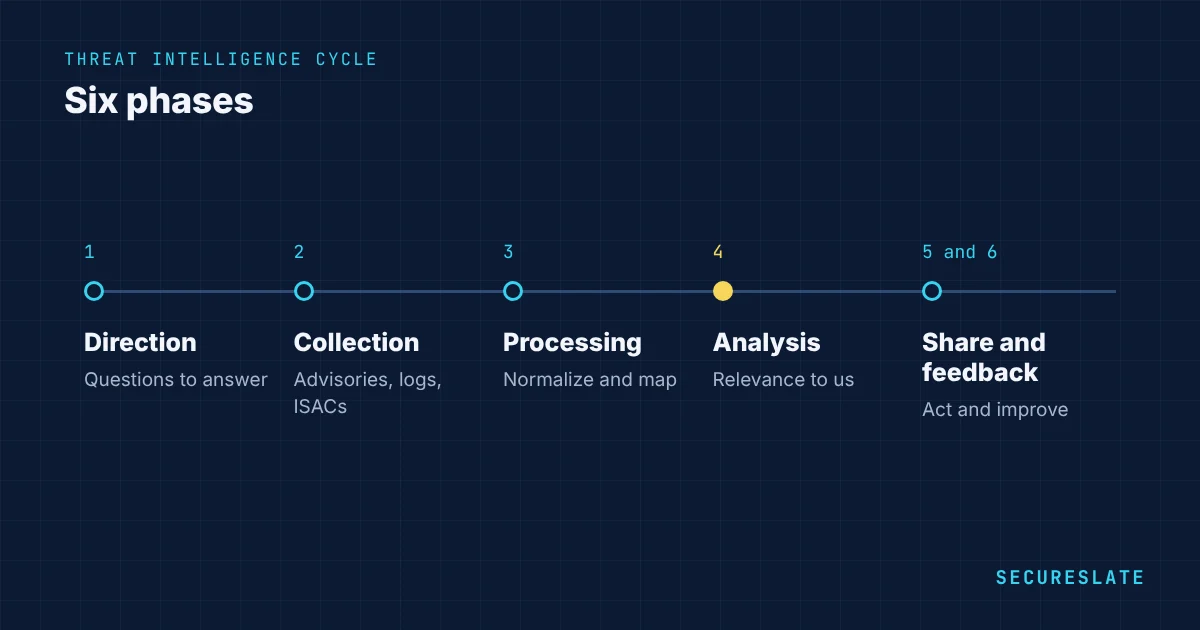
| Phase | What happens | Example |
|---|---|---|
| Direction | Define the questions leaders need answered | "Which ransomware groups target SaaS companies like us, and through which vendors?" |
| Collection | Gather data from sources | CISA advisories, vendor disclosures, ISAC reports, logs, open source research |
| Processing | Normalize, de-duplicate and translate data | Convert indicators to a common format, tag by technique |
| Analysis | Interpret meaning and relevance | Map techniques to our controls and vendors |
| Dissemination | Share findings in the right format | Executive summary, detection rules, vendor review list |
| Feedback | Check whether outputs were useful | Did the new detection fire? Did leaders act? |
Levels of threat intelligence
| Level | Audience | Content |
|---|---|---|
| Strategic | Executives and board | Trends, actor motivations, business impact |
| Operational | Security managers | Campaigns, actor capabilities, likely targets |
| Tactical | Security engineers | Tactics, techniques and procedures (TTPs) |
| Technical | Tools and analysts | Indicators of compromise such as IPs, domains and file hashes |
Analysis frameworks
MITRE ATT&CK
A public knowledge base of adversary tactics (the goal, such as initial access or exfiltration) and techniques (how, such as phishing or valid accounts). Mapping a threat to ATT&CK techniques lets you check which ones you can prevent or detect.
Lockheed Martin Cyber Kill Chain
Seven stages: reconnaissance, weaponization, delivery, exploitation, installation, command and control, actions on objectives. Useful for thinking about where to break an attack.
Diamond Model of Intrusion Analysis
Links four elements: adversary, capability, infrastructure and victim. Useful for connecting incidents and pivoting from one indicator to related activity.
STRIDE
A threat modeling method (spoofing, tampering, repudiation, information disclosure, denial of service, elevation of privilege) used mainly when designing systems.
Step-by-step tutorial
Scenario: A file transfer software vendor used by your company announces a critical vulnerability that is being exploited by a ransomware group to steal data from customers.
Step 1: Define the question
"Are we exposed through this vendor, what data could be affected and what should we do now?"
Step 2: Collect information
- Vendor advisory and patch details
- CISA alert and whether the vulnerability is in the Known Exploited Vulnerabilities catalog
- Indicators of compromise published by the vendor and researchers
- Your inventory: where the software runs, which data it handles, which vendors of yours also use it
Step 3: Process
Extract indicators into your detection tools. Map described techniques to ATT&CK, for example exploit public-facing application for initial access, web shell for persistence and exfiltration over web services.
Step 4: Analyze
- Exposure: Is your instance internet-facing? Is it patched?
- Detection: Do logs show indicators or suspicious file access?
- Impact: What data passed through it? Customer data? Regulated data?
- Third parties: Which of your critical vendors use the same software, and have they responded?
Step 5: Decide and disseminate
- Engineering: patch immediately, hunt for indicators, rotate credentials.
- TPRM: send a targeted inquiry to critical vendors asking whether they use the software and their status.
- Leadership: short summary of exposure, actions and remaining risk.
- Legal and privacy: prepare for notification if data was accessed.
Step 6: Feedback
After the event, review: Did we know where the software ran? How long did vendor responses take? What should change in our vendor contracts or inventory?
Best practices
- Start with intelligence requirements. Know what decisions the analysis supports.
- Know your environment. Asset and vendor inventories make analysis fast and relevant.
- Prioritize by relevance. Focus on actors and techniques that target your industry and technologies.
- Use structured frameworks. ATT&CK mappings make findings comparable and actionable.
- Separate fact from assessment. Label confidence levels in your conclusions.
- Turn findings into actions. Every analysis should end with owners and deadlines.
- Include third parties. Map which vendors share your exposure.
- Share and receive. Join an ISAC or industry group to exchange information.
- Measure usefulness. Track how many analyses led to changes.
Common mistakes
- Collecting large indicator feeds without the capacity to use them
- Reporting news instead of analysis relevant to your company
- Ignoring the supply chain, even though many major incidents came through vendors
- No feedback loop, so the same questions are answered badly again
Sources of threat information
| Source | What it offers | Cost |
|---|---|---|
| CISA advisories and KEV catalog | Authoritative alerts and exploited vulnerability list | Free |
| Vendor security advisories | Patches and indicators for products you use | Free |
| ISACs and industry groups | Sector-specific intelligence and peer sharing | Membership |
| MITRE ATT&CK | Technique descriptions and group profiles | Free |
| Open source feeds | Indicators from community projects | Free |
| Commercial threat intelligence platforms | Curated, enriched intelligence and alerting | Paid |
| Your own logs and incidents | The most relevant data about attacks on you | Internal |
Writing an analysis report
Keep reports short and decision-focused. A useful structure is: a bottom line in two or three sentences; what happened and how confident you are; whether and how it affects you and your vendors; recommended actions with owners and deadlines; and sources. Use clear confidence language such as "likely" or "unconfirmed" so readers know how much weight to give each point. Executives should be able to read the bottom line and know what decision is needed.
Analysis checklist
- Question clearly defined
- Sources listed and credibility assessed
- Techniques mapped to ATT&CK where possible
- Exposure checked against asset and vendor inventories
- Confidence levels stated
- Actions assigned with owners and dates
- Feedback collected after actions
How SecureSlate helps
SecureSlate helps small teams act on threat analysis. Your asset and vendor inventory shows quickly which systems and suppliers are exposed, outdated software monitoring and surface monitoring highlight vulnerable services, and targeted vendor questionnaires and the risk register record decisions and follow-up for auditors.
FAQ
What is cyber threat analysis?
The process of collecting and interpreting information about threats to produce findings and recommendations an organization can act on.
What are the steps of the threat intelligence cycle?
Direction, collection, processing, analysis, dissemination and feedback.
What is the difference between MITRE ATT&CK and the Cyber Kill Chain?
ATT&CK catalogs specific tactics and techniques used by attackers. The Kill Chain describes high-level stages of an attack.
How does threat analysis help third-party risk management?
It shows which vendors are exposed to current threats, so you can prioritize inquiries, reassessments and contract or control changes.
Do small companies need threat analysis?
Yes, in a lightweight form: follow relevant advisories, map them to your assets and vendors, and act on what matters.
How long should a threat analysis take?
For an urgent advisory, a first assessment of exposure should take hours, not days. Deeper analysis of trends or actors can take longer and feed quarterly reporting.
What is a threat intelligence requirement?
A question that decision makers need answered, such as which threats target our sector or vendors, used to focus collection and analysis.
Disclaimer (legal note)
This article is for general information only and is not legal, regulatory, or professional advice. Requirements vary by framework, industry, and jurisdiction. Consult qualified advisors for your specific obligations.
Need compliance without the complexity?
SecureSlate automates ISO 27001, SOC 2, GDPR, HIPAA, and more. Built for growing teams. See it in action.
Find compliance gaps in 30 seconds