
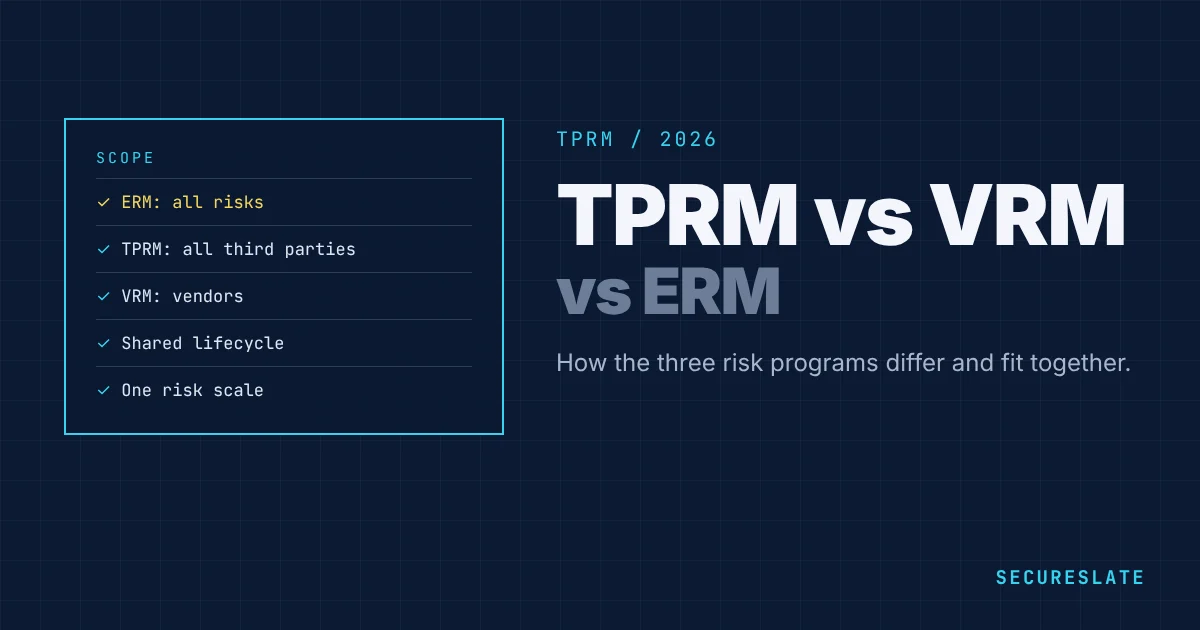
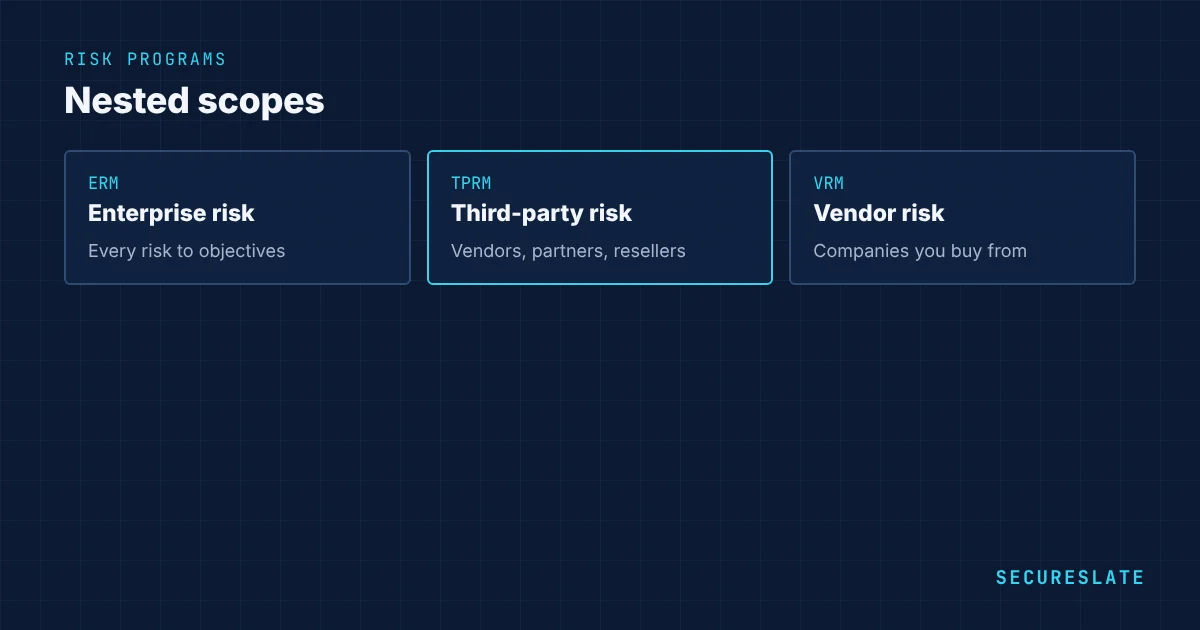
TPRM vs VRM vs ERM confuses many teams because the three terms overlap and are often used interchangeably. Enterprise risk management (ERM) covers every risk to the organization's objectives, from strategy and finance to operations and compliance. Third-party risk management (TPRM) is the part of risk management that deals with risks from any outside party: vendors, suppliers, partners, resellers, contractors and more. Vendor risk management (VRM) is narrower still, focusing on companies you buy products or services from. This guide explains the differences, how they fit together and how small and mid-size companies can run them without creating three separate bureaucracies.
Related guides: Vendor tiering model · Enhanced VRM for third-party oversight · Due diligence software · State of third-party risk management
Key takeaways
- ERM is the umbrella for all organizational risks. TPRM and VRM sit inside it.
- TPRM covers all external relationships, including vendors, partners, distributors, affiliates and contractors.
- VRM focuses on vendors and suppliers you pay for products or services.
- The programs share methods: identification, assessment, treatment and monitoring.
- Connect them so that third-party risks flow into the enterprise risk register and leadership sees one picture.
Definitions
| Program | Scope | Typical owner | Main questions |
|---|---|---|---|
| Enterprise risk management (ERM) | All risks to strategy and objectives: strategic, financial, operational, compliance, reputational, security | CFO, chief risk officer or risk committee | What could stop us achieving our goals, and are we within our risk appetite? |
| Third-party risk management (TPRM) | Risks from all external relationships | Risk, procurement, security or compliance | Which outside parties could harm us, and how do we manage them? |
| Vendor risk management (VRM) | Risks from vendors and suppliers | Procurement, security or IT | Are the companies we buy from secure, reliable and compliant? |
How they differ
| Aspect | ERM | TPRM | VRM |
|---|---|---|---|
| Breadth | Widest | Medium | Narrowest |
| Parties covered | Internal and external | All third parties | Vendors and suppliers |
| Risk types | All | Security, privacy, operational, financial, compliance, reputational, ESG, concentration | Mostly security, privacy, operational and contractual |
| Frameworks | COSO ERM, ISO 31000 | NIST SP 800-161, interagency guidance for banks, DORA for EU financial entities | Vendor questionnaires, SOC 2 and ISO reports, contracts |
| Outputs | Enterprise risk register, risk appetite, board reports | Third-party inventory, tiering, assessments, monitoring | Vendor reviews, contract terms, issue tracking |
Examples of risks in each
| Program | Example risks |
|---|---|
| ERM | Loss of a key customer, regulatory change, failed product launch, major breach, currency swings |
| TPRM | A reseller misrepresents your product, a joint venture partner breaches sanctions, an affiliate mishandles customer data, a critical cloud provider has an outage |
| VRM | A SaaS vendor with weak access controls, a payroll provider breach, a supplier that misses delivery deadlines |
Shared lifecycle
All three follow a similar cycle:
- Identify risks or parties.
- Assess likelihood and impact, and the controls in place.
- Treat risks through controls, contracts, insurance or avoidance.
- Monitor for changes.
- Report to owners and leadership.
For TPRM and VRM, the lifecycle maps to the relationship: planning and sourcing, due diligence, contracting, onboarding, ongoing monitoring and offboarding.
Regulatory expectations
- Banking (US): the 2023 Interagency Guidance on Third-Party Relationships from the Federal Reserve, FDIC and OCC sets expectations across the third-party lifecycle.
- EU financial sector: DORA requires ICT third-party risk management, a register of information and contractual provisions for ICT service providers, applying since January 17, 2025.
- EU NIS 2: requires essential and important entities to address supply chain security.
- Security frameworks: SOC 2 (CC9.2), ISO 27001:2022 (Annex A 5.19 to 5.23) and NIST CSF 2.0 (GV.SC) all include supplier risk.
- Privacy: GDPR Article 28 requires due diligence and contracts with processors.
Connecting the programs
- Use one risk scale. Score third-party risks on the same likelihood and impact scale as enterprise risks.
- Feed the enterprise register. Material third-party risks, such as dependence on one cloud provider, appear in the ERM register.
- Share inventories. Procurement, finance and security should work from one list of third parties.
- Align appetite. Set third-party risk tolerances that match the enterprise risk appetite.
- Report together. Leadership sees third-party risk as part of overall risk, not a separate report.
Which one should a small company start with?
Most startups and SMBs do not need a formal ERM function on day one. They usually start with VRM, because customers and auditors ask about vendors early, especially for SOC 2 and ISO 27001. As the company grows, VRM expands into TPRM to cover partners, resellers and contractors, and leadership adds a light ERM process to review top risks quarterly. The key is to build each step so it can grow into the next.
Common mistakes
- Running VRM only at contract signature and never monitoring afterward
- Keeping third-party risks in a separate spreadsheet nobody in leadership sees
- Treating all vendors the same instead of tiering by risk
- Ignoring non-vendor third parties such as partners and resellers
- Using different risk scales in different programs, making comparisons impossible
Maturity path
| Stage | What it looks like |
|---|---|
| Ad hoc | Vendor checks happen only when someone remembers |
| Basic VRM | Inventory of vendors, security questionnaires for important ones |
| Structured TPRM | Tiering, lifecycle process, contract standards, monitoring for all third parties |
| Integrated | Third-party risks feed the enterprise register, with shared appetite and reporting |
| Optimized | Continuous monitoring, automated assessments and concentration risk analysis |
Example: one risk across all three programs
A SaaS company relies on a single cloud provider region for its entire platform. In VRM, the cloud provider is a critical vendor: the team reviews its SOC 2 report, confirms contract terms and monitors its status page. In TPRM, the team also looks at the company's resellers in Europe that promise customers specific uptime figures based on that platform, creating a contractual risk through a partner. In ERM, leadership sees "dependence on one cloud region" as a top enterprise risk that could stop revenue, decides it is outside appetite and funds a multi-region recovery capability. The same underlying issue is managed at three levels, each adding a different perspective.
Questions to ask when designing your program
- Who owns the list of all third parties, and is it complete?
- Do we use one risk scale across vendor, third-party and enterprise risks?
- Which third-party risks are material enough to appear in leadership reports?
- Do non-vendor relationships such as partners and resellers get any review?
- How do incidents at third parties flow into our risk register?
- Which regulations apply to our third-party relationships?
How SecureSlate helps
SecureSlate gives small and mid-size teams one place for vendor and third-party risk. Vendor risk management covers inventory, tiering, questionnaires, document collection and reviews, while the risk register brings third-party risks into the same view as your other risks. Evidence maps to SOC 2, ISO 27001, GDPR and DORA, at a price built for growing companies.
FAQ
What is the difference between TPRM and VRM?
TPRM covers risks from all third parties, including partners, resellers and contractors. VRM focuses on vendors and suppliers you buy from. VRM is a subset of TPRM.
Is TPRM part of ERM?
Yes. Third-party risks are one category of enterprise risks, and material third-party risks should appear in the enterprise risk register.
Do small companies need ERM?
Not a large formal program, but a simple quarterly review of top risks with leadership is valuable and expected by many frameworks.
What frameworks cover third-party risk?
SOC 2, ISO 27001, NIST CSF 2.0, NIST SP 800-161, DORA, NIS 2 and US banking interagency guidance all include third-party or supplier risk.
Who owns third-party risk?
Often a shared responsibility: procurement manages contracts, security assesses controls, legal handles terms and a risk or compliance lead coordinates the program.
Can one tool cover VRM, TPRM and ERM?
Many compliance and GRC platforms combine vendor management with a risk register, which covers most needs for small and mid-size companies.
What is the first step in building a TPRM program?
Build a complete inventory of third parties with owners, then agree how to tier them by risk.
Disclaimer (legal note)
This article is for general information only and is not legal, regulatory, or professional advice. Requirements vary by framework, industry, and jurisdiction. Consult qualified advisors for your specific obligations.
Need compliance without the complexity?
SecureSlate automates ISO 27001, SOC 2, GDPR, HIPAA, and more. Built for growing teams. See it in action.
Find compliance gaps in 30 seconds