
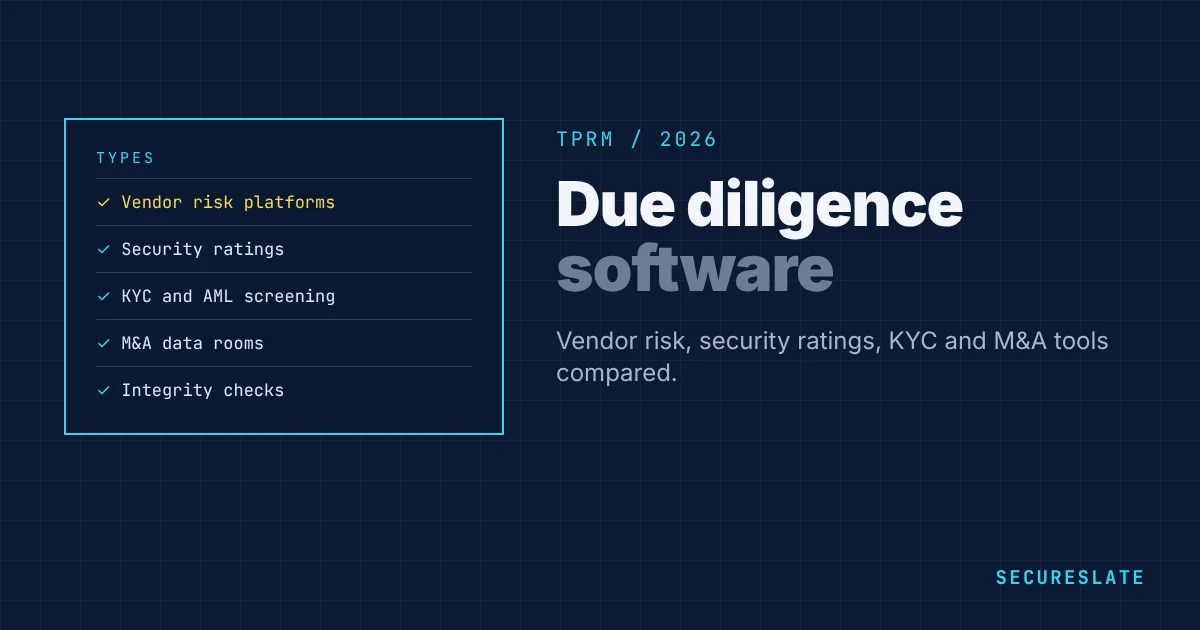
Due diligence software helps organizations investigate a company or person before entering a relationship, and keep watching afterward. The term covers several kinds of tools: vendor and third-party risk platforms that assess suppliers' security and compliance, KYC and AML screening tools that check customers and partners against sanctions and watchlists, security ratings services that score external cyber posture, and virtual data rooms for mergers and acquisitions. This guide explains each type, the features to look for, example tools and how to choose the right one for your needs.
Related guides: Vendor tiering model · Enhanced VRM for third-party oversight · TPRM vs VRM vs ERM · Supply chain risk management best practices
Product details change often. Confirm features with each vendor.
Key takeaways
- "Due diligence software" covers vendor risk, KYC and AML, security ratings and M&A tools.
- For security and compliance teams, the most relevant type is third-party risk management software.
- Key features include inventory, tiering, questionnaires, document collection, scoring, workflows and monitoring.
- Combine questionnaires and evidence with outside-in monitoring for a fuller picture.
- Match the tool to your volume of vendors and team size.
Types of due diligence software
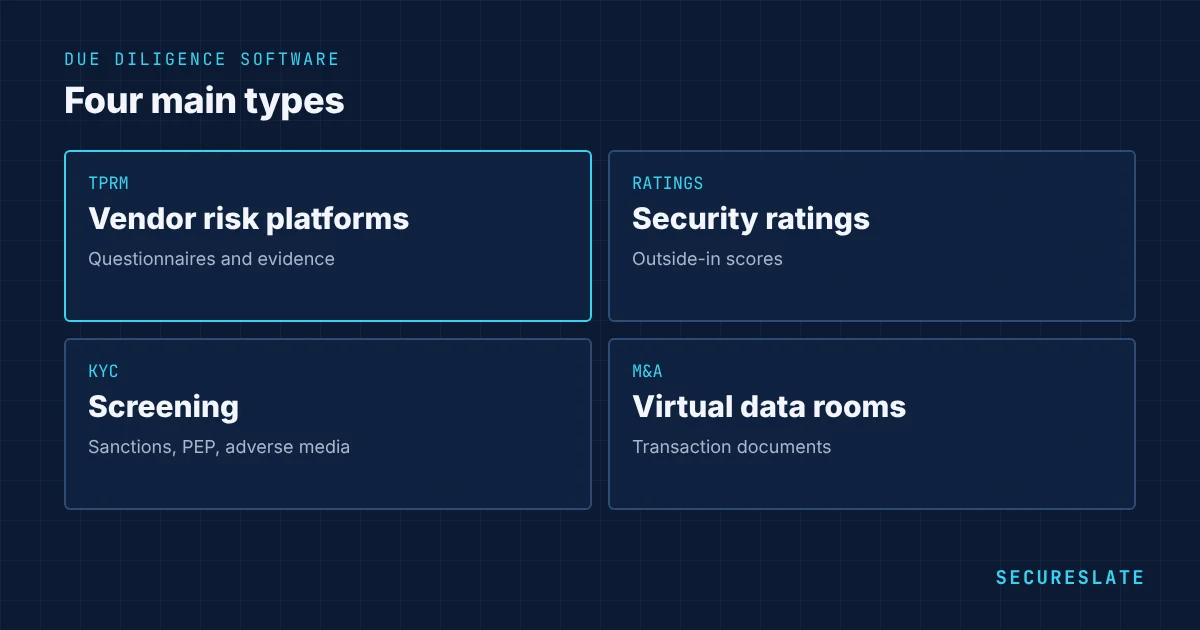
| Type | Purpose | Example tools |
|---|---|---|
| Third-party and vendor risk management | Assess and monitor suppliers' security, privacy and compliance | OneTrust Third-Party Management, Prevalent (Mitratech), ProcessUnity, Venminder, Whistic, compliance platforms with vendor risk modules such as SecureSlate |
| Security ratings | Score organizations' external cyber posture from public data | SecurityScorecard, Bitsight, UpGuard, Panorays |
| KYC, AML and sanctions screening | Check customers, partners and owners against sanctions, PEP and adverse media lists | LSEG World-Check, Dow Jones Risk and Compliance, LexisNexis Risk Solutions, Moody's |
| M&A virtual data rooms | Share and review documents securely during transactions | Datasite, Intralinks, Ansarada |
| Background and integrity checks | Investigate individuals and companies for reputation and legal history | Specialist investigation providers |
Features to look for in vendor due diligence software
| Feature | Why it matters |
|---|---|
| Vendor inventory | Single source of truth for all third parties |
| Tiering and inherent risk scoring | Matches effort to risk |
| Questionnaire library | Standard questionnaires such as SIG and CAIQ, plus custom ones |
| Document collection | SOC 2 reports, ISO certificates, policies, insurance, with expiry tracking |
| Automated analysis | AI or rules to extract answers and flag gaps from documents |
| Risk scoring and findings | Records issues, remediation and residual risk |
| Workflows and approvals | Routes reviews to security, legal and procurement |
| Continuous monitoring | Alerts on breaches, ratings changes and certificate expiry |
| Vendor portal | Lets vendors respond and upload documents easily |
| Reporting | Dashboards for leadership and auditors |
| Integrations | Procurement, contract management, SSO and ticketing |
Questionnaires vs outside-in monitoring
| Approach | Strengths | Limits |
|---|---|---|
| Questionnaires and evidence | Covers internal controls, policies and practices | Point in time; depends on honest answers |
| Independent audit reports | Third-party assurance on controls | Covers a past period; may exclude services |
| Security ratings | Continuous, no vendor effort required | Sees only external signals; possible false positives |
| Breach and news monitoring | Fast warning of incidents | Reactive |
The strongest programs combine all four, weighted by vendor tier.
How to choose
- Define the use case. Vendor security reviews, customer screening, M&A or several.
- Estimate volume. Ten critical vendors need a different tool than thousands of suppliers.
- Check framework needs. SOC 2, ISO 27001, DORA and GDPR each expect vendor oversight evidence.
- Evaluate vendor experience. A simple vendor portal improves response rates.
- Review automation. Document parsing and automated reminders save the most time.
- Consider integration with your compliance program. Vendor findings should flow into your risk register.
- Compare total cost. Licenses, implementation and internal time.
Due diligence workflow example
- Business owner requests a new vendor in procurement.
- Intake questions set the inherent risk tier (data, access, criticality).
- Tool sends the right questionnaire and requests documents.
- Security reviews answers and evidence; legal reviews contract terms.
- Findings are logged with required fixes or compensating controls.
- Approver signs off; the vendor is onboarded.
- Monitoring tracks certificate expiry, ratings and breach news.
- Reassessment happens on schedule by tier.
Common mistakes
- Sending the same long questionnaire to every vendor
- Collecting documents but never reading SOC 2 exceptions
- No follow-up on findings
- Separate tools for vendor reviews and risk register, with no link
- Ignoring vendors that bypass procurement
Regulatory context
Due diligence on vendors is expected by SOC 2 (CC9.2), ISO 27001:2022 (Annex A 5.19 to 5.22), GDPR Article 28 for processors, HIPAA for business associates, DORA for ICT third-party providers in EU financial services, and US banking interagency guidance on third-party relationships. KYC and AML screening is required for regulated financial institutions under anti-money laundering laws.
Example vendor due diligence by tier
| Tier | Questionnaire | Evidence | Review by | Turnaround target |
|---|---|---|---|---|
| Critical | Full security and privacy questionnaire | SOC 2 Type 2 or ISO 27001, pen test summary, BCP, insurance | Security, privacy, legal, finance | 2 to 4 weeks |
| High | Standard questionnaire | SOC 2 or ISO 27001, DPA | Security and privacy | 1 to 2 weeks |
| Medium | Short questionnaire | Trust center review | Security | A few days |
| Low | None | Basic legal and sanctions check | Procurement | Same day |
Automation that saves the most time
- Intake forms that set the tier automatically from a few questions
- Reminders that chase vendors without manual emails
- Document parsing that pulls report periods, exceptions and certificate scopes into structured fields
- Expiry tracking for reports, certificates and insurance
- Answer reuse when vendors have already completed standard questionnaires such as SIG or CAIQ
- Approval workflows that route decisions to the right reviewers
Building versus buying
Many small companies start with a spreadsheet and shared folders. That works for a handful of vendors, but it breaks down as the list grows, when people change roles or when auditors ask for a complete history. A good rule: once you have more than 25 vendors handling company data, or customers and auditors ask detailed vendor questions, move to software. Choosing a compliance platform with built-in vendor risk often costs less than a standalone TPRM suite and keeps vendor evidence next to your other controls.
Due diligence for your own customers
Remember that your customers run due diligence on you. The same discipline you apply to vendors helps you respond: keep your own SOC 2 report, certificates, policies and standard questionnaires current and available through a trust center.
How SecureSlate helps
SecureSlate includes vendor risk due diligence built into its compliance platform. Inventory and tier vendors, send questionnaires, collect SOC 2 reports and certificates, record findings and approvals, and schedule reassessments. Vendor risks feed the risk register, and questionnaire automation helps you answer your own customers' due diligence requests, at a price designed for SMBs.
FAQ
What is due diligence software?
Software that helps organizations investigate and monitor vendors, customers, partners or acquisition targets for risk before and during a relationship.
What is vendor due diligence?
Reviewing a vendor's security, privacy, compliance, financial and operational practices before contracting and periodically afterward.
What is the difference between due diligence and security ratings?
Due diligence often uses questionnaires and evidence from the vendor. Security ratings score external signals without vendor involvement. They complement each other.
Do small companies need due diligence software?
Small companies with few vendors can start with a compliance platform's vendor module rather than a standalone enterprise tool.
What documents should vendors provide during due diligence?
Typically a SOC 2 report or ISO 27001 certificate, security policies, penetration test summary, insurance certificates, data processing agreement and subprocessor list.
How long does vendor due diligence take?
Low-risk vendors can be cleared the same day. Critical vendors with full assessments commonly take two to four weeks, depending on how quickly they provide evidence.
Can AI help with vendor due diligence?
Yes. Many tools use AI to extract information from SOC 2 reports and questionnaires, but a reviewer should confirm conclusions for important vendors.
Disclaimer (legal note)
This article is for general information only and is not legal, regulatory, or professional advice. Requirements vary by framework, industry, and jurisdiction. Consult qualified advisors for your specific obligations.
Need compliance without the complexity?
SecureSlate automates ISO 27001, SOC 2, GDPR, HIPAA, and more. Built for growing teams. See it in action.
Find compliance gaps in 30 seconds