
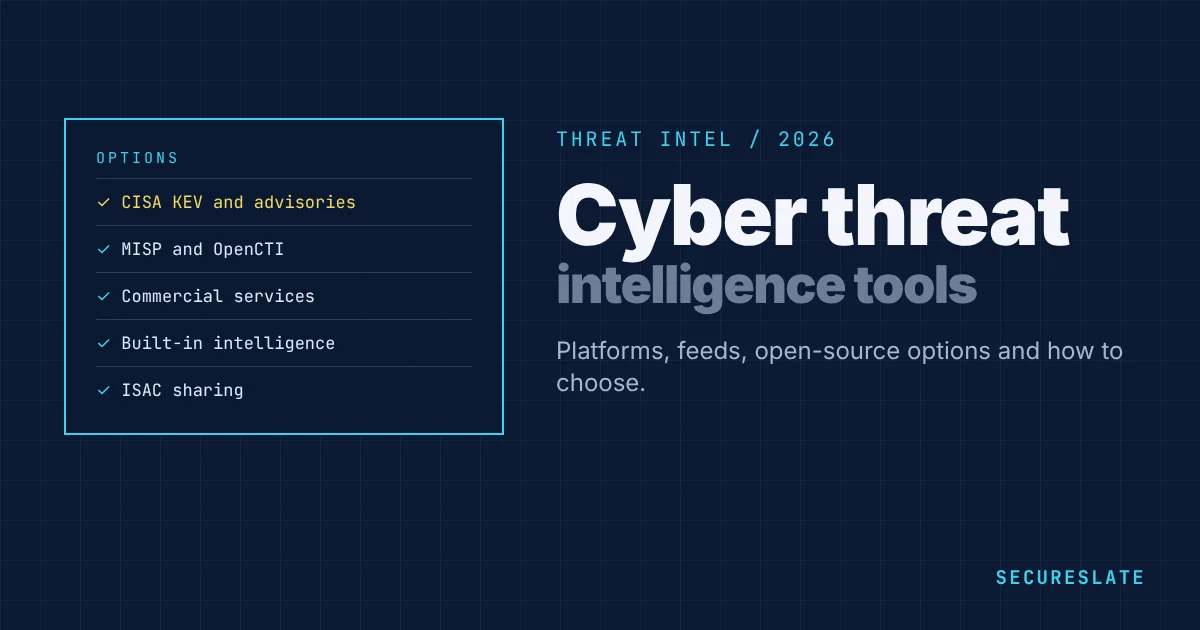
Cyber threat intelligence tools help security teams collect, analyze and act on information about attackers, their techniques and the vulnerabilities they exploit. The category ranges from free government alerts and open-source platforms to commercial services with dedicated analysts. The right choice depends on what decisions you need intelligence for, your team's size and the tools that will consume it. This guide explains the types of threat intelligence tools, gives examples of widely used options and offers a practical way for small and mid-size teams to choose.
Related guides: Cyber threat analysis tutorial · Third-party cyber threat assessment · Security posture best practices · Supply chain security
Product details change often. Confirm features with each vendor.
Key takeaways
- Threat intelligence tools range from free feeds and open-source platforms to commercial intelligence services.
- A threat intelligence platform (TIP) collects, enriches and shares intelligence; feeds supply raw indicators; intelligence services add expert analysis.
- Intelligence is only useful when it connects to your tools, such as SIEM, EDR and firewalls, and to decisions.
- Small teams often get most value from free authoritative sources plus intelligence built into security tools they already use.
- Choose based on intelligence requirements, integration and the capacity to act.
Types of threat intelligence tools
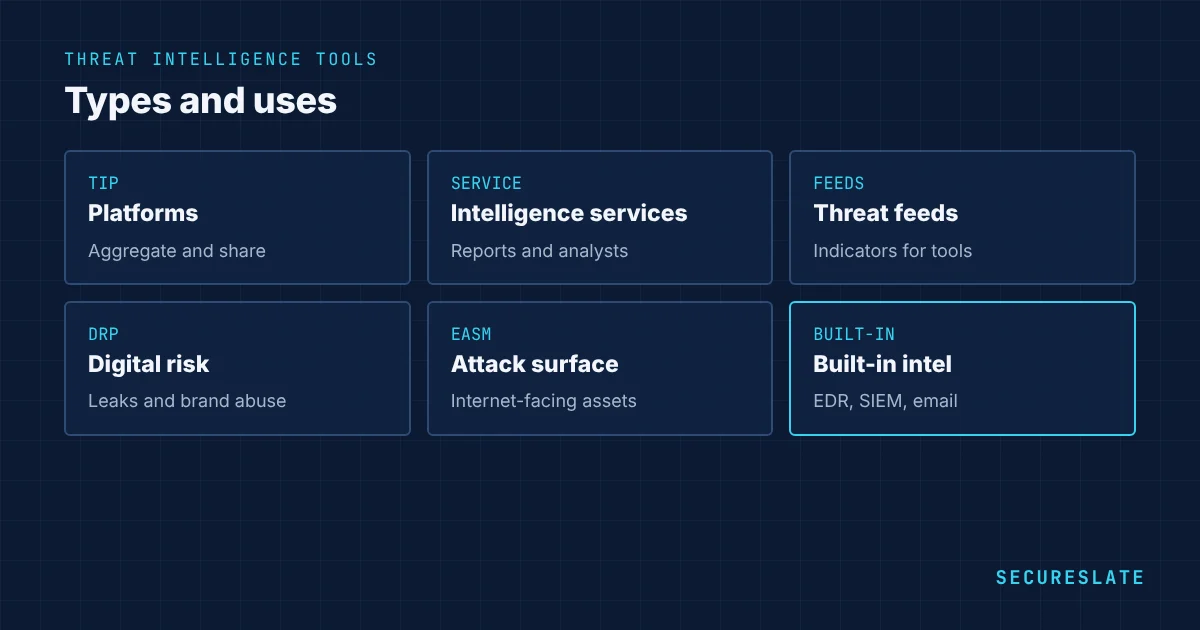
| Type | What it does | Typical users |
|---|---|---|
| Threat intelligence platforms (TIPs) | Aggregate feeds, deduplicate and enrich indicators, support analysis and sharing | SOC teams, intelligence analysts |
| Commercial intelligence services | Provide finished reports, actor profiles, vulnerability intelligence and analyst access | Mid-size to large security teams |
| Threat feeds | Lists of indicators such as IPs, domains, URLs and file hashes | Tools such as SIEM and firewalls |
| Digital risk protection | Monitor for leaked credentials, brand abuse, dark web mentions and exposed data | Security and brand teams |
| External attack surface management | Find and monitor your internet-facing assets | Security and IT teams |
| Vulnerability intelligence | Prioritize vulnerabilities by exploitation and threat activity | Vulnerability management teams |
| Built-in intelligence | Intelligence integrated in EDR, SIEM, email security and firewalls | All teams |
Widely used examples
Free and government sources
- CISA advisories and the Known Exploited Vulnerabilities (KEV) catalog
- Automated Indicator Sharing (AIS) from CISA for machine-readable indicators
- MITRE ATT&CK for adversary techniques
- Industry ISACs for sector sharing (membership based)
- National CERT advisories in other countries
Open-source platforms
- MISP: an open-source threat intelligence and sharing platform widely used by CERTs and companies
- OpenCTI: an open-source platform for structuring and visualizing threat knowledge, using STIX 2.1
- AlienVault Open Threat Exchange (OTX): a free community intelligence exchange
Commercial intelligence providers
Large commercial providers include Recorded Future, Google Threat Intelligence (incorporating Mandiant and VirusTotal), CrowdStrike Counter Adversary Operations, Microsoft Defender Threat Intelligence, Palo Alto Networks Unit 42, Anomali and ThreatConnect. They differ in sources, analyst depth, integrations and pricing.
Standards that matter
| Standard | Purpose |
|---|---|
| STIX 2.1 | Language for describing threat intelligence objects |
| TAXII 2.1 | Protocol for exchanging STIX data |
| MITRE ATT&CK | Common taxonomy for tactics and techniques |
| Traffic Light Protocol (TLP) | Rules for how shared intelligence can be redistributed |
Tools that support STIX and TAXII integrate more easily with other platforms and sharing communities.
How to choose
- Define intelligence requirements. What decisions will intelligence support: patch prioritization, phishing defense, vendor monitoring, executive briefings?
- Inventory what you have. EDR, SIEM, email security and firewalls often include intelligence already.
- Assess capacity. Who will read reports and tune detections? A small team cannot use dozens of feeds.
- Check integrations. Can the tool push indicators to your SIEM, EDR or firewall automatically?
- Evaluate relevance. Does the provider cover your industry, region and technologies?
- Trial with real questions. Use a proof of concept to answer two or three real questions.
- Measure outcomes. Track detections, prevented incidents and decisions informed.
Choosing by team size
| Team | Recommended approach |
|---|---|
| No dedicated security staff | Rely on built-in intelligence in EDR and email security; follow CISA KEV; use a compliance platform for exposure monitoring |
| Small security team (1 to 3) | Add free sources, an ISAC, and possibly MISP or OpenCTI if someone can maintain it; prioritize vulnerability intelligence |
| Mid-size SOC | Add a commercial intelligence service and a TIP integrated with SIEM and SOAR |
| Large enterprise | Dedicated intelligence team with multiple commercial sources and custom requirements |
Common mistakes
- Buying feeds that generate thousands of alerts nobody reviews
- Measuring success by the number of indicators collected
- Ignoring the supply chain, even though many incidents start with vendors
- Not sharing intelligence across security, IT and risk teams
- No process to retire old indicators, which causes false positives
Threat intelligence and compliance
ISO 27001:2022 added Annex A 5.7 Threat intelligence, which requires organizations to collect and analyze information about threats to produce threat intelligence. Small companies can meet it with a documented process: defined sources (for example CISA, vendor advisories and an ISAC), a regular review, and records showing actions taken, such as patches prioritized or detections added. SOC 2 auditors also look for threat identification as part of risk assessment and monitoring.
Measuring value
| Metric | What it shows |
|---|---|
| Detections created from intelligence | Operational use |
| Vulnerabilities prioritized using exploitation data | Better patching decisions |
| Time from advisory to action | Responsiveness |
| Incidents where intelligence helped | Real-world value |
| Reports read and acted on by leaders | Strategic use |
Evaluation scorecard
| Criterion | Weight | Questions to score |
|---|---|---|
| Relevance | High | Does it cover our industry, region, technologies and suppliers? |
| Actionability | High | Can findings become detections, patches or vendor actions quickly? |
| Integration | High | Native connectors to our SIEM, EDR, firewall and ticketing? STIX and TAXII support? |
| Signal to noise | Medium | How many alerts per week, and how many are useful? |
| Analyst support | Medium | Access to experts for questions and context? |
| Ease of use | Medium | Can a generalist security engineer use it without training? |
| Cost | Medium | Total cost including staff time to operate |
Score each candidate during a time-boxed trial using two or three real questions, such as "Which vulnerabilities in our stack are being exploited this month?"
Using open-source platforms well
MISP and OpenCTI are powerful but need care: someone must install and update them, connect feeds, tune what is imported and remove stale indicators. Small teams sometimes start with a hosted community instance or join an ISAC that runs one, instead of hosting their own. Whichever route you pick, write down who owns the platform and how indicators reach your detection tools, or the platform becomes another unused database.
A weekly threat intelligence routine for small teams
- Review new CISA KEV entries and vendor advisories for products in your inventory.
- Check your ISAC or community channel for sector-specific alerts.
- Look at exposure monitoring results for new internet-facing assets or leaked credentials.
- Create tickets for patches, detections or vendor questions.
- Record what you reviewed and what you did, which also supports ISO 27001 Annex A 5.7 evidence.
How SecureSlate helps
SecureSlate helps small teams act on threat information without a dedicated intelligence analyst. It monitors your external attack surface, leaked credentials on the dark web, outdated and end-of-life software and code dependencies, then ties findings to controls and risks. A documented threat intelligence process for ISO 27001 Annex A 5.7 is included, at SMB-friendly pricing.
FAQ
What are cyber threat intelligence tools?
Tools and services that collect, analyze and distribute information about cyber threats so organizations can prevent, detect and respond to attacks.
What is a threat intelligence platform?
Software that aggregates intelligence from many sources, enriches and correlates it, supports analysis and shares it with other tools and teams.
Are there free threat intelligence tools?
Yes. CISA advisories and KEV, MITRE ATT&CK, MISP, OpenCTI and AlienVault OTX are widely used free resources.
Does ISO 27001 require threat intelligence?
ISO 27001:2022 includes Annex A 5.7 Threat intelligence. If it applies to your risks, you need a process to collect and analyze threat information.
Do small companies need a commercial threat intelligence service?
Usually not at first. Built-in intelligence in security tools, free government sources and exposure monitoring often meet small company needs.
Disclaimer (legal note)
This article is for general information only and is not legal, regulatory, or professional advice. Requirements vary by framework, industry, and jurisdiction. Consult qualified advisors for your specific obligations.
Need compliance without the complexity?
SecureSlate automates ISO 27001, SOC 2, GDPR, HIPAA, and more. Built for growing teams. See it in action.
Find compliance gaps in 30 seconds