
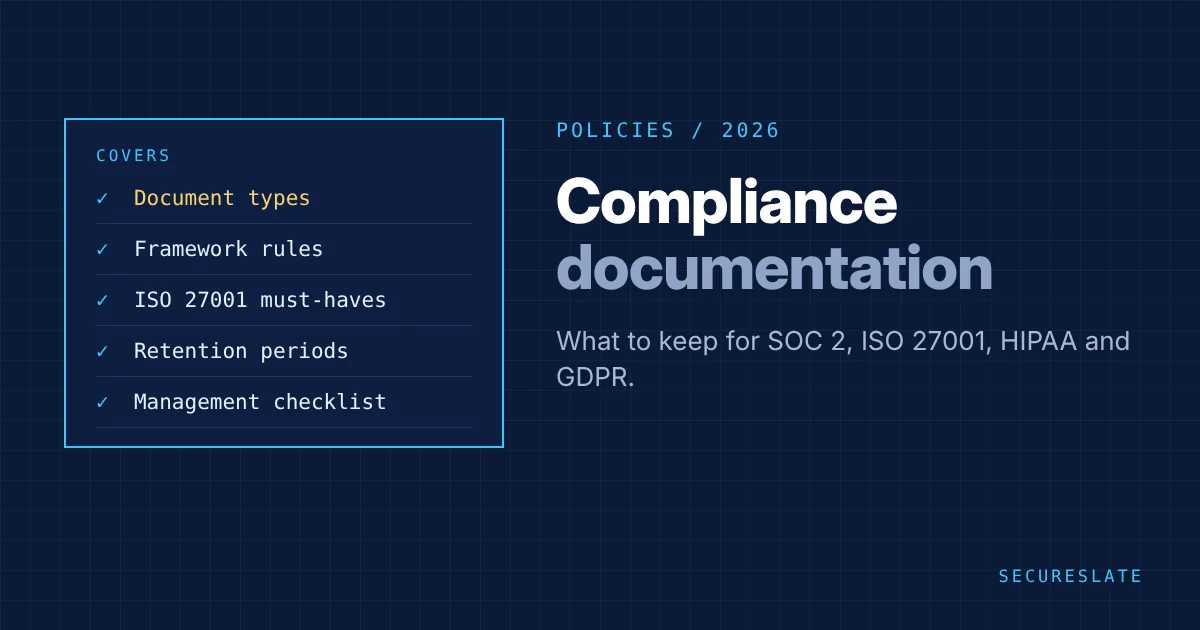
Short answer: Compliance documentation is the set of policies, procedures, plans, registers and records that show what your controls are and that they operate. Frameworks such as ISO 27001 and HIPAA name specific documents and retention rules. SOC 2 and GDPR expect you to prove controls with records. Keep documents version-controlled, owned, reviewed on a schedule and linked to controls.
Related guides: Document control procedure · ISO 27001 documentation template · SOC 2 evidence collection
Key takeaways
- Compliance documentation has two layers: documents that state intent (policies, procedures) and records that prove operation (logs, tickets, review results).
- ISO 27001 lists specific documented information, including the scope, policy, risk processes and Statement of Applicability.
- HIPAA requires covered entities and business associates to keep Security Rule documentation for six years from creation or the date it was last in effect, whichever is later.
- GDPR requires controllers and processors to be able to demonstrate compliance, including records of processing activities in most cases.
- Auditors care most about records. A policy without matching evidence is a finding waiting to happen.
What counts as compliance documentation?
Compliance documentation is any written material that defines how you meet a requirement or proves that you did.
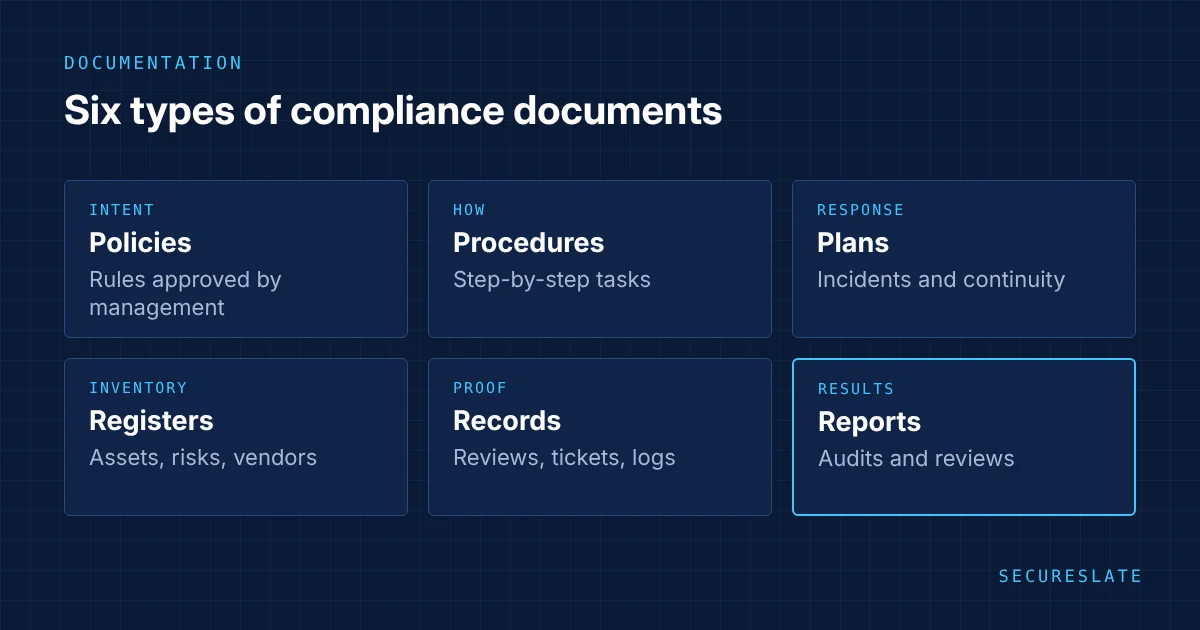
It helps to group documents by what they do:
- Policies state rules and intent, such as an information security policy or an acceptable use policy. They are short and approved by management.
- Procedures describe how a task is done step by step, such as onboarding, offboarding or incident handling.
- Plans describe how you will respond to events, such as incident response and business continuity plans.
- Registers and inventories list things you manage: assets, risks, vendors, processing activities, data flows.
- Records prove that controls operated: access review sign-offs, change tickets, training completions, log reviews, meeting minutes.
- Reports and attestations summarize results for others: internal audit reports, management reviews, external audit reports.
What documentation does each framework require?
Each framework sets its own documentation expectations, but they overlap heavily, so one well-organized set can serve several.
| Framework | Documentation expectation | Key references |
|---|---|---|
| SOC 2 | A system description plus evidence that controls met the criteria over the period. Policies support the controls but are not enough alone | AICPA Trust Services Criteria |
| ISO 27001 | Specific "documented information" named in the clauses, plus whatever the organization decides is needed for the ISMS to be effective | ISO/IEC 27001:2022, clause 7.5 |
| HIPAA | Written policies and procedures for the Security Rule, records of required actions and assessments, retained six years, available to those responsible and reviewed periodically | 45 CFR 164.316 |
| GDPR | Ability to demonstrate compliance, records of processing activities, DPIAs where required, processor contracts, breach records | GDPR Articles 5(2), 28, 30, 33(5), 35 |
For HealthTech companies, HIPAA documentation needs special care because the retention rule is explicit and applies to policies, procedures and records of actions, activities and assessments the Security Rule requires. A HIPAA security risk assessment is one of the first documents a covered entity customer will ask for.
Which documents are mandatory for ISO 27001?
ISO 27001 names a set of documented information that every certified ISMS must have, and auditors check each item.
| Clause | Documented information |
|---|---|
| 4.3 | Scope of the ISMS |
| 5.2 | Information security policy |
| 6.1.2 | Information security risk assessment process |
| 6.1.3 | Risk treatment process and Statement of Applicability |
| 6.2 | Information security objectives |
| 7.2 | Evidence of competence |
| 8.1 | Information needed to have confidence that processes were carried out as planned |
| 8.2 | Results of risk assessments |
| 8.3 | Results of risk treatment |
| 9.1 | Evidence of monitoring and measurement results |
| 9.2 | Evidence of the internal audit programme and audit results |
| 9.3 | Evidence of the results of management reviews |
| 10.2 | Nature of nonconformities, actions taken and results of corrective action |
Annex A controls add more. Several controls call for documented procedures or records, such as operating procedures, an inventory of assets and access rights. Your Statement of Applicability decides which apply. Clause 7.5 also requires you to control documented information: identify it, review and approve it, keep it available and protected, and manage versions and retention.
How long should you keep compliance documentation?
Keep compliance documentation for at least as long as the strictest rule that applies to it, and longer if contracts or litigation require.
- HIPAA: six years from the date of creation or the date it was last in effect, whichever is later, under 164.316(b)(2). State medical record laws may set different periods for patient records, which are a separate question.
- ISO 27001: the standard leaves retention to you, but you must define it. In practice, keep records for at least the current certification cycle so auditors can see history.
- SOC 2: no fixed retention period in the criteria, but you need records covering each audit period, and auditors may look at prior periods.
- GDPR: there is no fixed period for compliance records, but personal data inside them falls under storage limitation. Keep records needed to demonstrate compliance, and do not keep personal data longer than necessary.
Write your retention rules into a data retention policy so the decision is made once and applied consistently.
How do you manage compliance documentation?
Manage compliance documentation as a controlled system with owners, versions, review dates and links to controls.
- Create a document register. List every document with owner, version, approval date, next review date and the controls it supports.
- Use templates. Consistent headers for purpose, scope, roles, review cycle and version history make documents easier to maintain and audit.
- Control versions. Keep the approved version clearly marked and archive old versions instead of overwriting them.
- Set review cycles. Review policies at least annually and whenever a significant change happens, such as a new system, regulation or incident.
- Collect acknowledgments. Record that staff have read and accepted key policies.
- Link records to controls. Store evidence where it can be found by control ID, not in personal drives or chat threads.
- Automate what you can. Pull records such as MFA status, encryption settings and training completion from source systems rather than taking screenshots.
Compliance documentation checklist
Use this checklist to check your documentation set before an audit or customer review.
Work through it with the document register open, so you can confirm each item has a named owner, a current approved version and a review date that has not passed. Where an item exists but has no supporting records for the audit period, treat it as incomplete. It is better to find that gap now than during fieldwork, when the only remedy left is an explanation to the auditor. Items that do not apply to you, such as GDPR records for a company with no EU personal data, should be marked as not applicable with a short reason.
- Scope statement covering systems, data, locations and teams
- Information security policy approved by management
- Supporting policies such as access control, change management, incident response, vendor management and data retention
- Procedures for onboarding, offboarding, access reviews and incident handling
- Risk assessment method, current risk register and treatment plan
- Asset inventory and, for GDPR, records of processing activities
- Vendor inventory with risk ratings and contracts, including business associate agreements for HIPAA
- Incident response and business continuity plans, with test records
- Training and policy acknowledgment records
- Access review, change management and log review records for the audit period
- Internal audit and management review results, for ISO 27001
- Document register showing owners, versions and review dates
How SecureSlate helps
SecureSlate keeps compliance documentation and evidence organized by control. It does not perform audits or issue certifications.
- Multi-framework control mapping for SOC 2, ISO 27001, HIPAA, HITRUST, GDPR and more, so each document and record supports every framework it applies to.
- Agentless, read-only cloud integrations and a device agent that collect records automatically instead of screenshots.
- Access reviews, vendor risk management and risk management that produce their own records as you work.
- Audit management to share documents and evidence with auditors, and a trust center to share approved documents with customers.
Start a free trial to organize your documentation around your controls.
FAQ
What is the difference between a policy and a procedure?
A policy states what must happen and why, and is approved by management. A procedure explains how to do it step by step. Auditors expect policies to be backed by procedures and records.
Do I need separate documentation for each framework?
Usually not. Most policies and records can serve several frameworks if they are mapped to a shared control set. Some items are framework-specific, such as the ISO 27001 Statement of Applicability or GDPR records of processing.
How often should compliance documents be reviewed?
At least annually for most policies, and whenever a significant change happens. HIPAA requires periodic review and updates in response to environmental or operational changes.
Are screenshots acceptable as compliance evidence?
Often yes, but they are slow to collect and hard to date reliably. System exports, logs and automated checks are usually stronger and easier to keep current.
Disclaimer (legal note)
This article is for general information only and is not legal, regulatory, or professional advice. Requirements vary by framework, industry, and jurisdiction. Consult qualified advisors for your specific obligations.
Need compliance without the complexity?
SecureSlate automates ISO 27001, SOC 2, GDPR, HIPAA, and more. Built for growing teams. See it in action.
Find compliance gaps in 30 seconds