
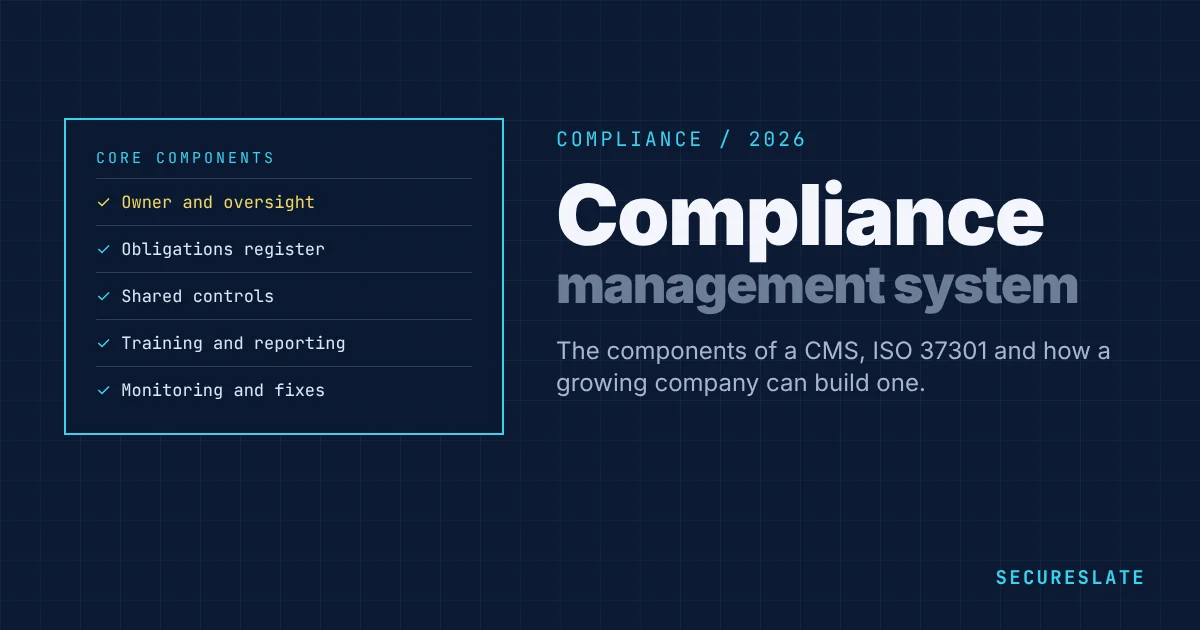
A compliance management system (CMS) is the set of people, policies, processes and tools a company uses to identify its legal, regulatory and contractual obligations, meet them, and prove that it does. For a growing company, it ties together frameworks such as SOC 2, ISO 27001, GDPR and HIPAA so compliance is run as one program instead of a pile of separate projects. This guide explains the components, the standards behind them, and how to build a CMS step by step.
Related guides: GRC framework · Compliance risk management · Common control framework · Continuous control monitoring
Key takeaways
- A CMS covers obligations, risk assessment, policies and controls, training, monitoring, reporting and corrective action.
- ISO 37301 is the international standard for compliance management systems, and it can be certified.
- The widely used seven elements of an effective compliance program come from US sentencing and health care compliance guidance.
- For a small company, a CMS can be lean: a clear owner, an obligations register, shared controls and regular review.
What is a compliance management system?
A CMS is not a single document or tool. It is the way your company runs compliance: who is responsible, how you find out what applies to you, how you meet each requirement, and how you check that it keeps working. A good CMS makes compliance repeatable, so passing the next audit or answering the next customer review is routine rather than a scramble.
Core components of a compliance management system
| Component | What it includes |
|---|---|
| Governance and ownership | A compliance owner, leadership oversight, clear roles and reporting lines |
| Obligations register | Laws, regulations, standards and contract terms that apply, with owners |
| Compliance risk assessment | Which obligations carry the most risk, and why |
| Policies and procedures | Written rules for staff, approved and reviewed regularly |
| Controls | The specific activities that meet each obligation, mapped across frameworks |
| Training and communication | Onboarding and yearly training, plus ways to ask questions |
| Monitoring and testing | Ongoing checks, internal audits and continuous control monitoring |
| Reporting and escalation | Ways to report concerns, including anonymously, and escalate issues |
| Corrective action | Investigating issues, fixing root causes and tracking actions to closure |
| Documentation and evidence | Records that prove the system works |
ISO 37301 and the seven elements
ISO 37301:2021 sets requirements for a compliance management system using the same high-level structure as ISO 27001: context, leadership, planning, support, operation, performance evaluation and improvement. Organizations can be certified against it, though most small companies use it as guidance.
The seven elements of an effective compliance program, drawn from the US Federal Sentencing Guidelines and health care compliance guidance from the HHS Office of Inspector General, are widely used as a checklist:
- Written policies, procedures and standards of conduct
- A compliance officer and oversight by leadership
- Effective training and education
- Effective lines of communication, including ways to report concerns
- Internal monitoring and auditing
- Enforcement through well-publicized disciplinary guidelines
- Prompt response to detected problems and corrective action
How to build a compliance management system
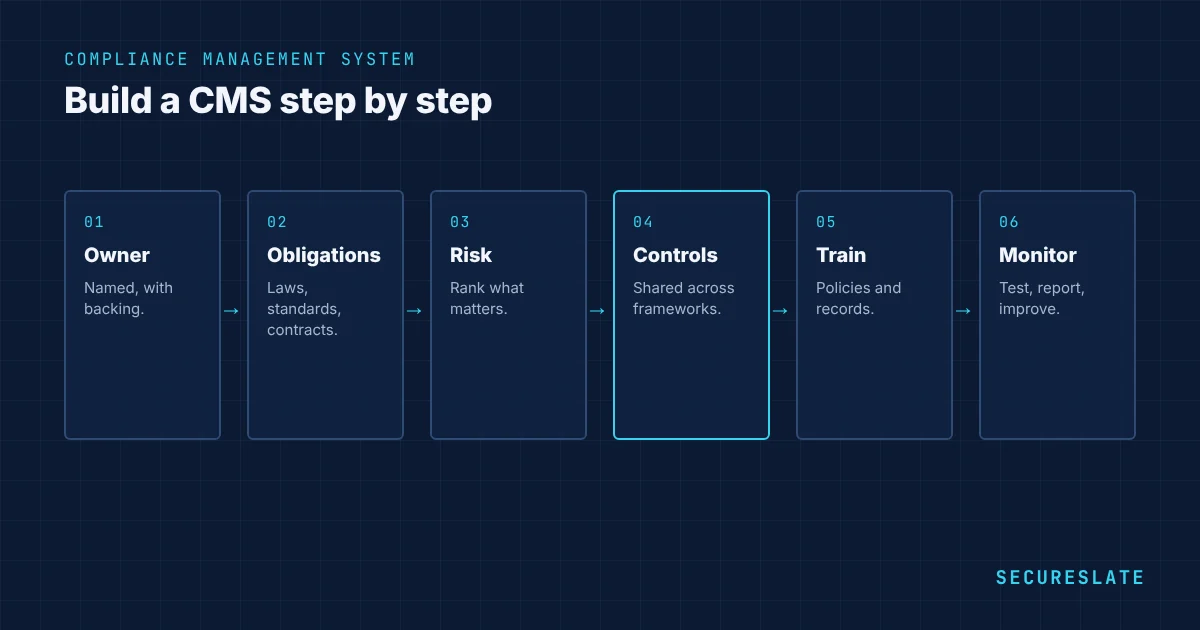
- Name an owner. Give one person responsibility for the CMS and a direct line to leadership.
- Build an obligations register. List the laws, frameworks and contract terms that apply, such as GDPR, HIPAA, SOC 2, ISO 27001 and customer DPAs.
- Assess compliance risk. Rank obligations by impact and likelihood of failure, using a compliance risk assessment.
- Design shared controls. Map one set of controls to all obligations so each control is done once.
- Write and approve policies. Keep them short and true to how the company works.
- Train staff at onboarding and yearly, with records.
- Monitor continuously with automated tests where possible, plus periodic internal audits.
- Report and improve. Share a simple dashboard with leadership, track issues to closure and review the system at least once a year.
Compliance management for small and mid-sized companies
Large enterprises run compliance departments. A small company can run an effective CMS with a part-time owner and the right tooling. Focus on the obligations customers and regulators actually test, automate evidence, and keep everything in one place so knowledge does not leave with one person.
Compliance management software
Compliance management software holds the obligations register, controls, policies, evidence, risks and tasks in one system, connects to your cloud and business tools to test controls automatically, and produces reports for audits and leadership. Look for multi-framework mapping, automated evidence, policy management with acknowledgments, risk management and a trust center for customers.
Example obligations register
| Obligation | Source | Owner | Key controls | Review |
|---|---|---|---|---|
| Protect customer data security | SOC 2, customer contracts | Head of Security | Access control, encryption, logging, vendor reviews | Yearly audit |
| Process personal data lawfully | GDPR | Privacy lead | Records of processing, DPAs, rights requests, DPIAs | Yearly |
| Safeguard PHI | HIPAA, BAAs | Security officer | Risk analysis, safeguards, BAAs, breach procedure | Yearly |
| Maintain an ISMS | ISO 27001 | Head of Security | Risk assessment, SoA, internal audit, management review | Surveillance audit |
| Notify customers of breaches | Customer DPAs | Head of Security | Incident response plan with notice timelines | Tested yearly |
Each obligation links to controls, and each control links to evidence. That chain is what makes the system auditable.
Measuring whether the CMS works
Track a small set of indicators and share them with leadership every quarter:
- Share of controls passing automated tests
- Number of open issues and how long they stay open
- Training completion rate
- Policy reviews completed on time
- Audit findings and exceptions, compared with last year
- Time to answer customer security reviews
Trends matter more than single numbers. A falling number of findings and faster security reviews show the system is maturing.
Common mistakes
- Treating each framework as a separate project with its own controls and evidence
- Policies that describe an ideal company rather than how work is actually done
- No single owner, so tasks fall between security, legal and engineering
- Monitoring only before audits, so controls drift for most of the year
- No way for staff to raise concerns or report incidents easily
How SecureSlate helps
SecureSlate gives growing companies a ready-made compliance management system: multi-framework controls, policy templates, risk management, automated evidence, audit management and continuous monitoring, at prices built for SMBs.
FAQ
What is the purpose of a compliance management system?
To make sure an organization knows its obligations, meets them consistently and can prove it, reducing legal, financial and reputational risk.
Is a compliance management system the same as a compliance program?
They are closely related. The compliance program is the overall effort. The CMS is the structured system of roles, processes and tools that runs it.
Can you get ISO 37301 certified?
Yes. ISO 37301 contains requirements that accredited certification bodies can audit, though many organizations use it as guidance only.
Who should own the CMS in a startup?
Often a head of security, operations lead or COO, with support from engineering and legal. What matters is a named owner with leadership backing.
How often should a compliance program be reviewed?
At least yearly, and whenever laws, products, customers or the business change significantly.
What is the difference between a CMS and a GRC program?
GRC covers governance, risk management and compliance together. A CMS is the compliance part, though in small companies the two are usually run as one program.
What tools does a compliance management system need?
At minimum, a place to keep obligations, controls, policies, evidence, risks and tasks. Spreadsheets work at first. A compliance platform adds automated evidence, monitoring and reporting as the program grows.
How does a CMS help with customer security reviews?
It keeps current policies, reports and control evidence in one place, so answers to questionnaires are quick, consistent and backed by proof.
Do we need a CMS if we only have SOC 2?
Even with one framework, the same building blocks apply: an owner, controls, evidence, monitoring and review. Setting them up as a system makes adding the next framework much easier.
What is an obligations register?
A list of every law, regulation, standard and contract term that applies to the company, with an owner and the controls that meet each one. It is the starting point of any compliance management system.
Disclaimer (legal note)
This article is for general information only and is not legal, regulatory, or professional advice. Requirements vary by framework, industry, and jurisdiction. Consult qualified advisors for your specific obligations.
Need compliance without the complexity?
SecureSlate automates ISO 27001, SOC 2, GDPR, HIPAA, and more. Built for growing teams. See it in action.
Find compliance gaps in 30 seconds
