
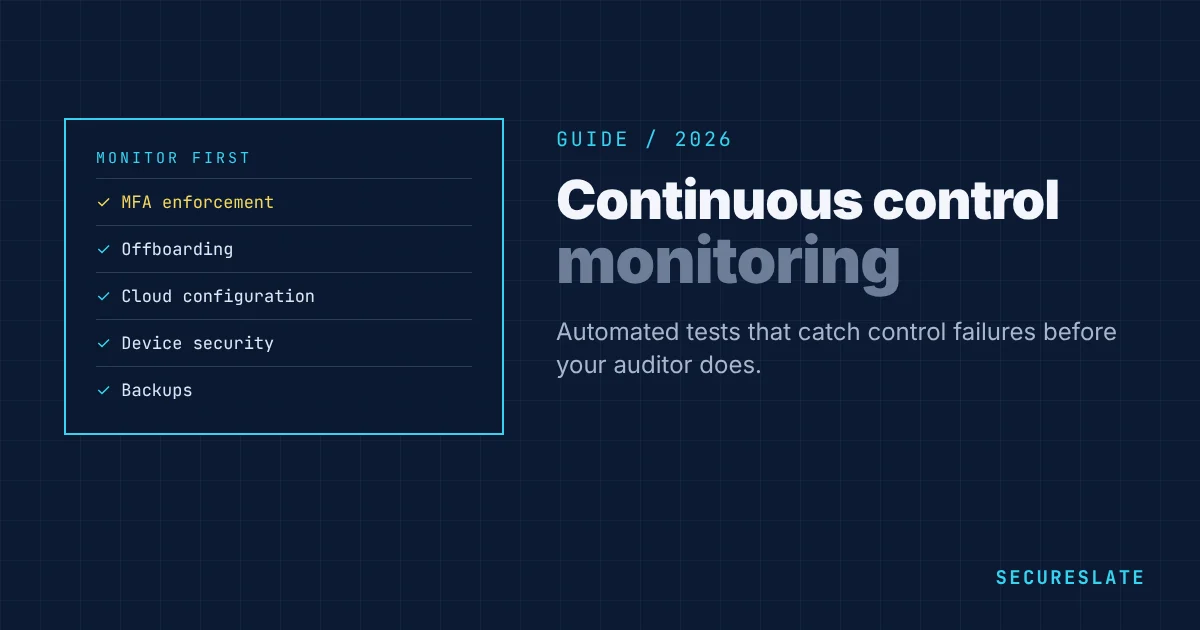
Continuous control monitoring (CCM) means testing your security and compliance controls automatically and often, instead of checking them by hand once a year before an audit. A CCM setup connects to your cloud, identity, code and HR systems, runs tests such as "is MFA enforced for every user?" every day, and alerts the owner when a control fails. For small teams, it turns compliance from a yearly scramble into a steady routine.
Related guides: SOC 2 evidence collection · Audit fatigue and how to fix it · Common control framework · Security metrics and KPI tracker template
Key takeaways
- Continuous control monitoring runs automated tests against your systems and flags control failures as they happen.
- It works best for technical controls: MFA, encryption, logging, backups, vulnerability scanning, access and device security.
- Process controls, such as policy reviews and risk assessments, still need people, but CCM can track whether they are done on time.
- CCM shrinks audit preparation, reduces exceptions and gives leadership a live view of security posture.
What is continuous control monitoring?
A control is any safeguard you rely on, such as "all laptops have disk encryption." Traditional compliance checks controls periodically, often by taking screenshots before an audit. Continuous control monitoring replaces that with automated tests that run on a schedule, collect evidence, and alert when something drifts out of compliance.
For example, a CCM test might check your identity provider every day and list any user without MFA, or check your cloud account and flag any storage bucket that has become public.
Continuous monitoring vs continuous compliance
The terms overlap. Continuous control monitoring is the technical practice of testing controls automatically. Continuous compliance is the outcome: your company stays audit-ready all year because controls are monitored and evidence is collected continuously. Continuous monitoring in security operations can also mean watching logs and alerts for threats, which is related but different.
How continuous control monitoring works
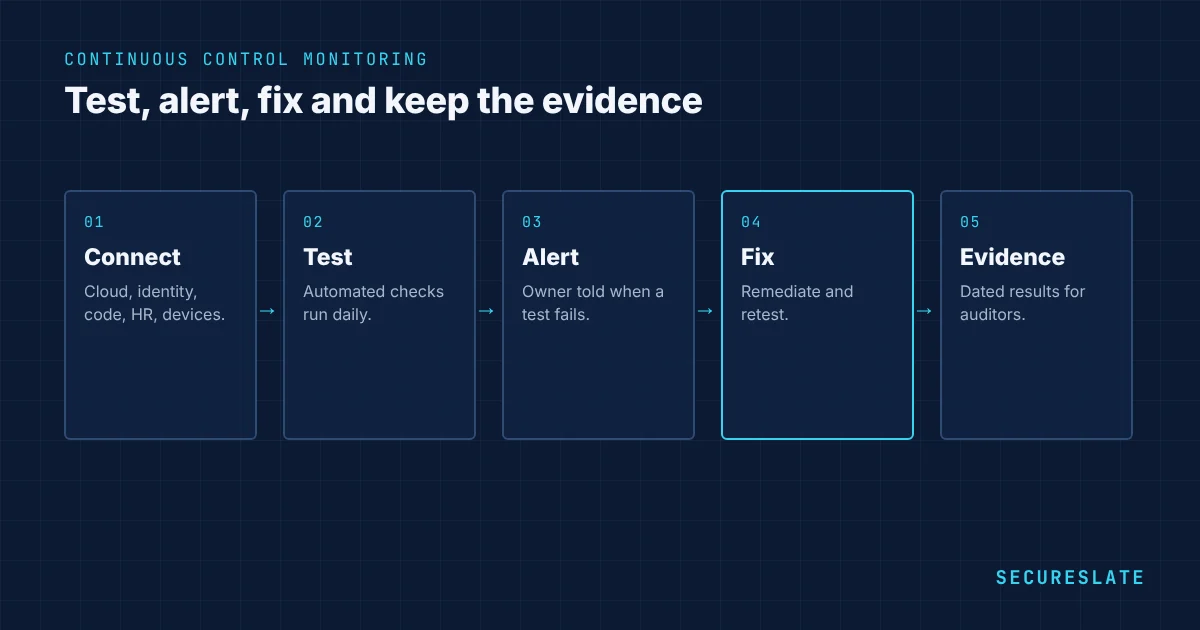
- Connect systems through APIs: cloud provider, identity provider, code repository, HR system, device management, ticketing.
- Define tests for each control, for example "every production database has encryption enabled" or "every leaver's accounts are disabled within one day."
- Run tests automatically, often daily or hourly for technical controls.
- Alert owners when a test fails, with details on what failed.
- Track remediation until the test passes again.
- Store evidence with dates, so auditors can see the control operated throughout the period.
- Report on control health to leadership and customers.
Which controls to monitor first
| Control | Example automated test | Why it matters |
|---|---|---|
| MFA enforcement | Every active user in the identity provider has MFA | Most account takeovers exploit missing MFA |
| Offboarding | Accounts of leavers in the HR system are disabled everywhere | A top cause of SOC 2 exceptions |
| Cloud configuration | No public storage, encryption on, logging enabled | Misconfigurations cause many cloud breaches |
| Endpoint security | Every laptop has disk encryption, screen lock and updates | Lost devices are a common breach source |
| Vulnerability management | Critical findings fixed within SLA | Known vulnerabilities are a leading attack path |
| Backups | Backups ran successfully in the last 24 hours | Recovery depends on them |
| Code review | Production branch requires approved pull requests | Change management evidence |
| Access reviews | Quarterly review completed and signed off on time | Frequent audit finding when missed |
| Training | All staff completed security training within the year | Required by most frameworks |
| Vendor reviews | Critical vendors reviewed in the last 12 months | Third-party risk evidence |
How CCM supports SOC 2 and ISO 27001
SOC 2 CC4 (monitoring activities) expects you to evaluate whether controls are present and functioning, and CC7 expects monitoring of system components. A Type 2 audit tests controls over a period, so continuous evidence makes sampling easy.
ISO 27001 clause 9.1 requires monitoring, measurement, analysis and evaluation of the ISMS, and Annex A 8.16 covers monitoring activities. CCM results feed directly into internal audit and management review.
CCM does not replace the auditor. It gives the auditor better evidence and gives you early warning before small failures become exceptions.
How to start in a small company
- List your top 15 to 20 controls using the table above.
- Connect the systems that hold the evidence: identity, cloud, code, HR and devices.
- Turn on tests for those controls and fix the failures you find. Expect several in the first week.
- Assign owners and set an expectation that failures are fixed within a set time, such as five business days.
- Review a weekly summary of failing controls in a short team meeting.
- Expand coverage to more controls and frameworks over time.
Measuring control health
Track a few numbers each month: the share of automated tests passing, the number of failing controls and how long they stay failed, the number of controls with stale evidence, and the share of controls covered by automated tests. Share a simple trend with leadership. A rising pass rate and falling time to fix are the clearest signs the program works.
CCM for customers and trust
Continuous monitoring also helps sales. A trust center can show real-time control status for key areas, such as encryption, MFA and backups, which gives customers more confidence than a report that is months old. Many buyers now ask how you stay compliant between audits, and CCM is the answer.
Limits of continuous control monitoring
- Some controls cannot be fully automated, such as whether a risk assessment was thoughtful or a policy is understood.
- Tests are only as good as their definitions. A test that checks the wrong thing gives false confidence.
- Too many alerts lead to fatigue. Start with the controls that matter and tune noisy tests.
- Integrations need maintenance when systems change.
How SecureSlate helps
SecureSlate monitors your controls continuously across cloud, identity, code, HR and devices, alerts owners when a control fails, and keeps dated evidence for SOC 2, ISO 27001, HIPAA and other frameworks through one multi-framework control set. Built-in surface monitoring and secrets detection add security checks most compliance tools leave out.
FAQ
What is continuous control monitoring?
It is the practice of testing controls automatically and frequently using connections to your systems, so failures are detected quickly and evidence is collected continuously.
How often should controls be tested?
Technical controls can be tested daily or hourly. Process controls, such as access reviews and risk assessments, follow their own schedule, and CCM checks that they happen on time.
Does continuous control monitoring replace audits?
No. Independent audits are still required for SOC 2 and ISO 27001. CCM makes audits faster and reduces the chance of exceptions.
Is continuous control monitoring only for large companies?
No. Small companies often benefit most, because they have few people to check controls by hand and need to stay audit-ready with a small team.
What is the difference between CCM and a SIEM?
A SIEM collects and analyzes security logs to detect threats. CCM tests whether your controls are configured and operating as required. They complement each other.
Which systems should CCM connect to first?
Your identity provider, cloud provider, code repository, HR system and device management. Together they cover most technical controls auditors test.
How long does it take to set up continuous control monitoring?
With a compliance platform, connecting core systems and enabling tests often takes days. Fixing the failures it uncovers usually takes a few weeks.
Can continuous control monitoring create audit evidence automatically?
Yes. Each test result is stored with a date and source, which auditors can sample instead of screenshots collected by hand.
What should happen when a control fails?
The owner gets an alert, fixes the issue or records an approved exception, and the test passes again. Track how long failures stay open.
Does continuous control monitoring help with ISO 27001 surveillance audits?
Yes. It shows the ISMS kept operating between audits, which is exactly what surveillance audits check, and feeds clause 9.1 monitoring records.
Can we build continuous control monitoring ourselves?
You can script some checks against cloud and identity APIs, but maintaining tests, integrations, evidence storage and framework mappings takes ongoing effort. Most small teams use a platform and add custom checks where needed.
Is continuous control monitoring required by SOC 2 or ISO 27001?
Neither standard requires automation, but both require monitoring of controls. Automated monitoring is the most efficient way to meet that requirement for technical controls.
Disclaimer (legal note)
This article is for general information only and is not legal, regulatory, or professional advice. Requirements vary by framework, industry, and jurisdiction. Consult qualified advisors for your specific obligations.
Need compliance without the complexity?
SecureSlate automates ISO 27001, SOC 2, GDPR, HIPAA, and more. Built for growing teams. See it in action.
Find compliance gaps in 30 seconds
