
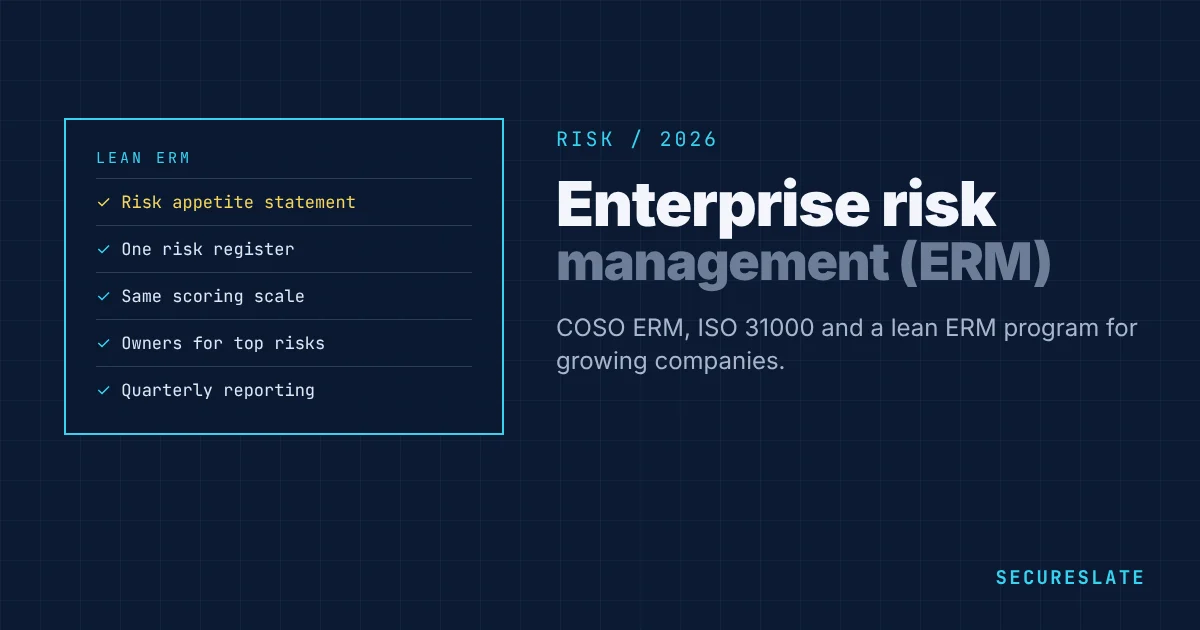
Enterprise risk management (ERM) is a company-wide approach to identifying, assessing and managing the risks that could stop the business from reaching its goals. Where a cybersecurity risk assessment looks at threats to systems and data, ERM looks across strategy, finance, operations, people, legal, compliance and technology together. This guide explains the main ERM frameworks, the ERM process, and how a growing company can introduce ERM without building a large risk department.
Related guides: Cybersecurity risk assessment · Risk register · Risk appetite statement · ISO 31000
Key takeaways
- ERM manages all major risks in one consistent way, linked to strategy and objectives.
- The two most used frameworks are COSO ERM (2017) and ISO 31000:2018.
- A clear risk appetite, a single risk register and regular reporting to leadership are the core of a lean ERM program.
- ERM and security compliance share tools and methods, so they work best as one integrated risk management program.
What is enterprise risk management?
ERM asks a simple question: what could stop us from achieving our objectives, and what are we doing about it? It replaces scattered risk lists in finance, security, legal and operations with one view, using the same scales and the same process. That lets leadership compare very different risks, such as losing a key customer, a ransomware attack or a new regulation, and decide where to invest.
ERM vs traditional risk management
| Traditional (siloed) risk management | Enterprise risk management | |
|---|---|---|
| Scope | Each department manages its own risks | All significant risks across the company |
| Method | Different scales and templates | One method, scales and register |
| Link to strategy | Weak | Risks tied to objectives and decisions |
| Ownership | Specialists | Leadership and business owners, supported by specialists |
| Reporting | Separate reports | One risk report to leadership and the board |
| Opportunities | Mostly ignored | Considered alongside threats |
ERM frameworks: COSO and ISO 31000
COSO ERM, "Enterprise Risk Management: Integrating with Strategy and Performance" (2017), organizes ERM into five components supported by 20 principles:
- Governance and culture
- Strategy and objective-setting
- Performance
- Review and revision
- Information, communication and reporting
COSO ERM is widely used in the United States, especially by companies familiar with COSO internal control for financial reporting.
ISO 31000:2018 gives principles, a framework and a process for managing any type of risk. It is shorter and more general than COSO, used internationally, and is not certifiable. Its process steps are scope and criteria, risk identification, analysis, evaluation, treatment, monitoring and review, and communication and consultation.
Both work well. Many small companies use the ISO 31000 process because it is simple and lines up with ISO 27001 risk management.
The ERM process
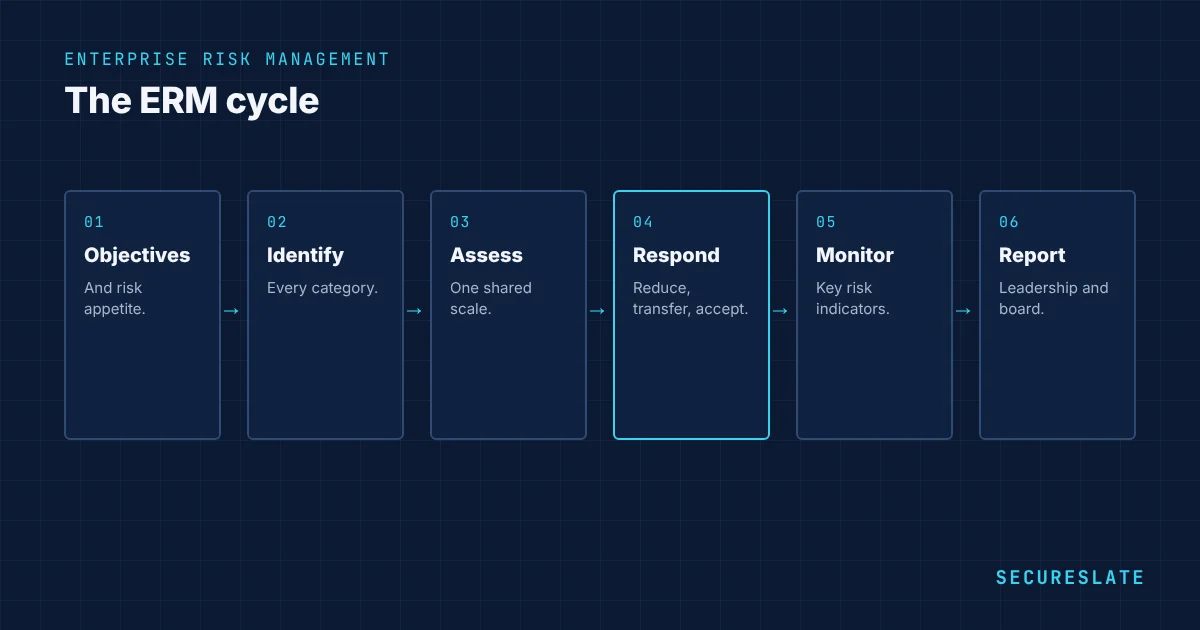
- Set objectives and risk appetite. Agree the company's goals and how much risk leadership will accept in pursuit of them, written down in a risk appetite statement.
- Identify risks across categories: strategic, financial, operational, technology and security, compliance and legal, people and reputation.
- Assess risks for likelihood and impact on objectives, using one scale for the whole company.
- Prioritize against risk appetite.
- Respond: reduce, transfer, avoid or accept each risk, with an owner and actions.
- Monitor with key risk indicators and regular reviews.
- Report to leadership and the board on top risks, trends and decisions.
Risk categories to include
| Category | Examples for a growing SaaS company |
|---|---|
| Strategic | Competitor pricing pressure, dependence on one market, slow product adoption |
| Financial | Cash runway, concentration of revenue in a few customers, currency exposure |
| Operational | Platform outages, key supplier failure, scaling support |
| Technology and security | Data breach, ransomware, cloud misconfiguration, AI misuse |
| Compliance and legal | GDPR, HIPAA, contract breaches, new AI regulation |
| People | Loss of key staff, hiring, culture as the team grows |
| Reputation | Public incidents, customer trust, social media |
The three lines model
The Institute of Internal Auditors' Three Lines Model (2020) describes how responsibilities are shared. First line: business and operational teams who own and manage risks day to day. Second line: risk, security and compliance functions that set methods, advise and monitor. Third line: internal audit, which gives independent assurance to leadership and the board. Small companies often combine the second line in one person and use external auditors or advisers for the third.
How to start ERM in a growing company
- Name a risk owner, often the COO, CFO or head of security.
- Write a one-page risk appetite statement approved by leadership.
- Run a short workshop with each department to collect top risks.
- Put them in one risk register with the same scoring scale.
- Agree owners and actions for the top ten risks.
- Review the register quarterly with leadership and report the top risks to the board.
Example ERM risk register entries
| Risk | Category | Likelihood | Impact | Owner | Response |
|---|---|---|---|---|---|
| Top three customers make up 40% of revenue | Financial | Likely | Major | CEO | Grow mid-market pipeline, multi-year renewals |
| Enterprise deals blocked without ISO 27001 | Compliance | Likely | Major | Head of Security | Certification project this year |
| Ransomware disrupts production | Technology | Possible | Severe | CTO | Backups, endpoint protection, incident plan, insurance |
| Key engineer leaves with critical knowledge | People | Possible | Major | CTO | Documentation, pairing, retention plan |
| Primary cloud region outage | Operational | Unlikely | Major | CTO | Multi-zone design, tested recovery |
| New AI regulation affects product features | Compliance | Possible | Moderate | Product lead | Track EU AI Act guidance, AI inventory |
The same scale and register work for every category, which is what lets leadership compare a revenue risk with a security risk.
Reporting risk to leadership and the board
A useful quarterly risk report fits on one or two pages:
- The top ten risks, with current score, trend and owner
- Risks above appetite and the plan to bring them down
- New and closed risks since the last report
- Key risk indicators that changed significantly
- Decisions needed from leadership, such as accepting a risk or approving a budget
Keep it short and decision-focused. Boards want to know what changed, what is outside appetite and what they need to decide.
Common ERM mistakes
- Building a long risk list with no owners or actions
- Different departments using different scales, so risks cannot be compared
- Treating ERM as a yearly exercise instead of part of planning and decisions
- Ignoring opportunities and focusing only on threats
- Keeping security and compliance risks out of the enterprise view
How SecureSlate helps
SecureSlate risk management gives growing companies one risk register for security, compliance and operational risks, with configurable scoring, treatment plans linked to controls, owners and review reminders, so ERM and compliance run from the same place.
FAQ
What is the main goal of enterprise risk management?
To help an organization achieve its objectives by managing the most significant risks consistently across the whole business, and by making risk part of strategic decisions.
Is COSO ERM better than ISO 31000?
Neither is better in general. COSO is more detailed and common in the US. ISO 31000 is shorter, international and easy to align with ISO 27001.
Do small companies need ERM?
A lean version helps any company that is growing quickly, raising funding or selling to enterprises. Investors and enterprise customers increasingly ask how risks are managed.
What is integrated risk management?
An approach that brings enterprise, operational, security, compliance and vendor risk together in one program and toolset, so risks are managed consistently.
What are key risk indicators?
Metrics that signal when a risk is increasing, such as rising customer churn, failed backups or overdue access reviews, used to trigger action early.
How is ERM different from GRC?
GRC combines governance, risk management and compliance. ERM is the risk management part applied across the whole enterprise. In practice, small companies run them together.
How often should the ERM risk register be reviewed?
Quarterly with leadership for the top risks, and at least yearly for the full register, plus whenever strategy or the business changes significantly.
Disclaimer (legal note)
This article is for general information only and is not legal, regulatory, or professional advice. Requirements vary by framework, industry, and jurisdiction. Consult qualified advisors for your specific obligations.
Need compliance without the complexity?
SecureSlate automates ISO 27001, SOC 2, GDPR, HIPAA, and more. Built for growing teams. See it in action.
Find compliance gaps in 30 seconds