
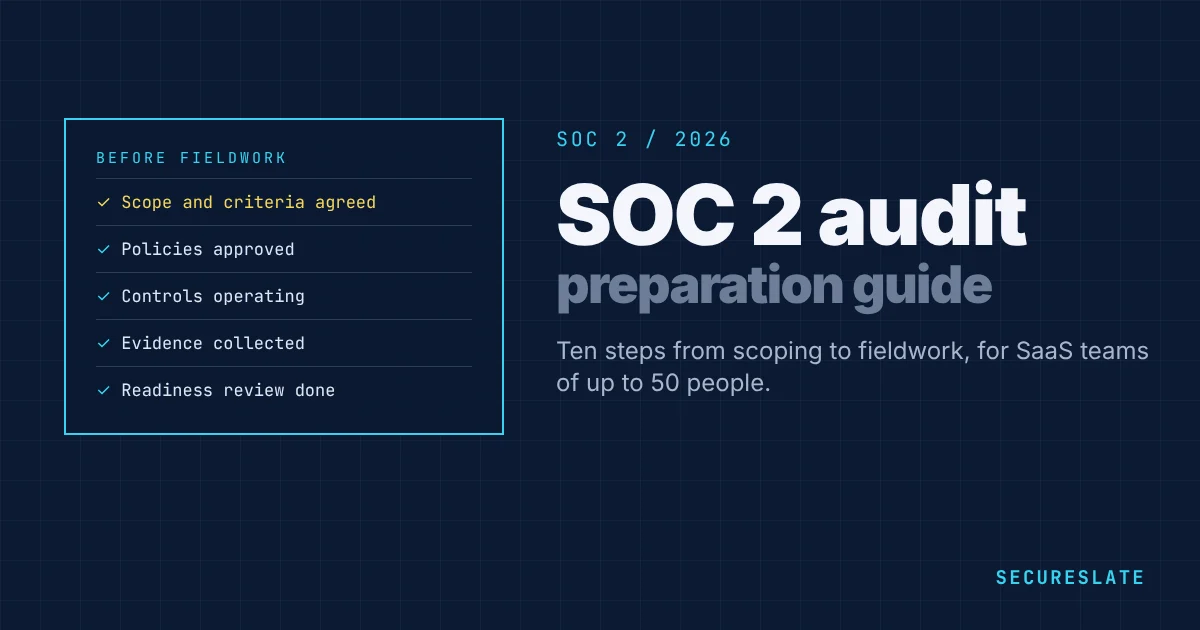
Knowing how to prepare for a SOC 2 audit is the difference between a smooth first report and months of rework. For a SaaS company of up to 50 people, preparation usually takes three to six months, and most of it happens before the auditor ever arrives. This guide walks through the ten steps in order, what auditors actually check, and the mistakes that cause exceptions.
Related guides: SOC 2 readiness checklist template · SOC 2 Trust Services Criteria explained · SOC 2 evidence collection · How to create a SOC 2 project plan
Key takeaways
- Preparing for a SOC 2 audit means scoping, closing control gaps, writing and operating policies and collecting evidence before fieldwork starts.
- Most first-time SMBs need 3 to 6 months to be ready for a Type 1 audit, then a 3 to 12 month observation period for Type 2.
- Choose your CPA firm early. Auditor availability and scope agreement often set your timeline.
- The most common causes of exceptions are missed access reviews, incomplete offboarding, unapproved changes and policies that were never followed.
What happens in a SOC 2 audit?
A SOC 2 audit is an independent examination by a licensed CPA firm of the controls you use to protect customer data. The auditor tests your controls against the AICPA Trust Services Criteria and issues a report your customers can read.
- A Type 1 report checks whether controls are suitably designed at a single point in time.
- A Type 2 report checks whether controls operated effectively over a period, usually 3 to 12 months.
Enterprise buyers usually ask for Type 2. Many startups get a Type 1 first to unblock sales, then start the Type 2 period straight away.
How long does SOC 2 audit preparation take?
| Phase | Typical time for a 10 to 50 person SaaS company |
|---|---|
| Scoping and gap assessment | 2 to 5 weeks |
| Remediation (policies, tools, processes) | 6 to 12 weeks |
| Readiness review | 1 to 2 weeks |
| Type 1 fieldwork and report | 4 to 8 weeks |
| Type 2 observation period | 3 to 12 months |
| Type 2 fieldwork and report | 4 to 8 weeks after the period ends |
The biggest variables are how many controls you already run, how much engineering time you can protect, and how quickly you book an auditor.
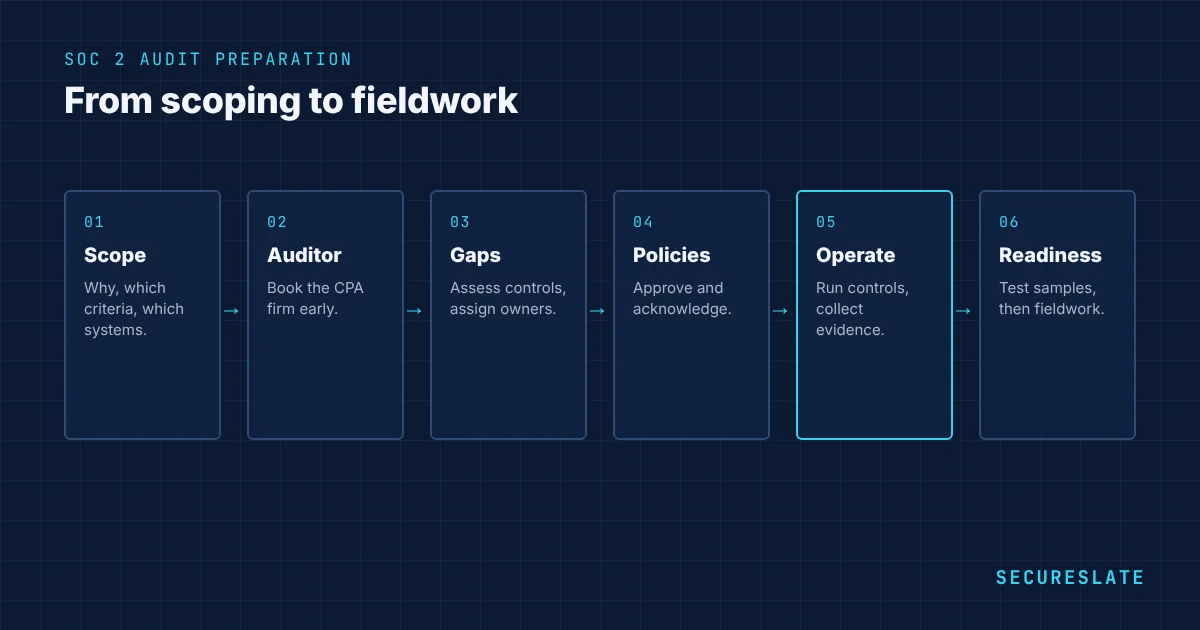
How to prepare for a SOC 2 audit in 10 steps
1. Decide why you need the report
Write down which customers asked for SOC 2, by when, and whether they need Type 1 or Type 2. This sets your deadline and scope, and helps you say no to scope creep later.
2. Define the scope
List the product, systems, data, people and locations in scope. Choose the Trust Services Criteria: Security is always included, and you add Availability, Confidentiality, Processing Integrity or Privacy only if customers need them. Identify subservice organizations such as your cloud provider. See SOC 2 Trust Services Criteria for help choosing.
3. Choose your auditor early
Shortlist two or three CPA firms that audit companies your size. Ask about experience in your industry, fixed fees, timeline, and how they handle evidence requests. Booking early lets you confirm scope with the firm before remediation starts. Our guide to who can perform a SOC 2 audit explains what to check.
4. Run a gap assessment
Compare your current practices with the controls you need. A typical control set for a small SaaS company has 80 to 120 controls. Record each gap with an owner and a due date.
5. Write and approve your policies
You need a core set of policies, approved by leadership and acknowledged by staff: information security, acceptable use, access control, change management, incident response, risk management, vendor management, business continuity and data handling. See SOC 2 policies and procedures for the full list.
6. Close technical gaps
Common fixes are single sign-on and MFA for all systems, centralized logging and alerting, endpoint protection and device management, encryption at rest and in transit, vulnerability scanning, branch protection with code review, and backups with a tested restore.
7. Start operating your controls
Controls must run as described before the auditor tests them. Start quarterly access reviews, onboarding and offboarding checklists, change approvals, vendor reviews, security training and risk assessments now, and keep records.
8. Set up evidence collection
Decide where evidence lives and who provides it. Automate what you can from your cloud, identity, code and HR systems. Our SOC 2 evidence collection guide explains what auditors ask for.
9. Run a readiness review
Before fieldwork, test a sample of controls yourself or ask the auditor for a readiness assessment. Fix anything that would cause an exception.
10. Prepare your team for fieldwork
Write the system description, brief control owners on what they will be asked, and nominate one coordinator for all auditor requests.
What do SOC 2 auditors check?
| Area | What the auditor typically asks for |
|---|---|
| Governance | Org chart, policies with approval dates, board or leadership security reviews |
| Risk management | Annual risk assessment and treatment plan |
| Access control | User lists, MFA settings, access review sign-offs, onboarding and offboarding tickets |
| Change management | Pull requests with approvals, deployment records, emergency changes |
| Operations | Monitoring and alerting setup, vulnerability scans, incident tickets |
| Vendors | Vendor list, risk ratings, vendor SOC 2 reports |
| People | Background checks where lawful, training completion, policy acknowledgments |
Common mistakes that cause exceptions
- Access reviews scheduled quarterly but one quarter missed
- Leavers still active in a tool outside single sign-on
- Changes deployed without the documented approval
- Policies that describe a process nobody actually follows
- Evidence screenshots without dates or system context
- Vendor reviews done once and never repeated
SOC 2 audit exceptions explains what exceptions mean for your report and how to respond.
How much does a SOC 2 audit cost?
Audit fees depend on scope, criteria, report type and the firm. Add the cost of tools, internal time and any consultants. Our guide on how much a SOC 2 audit costs breaks down current ranges. SecureSlate's Ultra plan includes one framework audit and a penetration test for $8,500 a year, see pricing.
SOC 2 audit preparation checklist
Use this short checklist in the final month before fieldwork:
- Scope, criteria and audit period confirmed in writing with the auditor
- System description drafted and reviewed by engineering
- All policies approved within the last 12 months and acknowledged by staff
- Risk assessment completed and risk treatment plan up to date
- Access reviews completed and signed off for every quarter in the period
- Onboarding and offboarding records complete for every joiner and leaver
- Change approvals visible on every production change
- Vulnerability scans run on schedule, with findings tracked to closure
- Vendor list current, with reviews of critical vendors and their SOC reports
- Security training completed by all staff
- Backup restore or disaster recovery test completed
- One coordinator named for auditor requests, with control owners briefed
Related guides:
- How long SOC 2 compliance takes
- Automated SOC 2 compliance
- SOC 2 vs ISO 27001: 9 reasons to start with SOC 2
How SecureSlate helps
SecureSlate gives you a ready-made SOC 2 control set, policy templates, automated evidence collection from your systems and a dedicated auditor on the Ultra plan, so preparation takes weeks instead of months.
FAQ
How long does it take to prepare for a SOC 2 audit?
Most SaaS companies of up to 50 people need 3 to 6 months to prepare for a Type 1 audit. A Type 2 report then needs an observation period of 3 to 12 months before the audit.
Can we do a SOC 2 self-assessment first?
Yes. A self-assessment or readiness review against the Trust Services Criteria is the best way to find gaps before the auditor does, but it does not replace the CPA firm's report.
What should we ask a SOC 2 auditor before hiring them?
Ask about experience with companies your size and industry, the fixed fee and what it includes, the timeline, how evidence is requested, and whether they offer a readiness assessment.
Do we need a consultant to prepare for SOC 2?
Not always. Many small companies prepare with a compliance automation platform and internal owners. Consultants help when you have no security lead or a tight deadline.
What is the difference between preparing for Type 1 and Type 2?
Type 1 needs controls designed and in place on a date. Type 2 needs the same controls operating consistently, with evidence, for the whole observation period.
Disclaimer (legal note)
This article is for general information only and is not legal, regulatory, or professional advice. Requirements vary by framework, industry, and jurisdiction. Consult qualified advisors for your specific obligations.
Need compliance without the complexity?
SecureSlate automates ISO 27001, SOC 2, GDPR, HIPAA, and more. Built for growing teams. See it in action.
Find compliance gaps in 30 seconds
