
Internal audit methodology is the documented approach an internal audit function uses to plan, perform, report and follow up on its work. It turns professional standards into practical steps so that every audit is consistent, risk-focused and defensible. A good methodology covers the whole cycle: building the audit universe, ranking risks, writing an annual plan, running each engagement, rating findings and tracking corrective actions. This guide explains the standards behind internal audit methodology, the main approaches, the phases of an engagement and how to build a methodology that fits a small or growing organization.
Related guides: Internal audit process · Risk-based internal audit · Internal control audit · Audit risk model
Key takeaways
- The IIA Global Internal Audit Standards, effective January 9, 2025, are the main professional standard for internal audit methodology.
- Most modern methodologies are risk-based: audit effort follows the organization's biggest risks.
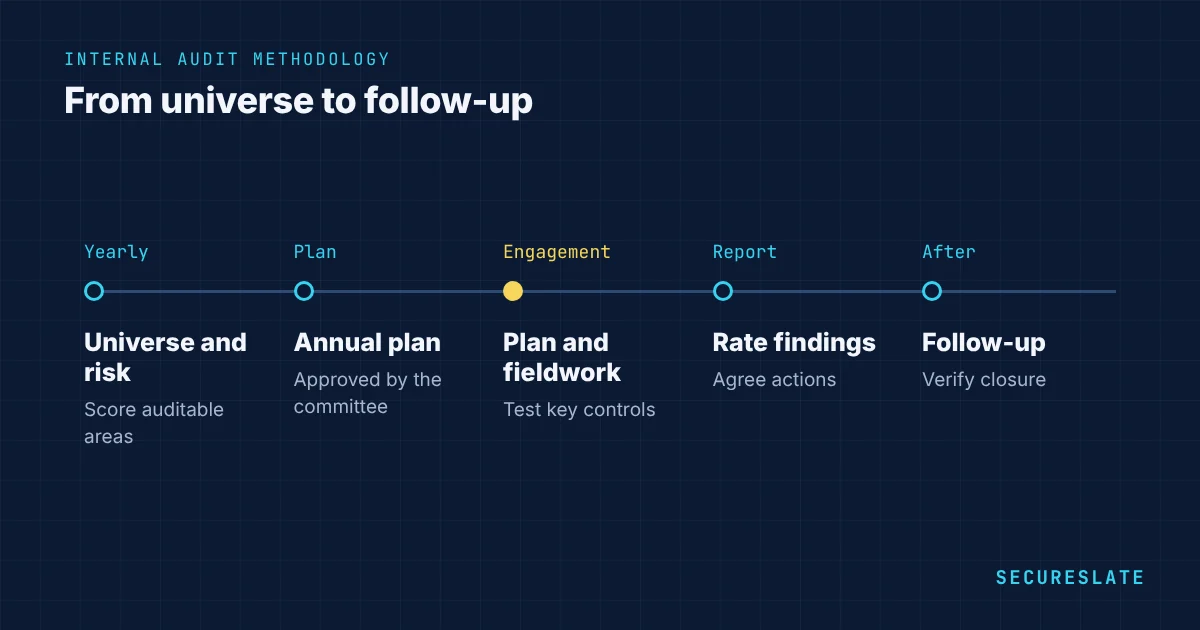
- Every engagement moves through planning, fieldwork, reporting and follow-up.
- Methodology documents should define templates, rating scales, sampling and quality review so results are consistent.
- For compliance frameworks such as ISO 27001 clause 9.2, internal audit methodology also proves the management system works.
Standards that shape internal audit methodology
| Standard or guidance | What it covers |
|---|---|
| IIA Global Internal Audit Standards (2024) | Purpose, ethics, governance, management of the function and performance of services |
| IIA Three Lines Model (2020) | Roles of management, risk and compliance functions, and internal audit |
| COSO Internal Control Integrated Framework (2013) | Components and principles for evaluating internal control |
| COSO ERM (2017) | Enterprise risk management concepts used in risk-based planning |
| ISO 19011 | Guidelines for auditing management systems such as ISO 27001 and ISO 9001 |
| ISO 27001 clause 9.2 | Requirements for ISMS internal audits |
The Global Internal Audit Standards replaced the previous International Professional Practices Framework standards and are organized into five domains with 15 principles, covering topics such as objectivity, due professional care, governing the internal audit function, managing resources and performing engagements.
Main methodology approaches
Risk-based auditing
The audit plan and each engagement focus on the risks that matter most to the organization's objectives. This is the dominant approach and the one the IIA standards expect.
Compliance auditing
Checks whether the organization follows laws, regulations, contracts and internal policies. Common for regulated industries and certification frameworks.
Operational auditing
Looks at efficiency and effectiveness of processes, such as procurement or customer onboarding.
IT auditing
Evaluates IT general controls, application controls, cybersecurity, cloud and data governance. Frameworks such as COBIT, NIST CSF and ISO 27001 are often used.
Financial auditing
Tests controls over financial reporting and accuracy of records, often in support of external auditors and SOX.
Continuous auditing and data analytics
Uses automated tests on full data sets to monitor controls and detect anomalies between periodic audits.
The audit universe and annual plan
- Build the audit universe. List auditable entities: processes, business units, systems, locations, vendors and projects.
- Assess risk for each entity. Score impact and likelihood using factors such as financial size, regulatory exposure, complexity, change, past findings and management concerns.
- Set audit frequency. High-risk areas every year, medium every two to three years, low as resources allow.
- Draft the plan. Balance coverage with available staff and budget, and leave room for ad hoc requests.
- Approve the plan. Present to the audit committee or board, which approves and oversees it.
- Revisit regularly. Update the plan when risks change during the year.
Phases of an internal audit engagement
| Phase | Main activities | Outputs |
|---|---|---|
| Planning | Understand the area, identify risks and controls, set objectives and scope, write the work program | Engagement plan, risk and control matrix |
| Fieldwork | Walkthroughs, test design and operating effectiveness, analyze data, document evidence | Workpapers, test results, draft observations |
| Reporting | Rate findings, agree management actions, write the report | Audit report with ratings and action plans |
| Follow-up | Track actions to closure, verify remediation | Closure evidence, updated status to the committee |
Testing techniques
- Inquiry: asking people how a process works. Weak alone; always corroborate.
- Observation: watching a control being performed.
- Inspection: examining documents, records or configurations.
- Reperformance: independently performing the control to see if results match.
- Analytics: testing full populations with data tools to find exceptions.
Sampling guidance
Many methodologies use a table based on control frequency. A common starting point:
| Control frequency | Typical sample size |
|---|---|
| Annual | 1 |
| Quarterly | 2 |
| Monthly | 2 to 5 |
| Weekly | 5 to 15 |
| Daily | 20 to 40 |
| Many times per day | 25 to 60 |
Adjust for risk and reliance, and document the rationale. Automated controls can often be tested with one instance plus testing of IT general controls.
Rating findings
A clear rating scale makes reports comparable. For example:
| Rating | Meaning | Expected action |
|---|---|---|
| High | Significant exposure to a key risk or regulatory breach | Fix within 30 to 60 days, report to the audit committee |
| Medium | Control weakness that could lead to loss or noncompliance | Fix within 90 days |
| Low | Minor improvement opportunity | Fix within 180 days or accept |
Many functions also give an overall engagement opinion such as satisfactory, needs improvement or unsatisfactory.
Quality assurance
The Global Internal Audit Standards require a quality assurance and improvement program. That includes supervision and review of each engagement, ongoing monitoring, periodic internal self-assessments and an external quality assessment at least once every five years.
Building a methodology for a small team
Small organizations and startups often have a one-person or outsourced internal audit function. Keep the methodology lean:
- A one-page charter approved by leadership or the board
- A simple risk-ranked audit universe in a spreadsheet or GRC tool
- Standard templates for plans, workpapers and reports
- A shared rating scale and sampling table
- A tracker for management actions with owners and dates
For ISO 27001, make sure the methodology also shows auditor objectivity, a planned audit program covering the whole ISMS over time, defined criteria and scope for each audit, and reporting to relevant management.
Common methodology mistakes
- Auditing the same low-risk areas every year because they are familiar
- No documented rationale for sample sizes or scope
- Findings without root cause, so the same issues return
- Reports that describe problems without agreed actions or owners
- No follow-up, which makes audit look like a paperwork exercise
Methodology documents to maintain
| Document | Purpose |
|---|---|
| Internal audit charter | Defines purpose, authority, independence and reporting lines |
| Methodology manual | Explains planning, fieldwork, reporting and follow-up steps |
| Risk assessment model | Shows how auditable entities are scored and prioritized |
| Templates | Engagement plan, risk and control matrix, workpaper, report, action tracker |
| Rating scales | Finding and overall engagement ratings |
| Quality program | Supervision, review checklists and self-assessment approach |
Review the manual each year and after any change to professional standards or the organization's risk profile, and record the version and approval date so auditors and reviewers know which rules applied to each engagement.
How SecureSlate helps
SecureSlate gives internal auditors a single place for controls, evidence and findings. Audit management organizes audit programs, workpapers and requests; continuous control monitoring provides population-level evidence for IT controls; and risk management links findings to risks and corrective actions. It suits small internal audit teams supporting SOC 2, ISO 27001 and other frameworks without enterprise GRC costs.
FAQ
What is internal audit methodology?
The documented approach an internal audit function follows to plan, perform, report and follow up on audits consistently with professional standards.
What standards govern internal audit?
The IIA Global Internal Audit Standards, effective January 9, 2025, are the main professional standards. ISO 19011 provides guidance for management system audits.
What is a risk-based internal audit methodology?
An approach where audit planning and testing focus on the risks that most threaten the organization's objectives.
What are the phases of an internal audit?
Planning, fieldwork, reporting and follow-up.
How often should internal audits happen?
High-risk areas are usually audited every year, medium-risk areas every two to three years. ISO 27001 requires internal audits at planned intervals covering the whole ISMS.
What is the difference between methodology and process?
Methodology is the overall approach and rules for the audit function, including standards, risk assessment and rating scales. The process is the sequence of steps followed in a single audit engagement.
Disclaimer (legal note)
This article is for general information only and is not legal, regulatory, or professional advice. Requirements vary by framework, industry, and jurisdiction. Consult qualified advisors for your specific obligations.
Need compliance without the complexity?
SecureSlate automates ISO 27001, SOC 2, GDPR, HIPAA, and more. Built for growing teams. See it in action.
Find compliance gaps in 30 seconds