
Risk-based internal audit (RBIA) means planning and performing audits according to the risks that most threaten an organization's objectives, rather than auditing every area on a fixed rotation. It focuses limited audit resources where failures would hurt most, links audit work to the organization's risk management, and gives leadership assurance on the issues that matter. The IIA Global Internal Audit Standards expect internal audit plans to be based on a documented assessment of risks. This guide explains how risk-based auditing works, the steps to build a risk-based plan and how smaller organizations can adopt it.
Related guides: Internal audit methodology · Internal audit process · Risk register · Audit risk model
Key takeaways
- RBIA ranks auditable areas by risk and audits the highest risks most often and most deeply.
- It relies on the organization's risk management, but auditors also form their own view of risk.
- Engagements are scoped around key risks and the controls that address them.
- RBIA gives the board assurance about risk management itself, not only about individual controls.
- Small teams can adopt RBIA with a simple risk-ranked audit universe and clear criteria.
Traditional vs risk-based internal audit
| Aspect | Traditional (cyclical) audit | Risk-based internal audit |
|---|---|---|
| Planning basis | Fixed rotation of all areas | Assessed risk to objectives |
| Focus | Compliance with procedures | Whether key risks are managed within appetite |
| Scope | Same checklist each time | Tailored to current risks and changes |
| Coverage | Even, regardless of importance | Concentrated on high-risk areas |
| Value to board | Assurance on controls | Assurance on risk management and key controls |
| Flexibility | Low | Plan updated as risks change |
Steps to implement risk-based internal audit
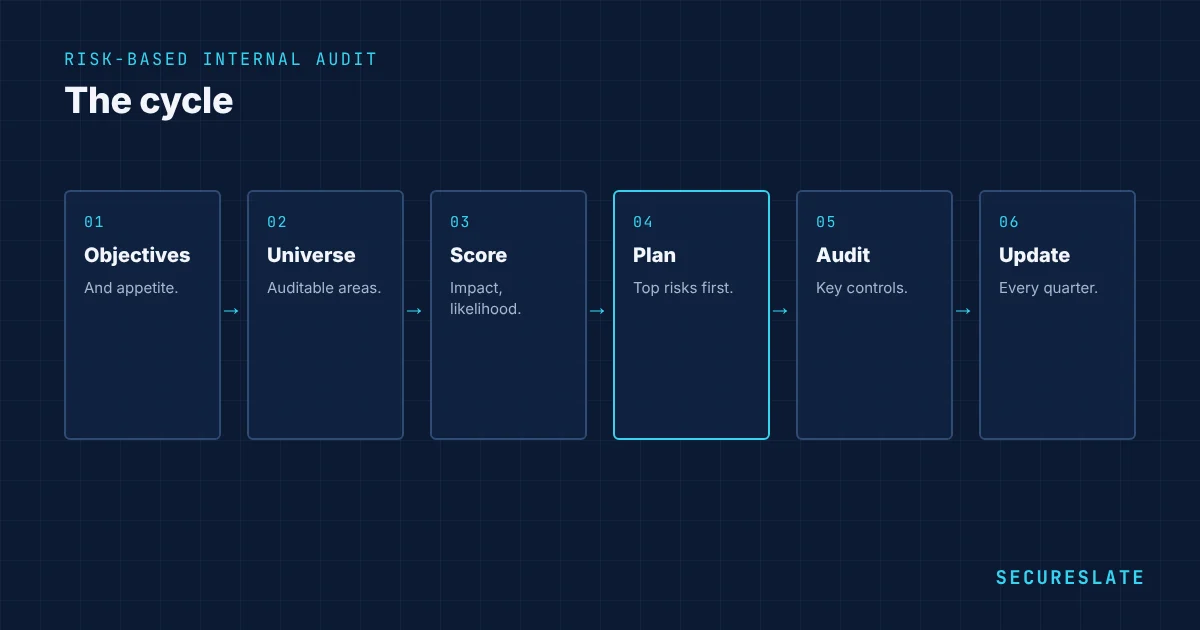
1. Understand objectives and risk appetite
Review the strategy, business plans and risk appetite statement. Audit focuses on risks to those objectives.
2. Assess risk management maturity
Determine how mature the organization's risk management is. If there is a reliable risk register with owners and regular review, auditors can use it as a starting point. If not, internal audit must do more of its own risk identification, and may recommend improvements to risk management.
3. Build the audit universe
List auditable entities: processes, business units, systems, projects, vendors and locations. Link each to the risks it affects.
4. Score each entity
Use criteria such as:
| Criterion | Questions to ask |
|---|---|
| Impact | How much financial, regulatory or reputational damage could failure cause? |
| Likelihood | How complex, manual or changing is the area? Any past incidents? |
| Control environment | What did previous audits find? Is management's own monitoring reliable? |
| Change | New systems, leaders, regulations or products? |
| Regulatory exposure | Is the area subject to specific laws or certification requirements? |
| Time since last audit | How long since independent assurance? |
5. Build the audit plan
Rank entities by score. Plan audits for the highest risks first, set frequency (yearly, every two years, every three years) and balance against resources. Include time for advisory work and unplanned requests.
6. Scope each engagement around key risks
For each audit, identify the specific risks and the key controls that address them. Test those controls rather than every procedure.
7. Report on risk
Express findings in terms of risk: which objective is threatened, how much, and whether it is within appetite. Give an overall opinion on how well the area manages its risks.
8. Update continuously
Revisit risk scores and the plan at least quarterly, and when significant events occur.
Example risk-based audit plan
| Auditable area | Risk score | Frequency | Planned quarter | Focus |
|---|---|---|---|---|
| Customer data access | High | Yearly | Q1 | Privileged access, access reviews, logging |
| Cloud infrastructure | High | Yearly | Q2 | Configuration, change management, backups |
| Third-party risk management | High | Yearly | Q3 | Vendor tiering, due diligence, contracts |
| Incident response | Medium | Every 2 years | Q4 | Plan, testing, lessons learned |
| Payroll | Medium | Every 2 years | Next year | Approvals and segregation of duties |
| Office facilities | Low | Every 3 years | Later | Physical access |
Benefits of risk-based auditing
- Better use of limited audit staff and budget
- Findings that leadership cares about because they affect objectives
- Earlier warning on emerging risks
- Stronger link between internal audit and enterprise risk management
- Audit opinions that support board oversight of risk
Challenges
- Immature risk management makes it harder to rely on management's assessments.
- Subjective scoring can be inconsistent between auditors without clear criteria.
- Low-risk areas may go many years without review, so a minimum coverage rule helps.
- Auditors need broad business knowledge to judge risk in technical areas such as cybersecurity.
RBIA for compliance frameworks
For ISO 27001, the internal audit program must take into account the importance of the processes concerned and the results of previous audits, which is a risk-based idea. Auditors can weight high-risk Annex A areas such as access control, supplier security and incident management more heavily while still covering the whole ISMS within the certification cycle. For SOC 2, an internal risk-based review before the audit period helps find control gaps early.
Getting started in a small organization
- List 15 to 30 auditable areas in a spreadsheet or GRC tool.
- Score each on impact and likelihood using a simple 1 to 5 scale.
- Add points for recent change, past findings and regulatory exposure.
- Pick the top four to six areas for the year.
- For each, write two or three key risks and test the controls for them.
- Report results to leadership with a short risk-focused summary.
- Repeat the scoring each quarter.
Linking RBIA to the risk register
The most efficient risk-based programs connect the audit universe directly to the risk register. Each auditable area lists the risks it affects, the owners and the residual scores. When residual risk rises, for example after an incident or a failed control test, the area moves up the audit plan. When an audit finds that a control does not work as management believed, the residual score in the register is corrected. This two-way link keeps risk scores honest and keeps the audit plan current.
Reporting results to the board
| Report element | What to show |
|---|---|
| Coverage | Which high-risk areas were audited this year and which were deferred |
| Overall opinions | Satisfactory, needs improvement or unsatisfactory for each engagement |
| Key risks | Areas where risk is outside appetite and why |
| Actions | Open, overdue and closed management actions |
| Themes | Recurring root causes across audits, such as access management or documentation |
| Plan changes | Additions or removals since the plan was approved, with reasons |
How SecureSlate helps
SecureSlate connects risk and audit in one platform. The risk register scores and tracks risks, controls are linked to those risks, and continuous control tests show which areas are weakest. Audit management lets you plan audits by risk, request evidence and track findings to closure, which is ideal for small internal audit and compliance teams.
FAQ
What is risk-based internal audit?
An approach that plans and scopes internal audits based on the risks that most threaten the organization's objectives.
How is risk-based audit different from traditional audit?
Traditional audit covers areas on a fixed cycle. Risk-based audit concentrates on the highest risks and adapts as risks change.
Do the IIA standards require risk-based auditing?
The Global Internal Audit Standards expect the internal audit plan to be based on a documented assessment of the organization's strategies, objectives and risks.
Can small companies use risk-based internal audit?
Yes. A simple risk-ranked list of areas and a focus on the top risks works well for small teams.
How often should the risk-based audit plan be updated?
At least yearly, with quarterly reviews and updates when significant changes occur.
What is an audit universe?
The full list of auditable areas, such as processes, business units, systems, projects and vendors, that internal audit could review.
What criteria are used to rank audit areas?
Common criteria include impact on objectives, likelihood of failure, regulatory exposure, complexity, recent change, past findings and time since the last audit.
Disclaimer (legal note)
This article is for general information only and is not legal, regulatory, or professional advice. Requirements vary by framework, industry, and jurisdiction. Consult qualified advisors for your specific obligations.
Need compliance without the complexity?
SecureSlate automates ISO 27001, SOC 2, GDPR, HIPAA, and more. Built for growing teams. See it in action.
Find compliance gaps in 30 seconds