
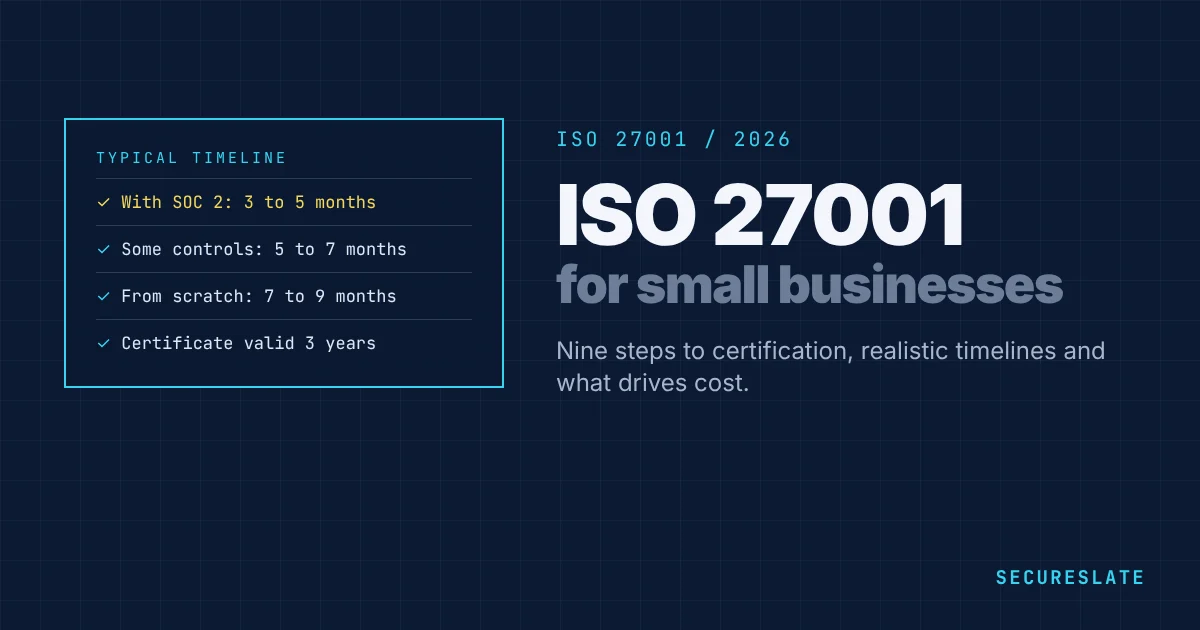
ISO 27001 for small businesses is more achievable than most founders expect. The standard scales to your size: a 15-person SaaS company does not need the same management system as a bank. What it does need is a clear scope, a real risk assessment, controls that match those risks, and records showing the system works. This guide covers whether you need ISO 27001, the steps to certification, realistic timelines and what drives the cost.
Related guides: How much ISO 27001 costs · ISO 27001 Annex A controls · How to write an ISO 27001 scope statement · ISO 27001 checklist
Key takeaways
- ISO 27001 certifies your information security management system (ISMS). It is the most widely recognized security standard outside the US, and increasingly asked for by US enterprises too.
- A small company can usually get certified in 4 to 9 months, depending on its starting point.
- Keep the scope tight and the documentation proportionate. Auditors expect evidence the system works, not thick binders.
- If you already have SOC 2, much of the work transfers. Expect to add the ISMS management clauses and a Statement of Applicability.
Does a small business need ISO 27001?
You probably need ISO 27001 if one or more of these is true:
- Customers in Europe, the UK, the Middle East or Asia ask for it in security reviews or tenders
- Enterprise customers ask for "SOC 2 or ISO 27001" and most of your pipeline is outside the US
- You sell to regulated industries, such as finance or healthcare, where suppliers must show certified security
- You want a structured way to run security as you grow from 10 to 100 people
If almost all your customers are US-based and ask for SOC 2, start there and add ISO 27001 later. Many controls overlap, so the second framework is far less work.
What ISO 27001 requires
ISO/IEC 27001:2022 has two parts:
- Clauses 4 to 10 describe how to run the ISMS: context and scope, leadership, planning and risk assessment, support (resources, competence, documentation), operation, performance evaluation (monitoring, internal audit, management review) and improvement.
- Annex A lists 93 controls in four themes (organizational, people, physical and technological). You choose the ones that treat your risks and record your choices in the Statement of Applicability.
For a small cloud-based company, physical controls are often light because data centers belong to your cloud provider, while access control, secure development, supplier management and incident response carry most of the work.
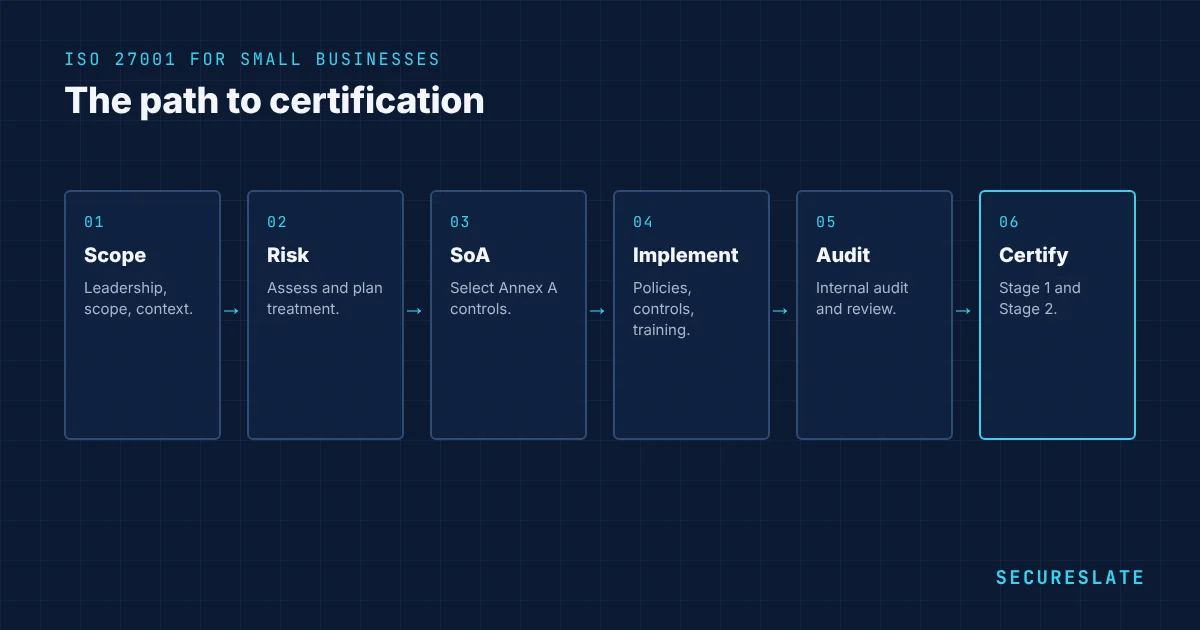
ISO 27001 implementation steps for a small business
1. Get leadership commitment
Name an executive sponsor and an ISMS owner. Leadership must approve the information security policy and take part in management review, so involve them from the start.
2. Define the scope
Decide which products, teams, locations and systems are in the ISMS. For most SaaS startups, the scope is "the development and operation of [product]" plus the people and systems that support it. See how to write an ISO 27001 scope statement.
3. Understand context and interested parties
List the internal and external issues that affect security (clause 4.1) and the requirements of customers, regulators and partners (clause 4.2).
4. Run a risk assessment
Identify risks to the confidentiality, integrity and availability of information in scope, score them, and decide how to treat each one. See ISO 27001 risk assessment made easy.
5. Select controls and write the Statement of Applicability
Map your risk treatments to Annex A controls, justify any exclusions and record implementation status. The Statement of Applicability template gives you a ready layout.
6. Implement controls and policies
Write proportionate policies, then put the controls in place: SSO and MFA, access reviews, device management, logging, backups, vulnerability management, secure development, supplier reviews and incident response.
7. Train staff and operate the ISMS
Run security awareness training, keep records, and let controls operate for at least a few months so there is evidence to audit.
8. Internal audit and management review
An objective internal auditor checks the ISMS against the standard, and leadership reviews performance, risks and improvements. Both are mandatory before certification. Use our internal audit checklist template.
9. Certification audit
An accredited certification body runs a Stage 1 documentation review and a Stage 2 audit of how the ISMS works in practice. Fix any nonconformities, and the certificate is issued for three years with annual surveillance audits.
How long does ISO 27001 take for a small company?
| Starting point | Typical time to certificate |
|---|---|
| Already SOC 2 certified, documented controls | 3 to 5 months |
| Some security practices, few documents | 5 to 7 months |
| Starting from scratch | 7 to 9 months or more |
The operating period before Stage 2 matters. Auditors want to see records, such as access reviews, training, incidents and internal audit results, not just policies.
What does ISO 27001 cost a small business?
Costs fall into four buckets: the certification body's audit fees, which depend on headcount and scope; tools such as a compliance platform; internal time from leadership and engineering; and optional consultancy or a penetration test. Our ISO 27001 cost breakdown gives current ranges. SecureSlate Starter covers one framework from $2,688 a year, and the Ultra plan includes one framework audit and a penetration test for $8,500 a year. See pricing.
Documents you will need
ISO 27001 requires documented information including the ISMS scope, information security policy, risk assessment and treatment process and results, the Statement of Applicability, security objectives, evidence of competence, operational procedures, monitoring results, the internal audit program and results, management review results, and records of nonconformities and corrective actions. Our guide to ISO 27001 documents lists them in detail.
ISO 27001 vs SOC 2 for a small company
| ISO 27001 | SOC 2 | |
|---|---|---|
| Type | Certification of an ISMS against an international standard | Attestation report by a CPA firm against the Trust Services Criteria |
| Output | Public certificate, valid three years | Private report shared under NDA, usually renewed yearly |
| Strongest demand | Europe, UK, Middle East, Asia, global enterprises | United States |
| Audit cycle | Certification audit, then annual surveillance | Annual Type 2 audit |
| Overlap | Most technical and operational controls are shared |
If you need both, implement one control set and map it to both. The second framework then mainly adds its specific documents and audits.
Tips to keep ISO 27001 lean
- Keep the scope to the product and team customers care about
- Reuse one control set for ISO 27001, SOC 2 and HIPAA
- Write short policies that describe what you really do
- Automate evidence collection from your cloud, identity and HR systems
- Book the certification body early, as availability varies
How SecureSlate helps
SecureSlate gives small teams an ISO 27001 control set mapped to Annex A, policy templates, a risk register, an SoA workflow and automated evidence, plus a dedicated compliance lead. Senbee A/S reached ISO 27001:2022 certification with SecureSlate (case study).
FAQ
Is ISO 27001 worth it for a small business?
It is worth it when customers or tenders ask for it, or when you sell internationally. It shortens security reviews and builds a structured security program as you grow.
How long does ISO 27001 certification take for a startup?
Most startups need 4 to 9 months from kickoff to certificate, depending on existing controls and how quickly they book the certification body.
Can a company with 10 employees get ISO 27001?
Yes. There is no minimum size. The ISMS scales to the organization, and audit days are lower for small headcounts.
Do we need a consultant for ISO 27001?
Not necessarily. Many small companies succeed with a compliance platform, templates and an internal owner, and use an external party only for the internal audit.
How long is an ISO 27001 certificate valid?
Three years, with surveillance audits in years two and three and a recertification audit before it expires.
Can we get ISO 27001 certified with a fully remote team?
Yes. Include remote working in the scope and show controls for devices, home working and access, while physical office controls may be excluded with a justification.
What is the most common reason small companies fail Stage 2?
Not enough operating records. Policies exist, but there is little evidence of internal audit, management review, access reviews or training actually happening.
Disclaimer (legal note)
This article is for general information only and is not legal, regulatory, or professional advice. Requirements vary by framework, industry, and jurisdiction. Consult qualified advisors for your specific obligations.
Need compliance without the complexity?
SecureSlate automates ISO 27001, SOC 2, GDPR, HIPAA, and more. Built for growing teams. See it in action.
Find compliance gaps in 30 seconds
