
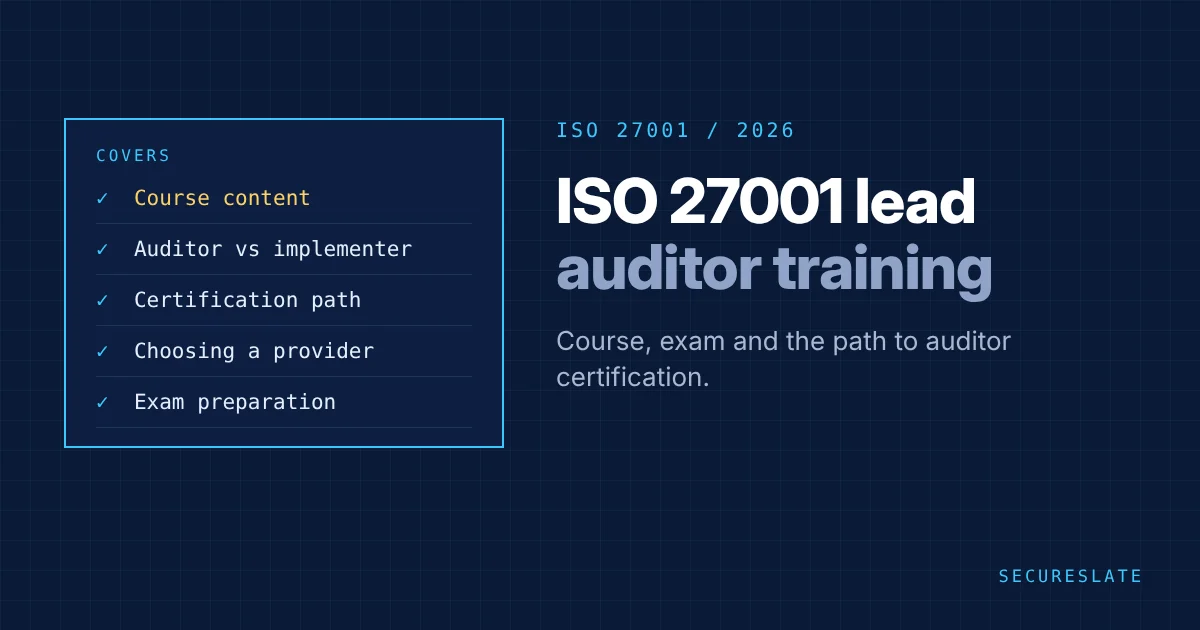
Short answer: ISO 27001 lead auditor training is a course, commonly about five days, that teaches you to plan, lead, conduct and report audits of an information security management system against ISO/IEC 27001:2022. It usually ends with an exam. Passing gives you a course certificate, but becoming a certified lead auditor also requires audit experience recognized by a personnel certification scheme.
Related guides: How to choose an information security auditor · ISO 27001 audit: how controls are tested · How to conduct an ISO 27001 internal audit
Key takeaways
- Lead auditor training teaches third-party audit skills: planning, leading an audit team, gathering evidence, grading findings and reporting.
- Courses are built around ISO/IEC 27001:2022, auditing guidance in ISO 19011 and ISMS-specific auditing guidance in ISO/IEC 27007.
- A course certificate is not the same as auditor certification. Personnel certification usually also needs logged audit experience.
- If your goal is to run your own company's ISMS, an internal auditor or lead implementer course may fit better.
- Choose a course that is recognized by a personnel certification body, uses the current edition of the standard and includes realistic audit exercises.
What is ISO 27001 lead auditor training?
ISO 27001 lead auditor training is a professional course that prepares you to lead audits of an ISMS, especially external audits such as certification and supplier audits. It combines knowledge of the standard with audit technique: how to sample, interview, review records and decide whether the organization conforms.
The "lead" part matters. A lead auditor is responsible for the whole audit: agreeing scope with the client, building the audit plan, managing other auditors, running opening and closing meetings, and signing off the report. Many courses are offered in classroom and live virtual formats, with the exam on the final day. Some training providers' courses are recognized by personnel certification bodies such as CQI and IRCA, which accept the course as meeting the formal training requirement for auditor certification.
What does a lead auditor course cover?
A typical course covers the standard, audit principles and the full audit lifecycle, with most of the time spent on practical exercises.
| Module | What you learn |
|---|---|
| ISMS and ISO/IEC 27001:2022 | Clauses 4 to 10, Annex A's 93 controls in four themes, and how risk drives control selection |
| Audit principles | Principles such as integrity, fair presentation, due professional care, confidentiality, independence and an evidence-based, risk-based approach |
| Audit types | First-party (internal), second-party (supplier) and third-party (certification) audits |
| Certification process | Stage 1 and stage 2 audits, surveillance and recertification, and the role of accredited certification bodies |
| Planning | Scope, objectives, criteria, sampling and the audit plan |
| Conducting | Opening meetings, interviews, document and record review, observing controls in operation |
| Findings | Writing clear nonconformities, grading them as major or minor, and recording observations |
| Reporting and follow-up | Closing meetings, audit reports and verifying corrective actions |
Courses normally reference ISO/IEC 27006-1:2024, which sets requirements for bodies that audit and certify ISMS. It builds on ISO/IEC 17021-1 and explains why certification body auditors work the way they do.
Lead auditor, internal auditor or lead implementer?
Pick the course that matches the job you will do: auditing other organizations, auditing your own, or building an ISMS.
| Lead auditor | Internal auditor | Lead implementer | |
|---|---|---|---|
| Main goal | Lead external or supplier audits | Run internal audits (clause 9.2) | Design and implement an ISMS |
| Typical length | Commonly about five days | Usually shorter | Commonly about five days |
| Focus | Audit leadership, team management, certification audits | Audit technique within your organization | Scope, risk, controls, documentation, project delivery |
| Best for | Aspiring certification body auditors, consultants, supplier assurance teams | ISMS team members, compliance staff | ISMS managers, security leads, consultants |
| Leads to auditor certification? | Often, with audit experience | Some schemes offer an internal auditor grade | No, it is an implementation credential |
For a small company, the internal audit requirement of ISO 27001 can be met by a trained internal auditor or an outsourced one, and the audit must be objective and impartial. Our internal audit checklist template shows what an internal audit typically covers.
How do you become a certified ISO 27001 lead auditor?
You become a certified lead auditor by combining recognized training, a passed exam and documented audit experience, then applying to a personnel certification scheme.
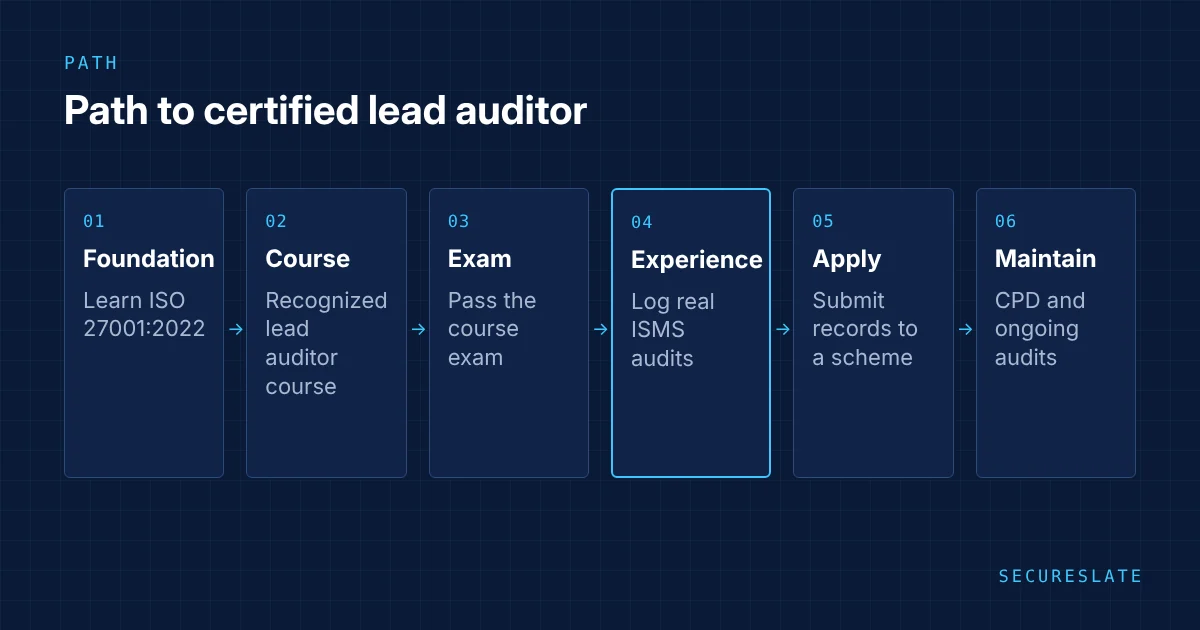
- Build the foundation. Understand information security and ISO/IEC 27001:2022 before the course. Many providers list prior knowledge of the standard as a prerequisite.
- Complete a recognized lead auditor course. Choose one accepted by the personnel certification scheme you plan to join.
- Pass the exam. Exams test both knowledge of the standard and audit judgment through scenarios.
- Log audit experience. Take part in real ISMS audits, often first as a team member under supervision. Certification schemes set their own experience requirements and grades, such as provisional auditor, auditor and lead auditor.
- Apply for certification. Submit training records, exam results and audit logs to the scheme.
- Maintain it. Keep up continuing professional development and audit activity to renew your certification.
Certification bodies also apply their own competence checks to the auditors they use. Passing a course does not, by itself, qualify you to audit for a certification body.
How do you choose a lead auditor training provider?
Choose a provider whose course is recognized for the credential you want and that teaches through realistic practice.
Use this checklist when comparing providers:
- Recognition: Is the course approved by a personnel certification body you intend to use?
- Current edition: Does it teach ISO/IEC 27001:2022 and reflect the current editions of ISO 19011 and ISO/IEC 27007?
- Exam format: Is the exam open or closed book, how long is it, and can you resit it?
- Practical work: Does it include case studies, mock interviews and writing nonconformities?
- Trainer background: Have the trainers led real certification audits?
- Format: Classroom, live virtual or self-paced, and does the format suit how you learn?
- Follow-on support: Does the provider explain how to log audit experience and apply for certification?
Avoid courses that promise certification without audit experience or that still teach the 2013 edition as current. As of November 2026, certification audits are against ISO/IEC 27001:2022.
How should you prepare for the lead auditor exam?
Prepare by learning the clause structure well and practising audit judgment, not by memorizing control lists.
- Know clauses 4 to 10 thoroughly. Exam questions often ask which clause a finding relates to.
- Learn Annex A by theme. Know the four themes (organizational, people, physical, technological) and what kind of control sits in each.
- Practise writing nonconformities. A good finding states the requirement, the evidence and why the evidence shows nonconformity.
- Understand major vs minor. Know how the course defines each grade and practise applying it to scenarios.
- Review audit principles. Questions about independence, objectivity and evidence-based conclusions are common.
- Use real examples. If you work in an ISMS, think about how you would audit your own controls. Our guide to how auditors test ISO 27001 controls is a useful companion.
How SecureSlate helps
SecureSlate helps the organizations that lead auditors visit. ISO 27001 is built in, with controls mapped to SOC 2, HIPAA, HITRUST and GDPR. Audit management gives internal and external auditors an organized view of controls and evidence, agentless read-only cloud integrations and a device agent collect evidence continuously, and access reviews, risk management and vendor risk management produce the records auditors ask for. SecureSlate does not perform audits, provide auditor training or issue certificates.
FAQ
How long is ISO 27001 lead auditor training?
Most lead auditor courses run for about five days, either in a classroom or live online, with the exam usually on the last day. Check each provider for exact duration.
Does lead auditor training make me a certified auditor?
Not on its own. The course and exam meet the training requirement. Personnel certification schemes usually also require documented audit experience.
Do I need lead auditor training to do internal audits?
No. ISO/IEC 27001 requires internal auditors to be competent, objective and impartial, but it does not require a lead auditor certificate. An internal auditor course is often enough.
What is the difference between lead auditor and lead implementer?
A lead auditor course teaches you to assess an ISMS against ISO/IEC 27001. A lead implementer course teaches you to design and build one.
Which standards does a lead auditor course use?
ISO/IEC 27001:2022 as the audit criteria, ISO 19011 for general auditing guidance, ISO/IEC 27007 for ISMS auditing guidance, and ISO/IEC 27006-1 for certification body requirements.
Disclaimer (legal note)
This article is for general information only and is not legal, regulatory, or professional advice. Requirements vary by framework, industry, and jurisdiction. Consult qualified advisors for your specific obligations.
Need compliance without the complexity?
SecureSlate automates ISO 27001, SOC 2, GDPR, HIPAA, and more. Built for growing teams. See it in action.
Find compliance gaps in 30 seconds