
Short answer: ISO/IEC 27002:2022 describes 93 information security controls in four themes: organizational, people, physical and technological. For each control it explains the purpose and gives implementation guidance. The same 93 controls appear in ISO 27001 Annex A, but ISO 27002 is guidance only, so you certify to ISO 27001, not ISO 27002.
Related guides: ISO 27001 Annex A controls · ISO 27001 vs ISO 27002 · ISO 27001 checklist
Key takeaways
- The current edition is ISO/IEC 27002:2022, published in February 2022, with 93 controls in four themes.
- Each control has a purpose, guidance and attributes, which makes ISO 27002 the practical "how" behind ISO 27001 Annex A.
- The 2022 edition added 11 new controls, such as threat intelligence, cloud security, data leakage prevention and secure coding.
- Attributes let you filter controls by type, security property, cybersecurity concept, operational capability and security domain.
- Use ISO 27002 to design and evidence controls, then record your choices in the ISO 27001 Statement of Applicability.
What are ISO 27002 controls?
ISO 27002 controls are a reference set of information security controls, each with guidance on how to implement it.
ISO/IEC 27002:2022 is titled "Information security, cybersecurity and privacy protection: Information security controls". ISO describes it as guidance that complements ISO/IEC 27001, which sets the requirements for an information security management system (ISMS). ISO 27002 itself is not certifiable.
The relationship is simple once you see it. ISO 27001 Annex A lists the 93 controls with a one-line statement each. ISO 27002 takes the same 93 controls, in the same order and numbering, and explains what each is for and how to put it in place. Organizations seeking certification use Annex A to decide which controls apply, and ISO 27002 to implement them well.
How are the 93 controls organized?
The controls are grouped into four themes that match clauses 5 to 8 of the standard.
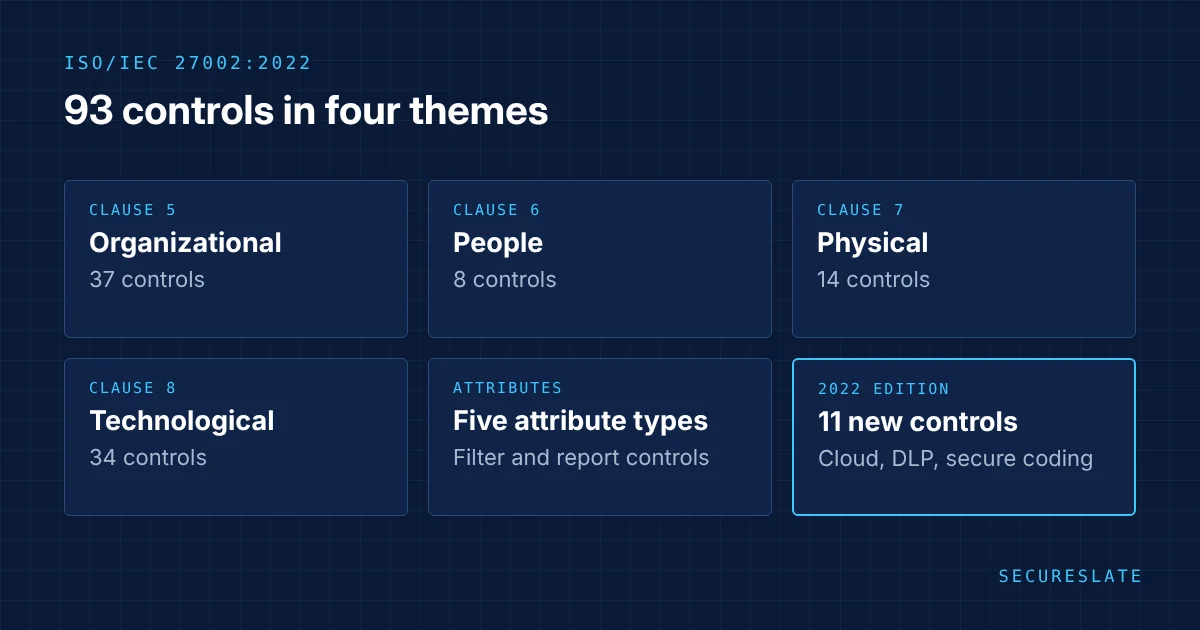
| Theme | Clause | Number of controls | Example controls |
|---|---|---|---|
| Organizational | 5.1 to 5.37 | 37 | 5.1 Policies for information security, 5.15 Access control, 5.19 Information security in supplier relationships, 5.24 Incident management planning and preparation |
| People | 6.1 to 6.8 | 8 | 6.1 Screening, 6.3 Information security awareness, education and training, 6.7 Remote working |
| Physical | 7.1 to 7.14 | 14 | 7.1 Physical security perimeters, 7.7 Clear desk and clear screen, 7.10 Storage media |
| Technological | 8.1 to 8.34 | 34 | 8.2 Privileged access rights, 8.8 Management of technical vulnerabilities, 8.13 Information backup, 8.24 Use of cryptography |
The themes are a filing system, not a ranking. A small SaaS company will usually find most of its effort in the organizational and technological themes, while a clinic or lab may spend more time on physical controls.
What does each ISO 27002 control contain?
Every control follows the same layout, which makes the standard easy to work through one control at a time.
- Control title, such as 8.5 Secure authentication.
- Attributes table, showing the control's values for the five attribute types.
- Control, a short statement of what should be in place.
- Purpose, explaining the risk the control addresses.
- Guidance, the detailed recommendations on how to implement it.
- Other information, with related standards and further notes where relevant.
The guidance is written as recommendations ("should"), not mandatory requirements. You can adapt it to your size and risk, as long as your ISO 27001 risk treatment justifies the choices.
What are ISO 27002 control attributes?
Attributes are tags that let you view the 93 controls from different angles, and they were new in the 2022 edition.
| Attribute type | Possible values | How teams use it |
|---|---|---|
| Control type | Preventive, Detective, Corrective | Check that you can detect and recover from incidents, not only prevent them |
| Information security properties | Confidentiality, Integrity, Availability | Link controls to the risks in your risk register |
| Cybersecurity concepts | Identify, Protect, Detect, Respond, Recover | Map controls to the NIST Cybersecurity Framework functions |
| Operational capabilities | Such as governance, asset management, identity and access management, threat and vulnerability management, information security event management | Assign controls to teams by capability |
| Security domains | Governance and ecosystem, Protection, Defence, Resilience | Report coverage to leadership in plain terms |
Attributes are optional. ISO 27002 also notes that organizations can create their own attributes, for example to tag controls by product, region or customer requirement.
What changed from the 2013 edition?
The 2022 edition cut the control count from 114 to 93 by merging overlapping controls, and it added 11 new ones.
The 2013 edition grouped 114 controls into 14 clauses. The 2022 edition reorganized them into four themes, merged many related controls, updated the rest and introduced these new controls:
- 5.7 Threat intelligence
- 5.23 Information security for use of cloud services
- 5.30 ICT readiness for business continuity
- 7.4 Physical security monitoring
- 8.9 Configuration management
- 8.10 Information deletion
- 8.11 Data masking
- 8.12 Data leakage prevention
- 8.16 Monitoring activities
- 8.23 Web filtering
- 8.28 Secure coding
For HealthTech teams, data masking, information deletion and data leakage prevention line up closely with privacy obligations under HIPAA and the GDPR, so they are good places to reuse evidence across frameworks. Organizations certified against ISO 27001:2013 had to move to the 2022 version, and the transition period for that has now ended.
How does ISO 27002 relate to other frameworks?
ISO 27002 is a common source of control guidance that several other standards and frameworks build on or map to.
- ISO/IEC 27017 and ISO/IEC 27018. These add cloud-specific guidance, and guidance for protecting personal data in public clouds, on top of the ISO 27002 controls.
- ISO/IEC 27701. Extends the ISO 27001 and ISO 27002 approach to privacy information management.
- SOC 2. The AICPA Trust Services Criteria cover many of the same topics, such as access, change management and incident response, so one control can often satisfy both.
- HIPAA Security Rule. Many technological and organizational controls line up with HIPAA administrative and technical safeguards, which helps HealthTech companies reuse evidence.
- NIST Cybersecurity Framework. The cybersecurity concepts attribute (Identify, Protect, Detect, Respond, Recover) gives a ready bridge to the NIST CSF functions.
Mapping is never one to one. Check each requirement's wording rather than assuming a control covers it fully.
How to use ISO 27002 to implement controls
Use ISO 27002 as a working manual during implementation, not as a document you read once.
- Finish your risk assessment first. ISO 27001 requires control selection based on risk, so know your risks before choosing controls.
- Shortlist applicable controls from Annex A and note why any are excluded.
- Read the ISO 27002 guidance for each selected control and decide what fits your environment.
- Write the control in your own words, naming real systems, owners and frequencies. For example, a backup control should name the tools, retention period and restore test schedule.
- Define evidence for each control: configuration exports, tickets, logs, review records or signed policies.
- Tag controls with attributes that help you report, such as control type and cybersecurity concept.
- Record decisions in the Statement of Applicability with justification and implementation status.
- Review and improve controls after incidents, audits and major changes.
Watch for three common mistakes. The first is copying ISO 27002 guidance word for word into policies, which produces documents that describe controls you do not actually run. The second is treating every "should" in the guidance as mandatory, which wastes effort on recommendations that do not fit your risks. The third is writing controls without evidence in mind, so the team scrambles for proof just before the certification audit. Writing each control around the evidence it will produce avoids all three, and it keeps the ISMS honest between audits.
If you also hold SOC 2 or plan to, map each ISO 27002 control to the matching Trust Services Criteria. Our guide on mapping SOC 2 and ISO 27001 shows how.
How SecureSlate helps
SecureSlate gives you a structured place to implement and evidence ISO 27001 Annex A controls, using ISO 27002 guidance as your reference.
- Built-in ISO 27001 framework with multi-framework control mapping to SOC 2, HIPAA, HITRUST, GDPR, NIST CSF, ISO 42001 and more.
- Custom controls to add your own wording, owners and attributes.
- Agentless read-only cloud integrations and a device agent to collect technical evidence.
- Access reviews, vendor risk management and risk management for key organizational controls.
- Code security and secrets detection to support secure development controls.
- Audit management to work with your certification body. SecureSlate does not perform audits or issue certifications.
FAQ
How many controls are in ISO 27002?
ISO/IEC 27002:2022 has 93 controls: 37 organizational, 8 people, 14 physical and 34 technological.
Can you get certified to ISO 27002?
No. ISO 27002 is guidance. Organizations certify to ISO 27001 and use ISO 27002 to implement the Annex A controls.
Are ISO 27002 controls the same as ISO 27001 Annex A?
They have the same titles and numbering. Annex A gives a short control statement, while ISO 27002 adds purpose, guidance and attributes.
Do you have to implement all 93 controls?
No. You select controls based on your risk assessment and justify exclusions in the Statement of Applicability.
Are the attributes mandatory?
No. They are optional tools for filtering and reporting. You can also define your own.
Disclaimer (legal note)
This article is for general information only and is not legal, regulatory, or professional advice. Requirements vary by framework, industry, and jurisdiction. Consult qualified advisors for your specific obligations.
Need compliance without the complexity?
SecureSlate automates ISO 27001, SOC 2, GDPR, HIPAA, and more. Built for growing teams. See it in action.
Find compliance gaps in 30 seconds