
Short answer: Security is the practice of protecting systems and data from real threats. Compliance is proving to an outside party that you meet a defined set of requirements, such as SOC 2, ISO 27001 or HIPAA. Security is driven by risk, compliance by rules and evidence. Strong programs use security work to earn compliance, not the reverse.
Related guides: Cybersecurity vs information security · Continuous compliance monitoring · Minimum Viable Secure Product
Key takeaways
- Security asks "are we protected against the threats we face?" Compliance asks "can we show we meet this standard?"
- The two overlap heavily in the controls they use, but differ in driver, scope, pace and proof.
- A company can pass an audit and still be breached, because audits test a defined scope over a defined period, usually by sampling.
- A company can be well defended and still lose deals or face penalties if it cannot document what it does.
- The practical answer is one risk-based control set, with frameworks mapped onto it and evidence collected continuously.
What is the difference between security and compliance?
Security is about outcomes against threats, while compliance is about conformance to requirements that someone else wrote.
Security is the set of technical, administrative and physical measures a company uses to protect the confidentiality, integrity and availability of its systems and data. It is judged by reality: whether an attacker gets in, how quickly the team notices, and how much damage follows. Because threats change constantly, security work never finishes. A new vulnerability, a new SaaS tool or a new hire with broad access can change the picture in a day.
Compliance is the process of meeting, and demonstrating that you meet, requirements set by a law, a regulator, a standards body or a customer contract. It is judged by evidence: policies, records, configurations and test results reviewed by an auditor, an assessor or a regulator. Requirements change far more slowly than threats, and assessments happen at set points in time or over set periods.
A simple way to hold the difference: security is what you do when nobody is checking, and compliance is how you show it when somebody is.
How do security and compliance compare side by side?
They differ most in what drives them, who judges them and what counts as success.
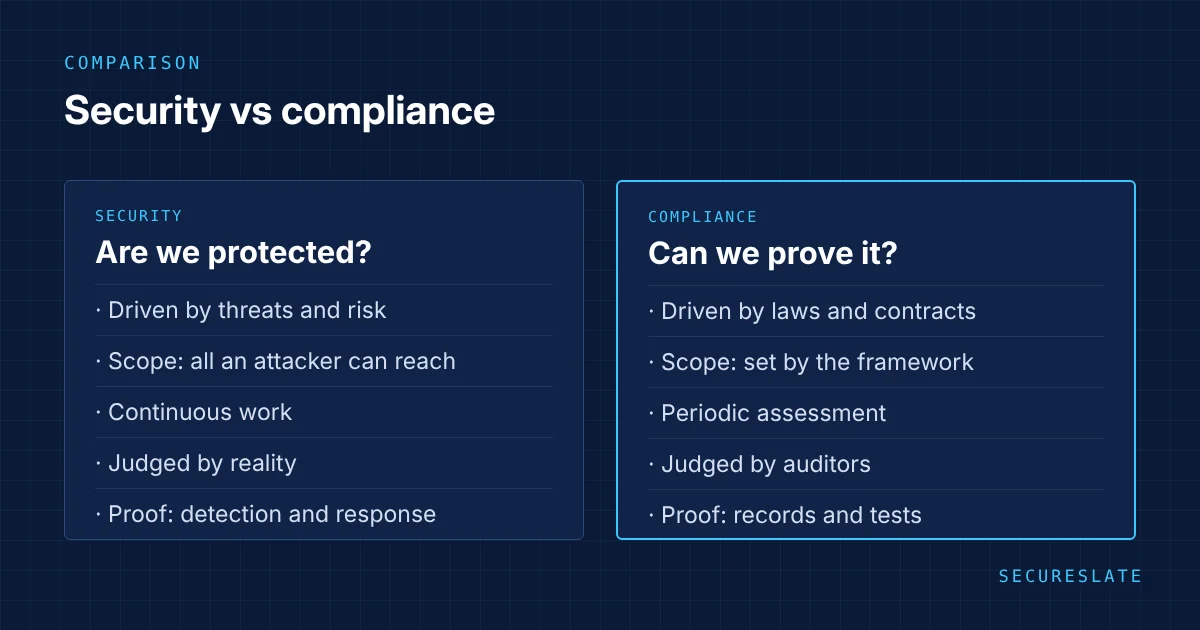
| Dimension | Security | Compliance |
|---|---|---|
| Main question | Are we protected? | Can we prove we meet the standard? |
| Driver | Threats and business risk | Laws, standards and contracts |
| Scope | Everything an attacker could reach | What the framework and the audit scope define |
| Pace | Continuous, changes with threats | Periodic, changes when the rules change |
| Judge | Reality, and attackers | Auditors, assessors, regulators, customers |
| Proof | Detection, response and resilience results | Documents, records and tested controls |
| Failure looks like | A breach or outage | A finding, a qualified report, a penalty or a lost deal |
| Typical owner | Security or engineering lead | Compliance or GRC lead |
The overlap is in the middle. Access control, encryption, logging, vulnerability management, incident response, vendor review and staff training appear in both columns. The same control serves both purposes when it is designed for the risk and documented for the audit. An access control policy, for example, is a security rule first and an audit document second.
Can a company be compliant but not secure?
Yes, because an audit confirms that specified controls existed and operated within a defined scope, not that the company is safe from every threat.
Several things create the gap:
- Scope. The company chooses, within limits, which systems and services an audit covers. A legacy system or a newly acquired product outside the scope gets no attention from the auditor, but attackers do not respect scope statements.
- Sampling. Auditors usually test a sample of records, such as a selection of new hires or change tickets. A sample can pass while exceptions exist elsewhere.
- Timing. A point-in-time assessment describes one day. A report over a period describes the past. Configuration can drift the week after the auditor leaves. The difference between report types is covered in SOC 2 Type 1 vs Type 2.
- Minimums. Frameworks set a baseline that applies to many kinds of organization. Your particular threats may call for more than the baseline.
- Paper controls. A policy can exist and be approved without matching what engineers actually do.
- New threats. Standards are revised over years. Attack techniques change much faster.
This is why "checkbox compliance" has a poor reputation. Treating the audit as the goal produces documents, while treating risk as the goal produces protection that also happens to satisfy the audit.
Can a company be secure but not compliant?
Yes, a technically strong team can still fail an audit or a customer review when its good practices are informal and unrecorded.
Common examples:
- Engineers review every production change, but approvals happen in chat and leave no retrievable record.
- Access is removed quickly when people leave, but there is no documented access review.
- The team knows its risks well, but there is no written risk assessment or treatment plan.
- Incidents are handled competently, but no incident log or post-incident review exists.
- Vendors are chosen carefully, but there is no vendor inventory or due diligence file.
- A law requires a specific document or agreement that was never put in place, whatever the technical controls.
The cost is real even without a breach: stalled enterprise deals, long security questionnaires, contract penalties or regulatory exposure. Compliance also adds things security teams sometimes skip, such as management oversight, training records, and the discipline of reviewing controls on a schedule.
How do common frameworks connect the two?
Most modern frameworks are risk-based, which means they expect you to do real security work and then prove it.
| Framework or law | Security expectation | How compliance is shown |
|---|---|---|
| SOC 2 | Controls that meet the AICPA Trust Services Criteria, with Security as the required category | An attestation report from an independent CPA firm |
| ISO/IEC 27001 | An information security management system with risk assessment and risk treatment, per ISO/IEC 27001 | Certification by a certification body, with surveillance audits |
| HIPAA Security Rule | Administrative, physical and technical safeguards, starting with an accurate and thorough risk analysis under 45 CFR 164.308 | Documentation kept by the organization and reviewed in investigations and audits by the regulator |
| GDPR | Technical and organisational measures that ensure "a level of security appropriate to the risk" under Article 32 of the GDPR | Accountability records that demonstrate compliance to supervisory authorities |
| NIST SP 800-53 | A catalog of security and privacy controls selected according to risk, per NIST SP 800-53 Rev. 5 | Assessment of the selected controls |
The pattern is consistent. None of these tells you exactly which firewall rule to write. They require you to understand your risks, choose suitable controls, operate them and keep evidence. That makes the frameworks a useful structure for a security program, as long as the risk assessment is honest and not written backwards from the control list.
How do you build one program that covers both?
Build a single control set from your risks, map frameworks onto it, and collect evidence as a by-product of normal operations.
- Start with a risk assessment. List the systems and data that matter, the threats to them and the likely impact. This drives security priorities and is also required by most frameworks.
- Define one control set. Write each control once, in terms of what your team actually does, such as "production access requires SSO with MFA and is reviewed quarterly."
- Map frameworks to controls. Link each control to every requirement it satisfies. Gaps show where a framework needs something you do not yet do.
- Give every control a named owner. One person is accountable for the control working and for its evidence.
- Automate evidence where systems allow. Pull configuration and activity records from cloud, identity, HR and code systems on a schedule instead of taking screenshots before an audit.
- Monitor continuously. Treat a failed control check like any other operational alert, with a ticket and a deadline.
- Test beyond the audit. Use vulnerability scanning, penetration testing and incident exercises to check whether controls hold up against realistic attacks. See penetration testing vs vulnerability scanning for how the two differ.
- Review and adjust. Revisit risks and controls after incidents, major changes and at least yearly.
Two measures help keep the balance. Track security outcomes, such as time to remediate serious vulnerabilities and time to remove leaver access. Track compliance health, such as the share of controls with current evidence and the number of overdue reviews. If the second set looks good while the first looks poor, the program has drifted toward paperwork.
How SecureSlate helps
SecureSlate is a compliance automation platform for small and mid-sized companies, with a focus on HealthTech. It is designed to let one set of controls serve both security and compliance:
- Multi-framework control mapping, so one control links to SOC 2, ISO 27001, HIPAA, HITRUST, GDPR, PCI DSS, NIST CSF and other built-in frameworks. Requirements outside the built-in list can be set up as a custom framework with custom controls.
- Agentless, read-only cloud integrations and a device agent that collect evidence from the systems you already run.
- Access reviews, risk management and vendor risk management tied to the same control library.
- Code security and secrets detection for engineering teams.
- Audit management, a trust center and security questionnaire automation to show customers and auditors what you do.
SecureSlate does not perform audits or issue certifications, and no tool removes the need for sound security decisions. You can try it with your own environment through a free trial.
FAQ
Is compliance the same as security?
No. Compliance shows that you meet a defined set of requirements at a point in time or over a period. Security is the ongoing protection of systems and data against actual threats. They share many controls, but a company can have one without the other.
Which should come first, security or compliance?
Security fundamentals should come first: an asset inventory, strong authentication, least privilege, patching, backups and logging. A framework then gives that work structure and a way to prove it. In practice many companies start because a customer asks for a report, and that is fine as long as the controls are built for real risk.
Does a SOC 2 report or ISO 27001 certificate mean a company is secure?
It means an independent party examined the controls in scope and reported on them. That is meaningful assurance, but it is limited to the scope, the period and the criteria of the assessment. Readers should check the scope and any exceptions noted in the report.
What is checkbox compliance?
Checkbox compliance means doing the minimum needed to pass an assessment, such as approving template policies nobody follows or gathering evidence once a year. It produces a report without much protection, and it tends to fail when auditors test whether controls actually operated.
How often should security controls be checked for compliance purposes?
It depends on the control and the framework. Many teams check configuration controls continuously or daily through automated monitoring, review access quarterly for sensitive systems, and review policies and the risk assessment at least yearly. Follow the frequencies your own policies state, because auditors test against them.
Disclaimer (legal note)
This article is for general information only and is not legal, regulatory, or professional advice. Requirements vary by framework, industry, and jurisdiction. Consult qualified advisors for your specific obligations.
Need compliance without the complexity?
SecureSlate automates ISO 27001, SOC 2, GDPR, HIPAA, and more. Built for growing teams. See it in action.
Find compliance gaps in 30 seconds