
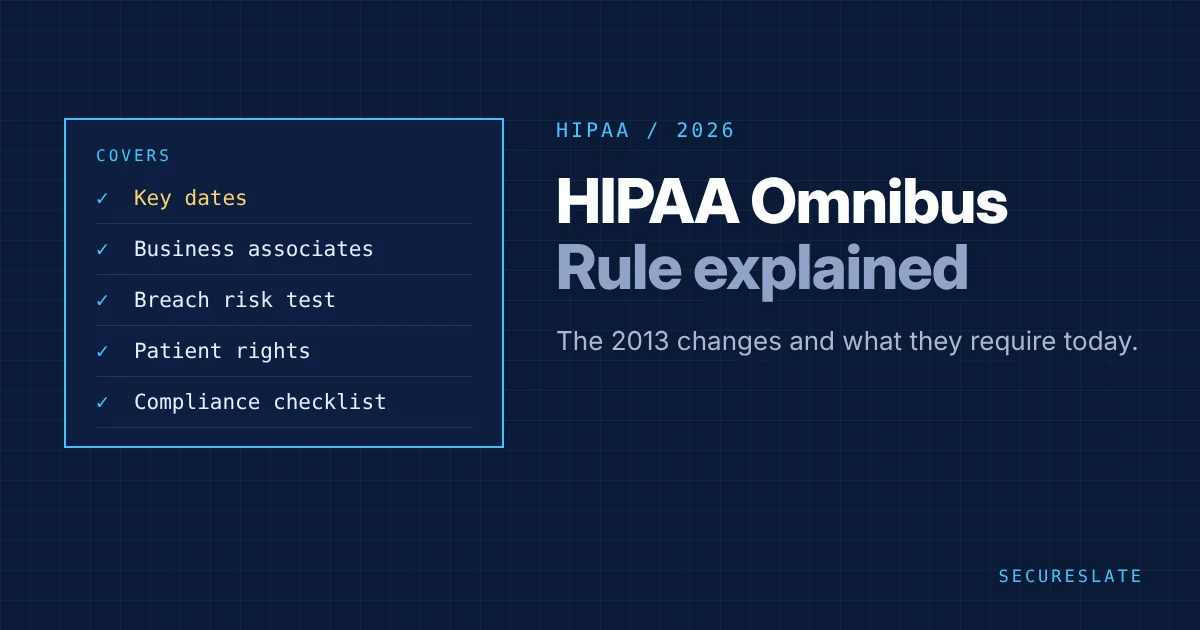
Short answer: The HIPAA Omnibus Rule is the 2013 final rule from HHS that put the HITECH Act changes into the HIPAA regulations. It made business associates and their subcontractors directly liable, replaced the breach "harm" test with a risk assessment, tightened marketing and sale of PHI, expanded patient rights and added genetic information protections.
Related guides: HIPAA vs. HITECH · HIPAA business associate agreements · HIPAA rules explained
Key takeaways
- The Omnibus Rule was published January 25, 2013, took effect March 26, 2013, and most requirements applied from September 23, 2013.
- Business associates and subcontractors became directly liable for Security Rule compliance and for parts of the Privacy Rule.
- A breach is now presumed unless a documented four-factor risk assessment shows a low probability that PHI was compromised.
- Patients gained the right to electronic copies and to restrict disclosures to health plans for care they paid for in full.
- The rule is not a historical footnote: its requirements still shape every BAA, breach decision and notice of privacy practices.
What is the HIPAA Omnibus Rule?
The Omnibus Rule is a single final rule that modified the HIPAA Privacy, Security, Enforcement and Breach Notification Rules at once, which is why it is called "omnibus." Its formal title is Modifications to the HIPAA Privacy, Security, Enforcement, and Breach Notification Rules Under the Health Information Technology for Economic and Clinical Health Act and the Genetic Information Nondiscrimination Act; Other Modifications to the HIPAA Rules, published in the Federal Register.
It did four main jobs:
- Finalized the HITECH Act's privacy, security and enforcement changes.
- Finalized the Breach Notification Rule, replacing the 2009 interim rule.
- Implemented the Genetic Information Nondiscrimination Act (GINA) for health plans.
- Made a set of smaller clarifications across the HIPAA Rules.
If you want the background on HITECH itself, see our comparison of HIPAA and HITECH.
When did the Omnibus Rule take effect?
The rule took effect on March 26, 2013, and covered entities and business associates had to comply with most provisions by September 23, 2013.
| Milestone | Date |
|---|---|
| Published in the Federal Register | January 25, 2013 |
| Effective date | March 26, 2013 |
| General compliance date | September 23, 2013 |
| Deadline to update qualifying existing BAAs (transition provision) | September 22, 2014 |
The transition provision let organizations keep using business associate agreements that were already in place and compliant with the old rules, as long as they were not renewed or modified, until the later deadline. All of those dates are long past, so every agreement in use today must meet the Omnibus requirements.
What changed for business associates and subcontractors?
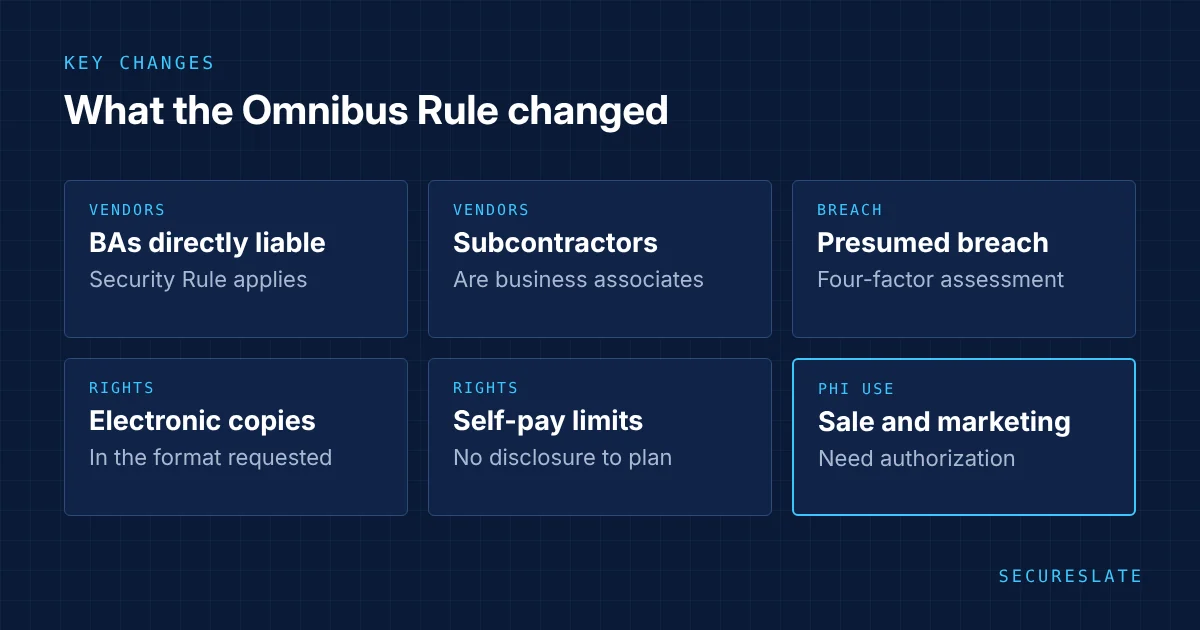
The biggest change was that business associates became directly liable under HIPAA, not only contractually liable to the covered entity. Before 2013, a cloud host or billing company that mishandled PHI mainly faced breach of contract claims. After the Omnibus Rule, OCR can enforce against the business associate directly.
What business associates must now do directly:
- Comply with the Security Rule for electronic PHI, including a risk analysis and safeguards.
- Follow the Privacy Rule limits on uses and disclosures that apply to them, including minimum necessary.
- Report breaches of unsecured PHI to the covered entity.
- Sign business associate agreements with their own subcontractors that handle PHI.
The rule also expanded the definition of business associate. Subcontractors that create, receive, maintain or transmit PHI on behalf of a business associate are business associates themselves, so the chain of liability follows the data. Data storage companies that maintain PHI, even if they never look at it, are business associates. Health information organizations and e-prescribing gateways were also named. Our guide to business associate agreements covers the required clauses.
How did the Omnibus Rule change breach notification?
The Omnibus Rule replaced the subjective "risk of harm" test with a presumption: any impermissible use or disclosure of PHI is a breach unless the organization shows a low probability that the PHI has been compromised. That showing must be based on a documented risk assessment that considers at least four factors:
- The nature and extent of the PHI involved, including identifiers and the likelihood of re-identification.
- The unauthorized person who used the PHI or to whom it was disclosed.
- Whether the PHI was actually acquired or viewed.
- The extent to which the risk to the PHI has been mitigated.
The rule also removed an exception for limited data sets that excluded dates of birth and ZIP codes. In practice, this means organizations need a repeatable assessment process and must keep the documentation. Notification timelines, such as 60 days for individuals, are covered in our guide to the HIPAA Breach Notification Rule.
Which patient rights and PHI limits changed?
The Omnibus Rule strengthened individual rights and narrowed several uses of PHI that did not need patient permission before. The main changes:
| Area | Change under the Omnibus Rule |
|---|---|
| Electronic copies | Individuals can get an electronic copy of PHI held electronically in a designated record set, in the form and format they request if readily producible |
| Self-pay restrictions | Providers must honor a request not to disclose PHI to a health plan for care the patient paid for in full out of pocket, unless law requires disclosure |
| Marketing | Authorization required for most treatment and health care operations communications when the covered entity is paid by a third party to send them |
| Sale of PHI | Prohibited without authorization, and the authorization must state that the entity is being paid |
| Fundraising | Every fundraising communication must give a clear opt-out, and treatment cannot be conditioned on the choice |
| Genetic information | Most health plans cannot use or disclose genetic information for underwriting (long-term care plans excepted) |
| Decedents | Information about a person who has been dead for more than 50 years is no longer PHI |
| Student immunizations | Proof of immunization can go to a school with documented agreement from a parent or the student, without a written authorization |
| Research | Compound authorizations for research are allowed in more cases |
| Notice of privacy practices | Notices had to be updated to describe these rights and limits |
Several of these remain common gaps. In our experience, providers often struggle with self-pay restrictions because billing systems send claims automatically. The right to electronic copies is now part of the broader HIPAA right of access.
How did enforcement and penalties change?
The Omnibus Rule wrote the HITECH Act's tiered civil money penalty structure into the Enforcement Rule. Penalties now scale with culpability, from violations the organization did not know about, through reasonable cause, to willful neglect that is corrected or left uncorrected. Each tier has a per-violation range and an annual cap for identical violations.
The rule also requires OCR to investigate complaints and compliance reviews where a preliminary review suggests possible willful neglect, and it lets OCR resolve lower-culpability cases informally. Penalty amounts are adjusted for inflation every year, so use the current figures in the HHS adjustment table rather than the 2013 numbers. A business associate is also liable for the acts of its own agents, such as subcontractors acting within the scope of agency.
Omnibus Rule compliance checklist for today
Use this checklist to confirm the Omnibus Rule requirements are still working in your program:
- Inventory business associates and subcontractors. Confirm every vendor that touches PHI has a current BAA, and that your vendors flow the terms down to their subcontractors.
- Review BAA language. Agreements should require Security Rule compliance, breach reporting to you, and subcontractor agreements.
- Document breach risk assessments. Use the four factors for every incident and keep the records.
- Test self-pay restriction handling. Make sure billing and claims systems can stop a disclosure to a health plan when a patient pays in full.
- Check electronic access workflows. Confirm you can deliver electronic copies in the requested format when readily producible.
- Audit marketing and fundraising. Confirm authorizations for paid communications and an opt-out in every fundraising message.
- Update the notice of privacy practices whenever your practices change, and confirm it describes the Omnibus rights.
- Train the workforce on the breach presumption and on when to escalate an incident.
How SecureSlate helps
SecureSlate includes HIPAA as a built-in framework with mapped controls, so the Omnibus requirements sit inside the same control library you use for SOC 2 or ISO 27001. Vendor risk management tracks business associates, their agreements and their security reviews. Risk management records incident assessments, audit management keeps documentation organized, and agentless read-only cloud integrations and the device agent collect technical evidence for the Security Rule safeguards that business associates must meet.
Start a free trial to map your HIPAA program. SecureSlate does not perform audits or issue certifications.
FAQ
Is the HIPAA Omnibus Rule still in effect?
Yes. Its changes are part of the current HIPAA regulations at 45 CFR Parts 160 and 164. Later rules have amended some sections, but the Omnibus requirements still apply.
Did the Omnibus Rule make business associates directly liable?
Yes. Business associates and their subcontractors are directly liable for Security Rule compliance, for impermissible uses and disclosures, and for other listed requirements.
What is the four-factor risk assessment?
It is the test used to decide whether an impermissible use or disclosure is a reportable breach. It looks at the PHI involved, who received it, whether it was actually viewed and how well the risk was mitigated.
Is HITECH the same as the Omnibus Rule?
No. HITECH is the 2009 law. The Omnibus Rule is the 2013 regulation that implemented many of HITECH's requirements, along with GINA protections.
Do subcontractors need a BAA?
Yes. A business associate must have a business associate agreement with any subcontractor that creates, receives, maintains or transmits PHI on its behalf.
Disclaimer (legal note)
This article is for general information only and is not legal, regulatory, or professional advice. Requirements vary by framework, industry, and jurisdiction. Consult qualified advisors for your specific obligations.
Need compliance without the complexity?
SecureSlate automates ISO 27001, SOC 2, GDPR, HIPAA, and more. Built for growing teams. See it in action.
Find compliance gaps in 30 seconds