
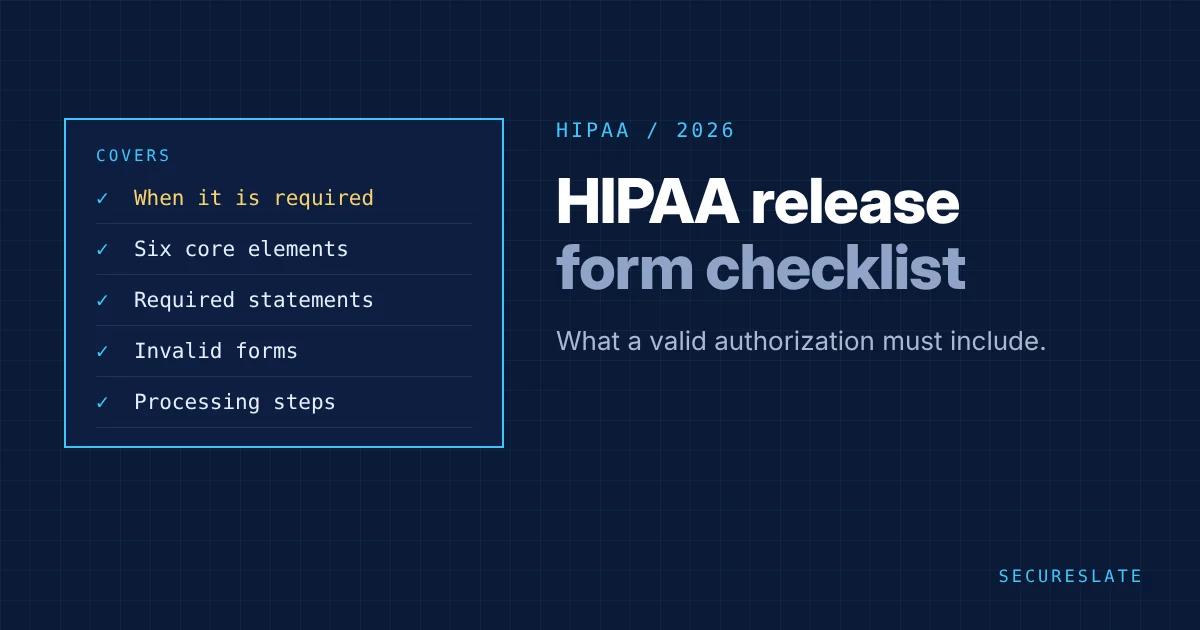
Short answer: A HIPAA release form, formally called an authorization, is a signed document that lets a covered entity use or disclose a person's protected health information for a purpose HIPAA does not otherwise permit. To be valid it must contain the core elements and required statements in 45 CFR 164.508, be written in plain language, and be signed and dated.
Related guides: HIPAA permitted uses and disclosures · HIPAA right of access · What is considered PHI
Key takeaways
- You need an authorization only when no other HIPAA permission covers the use or disclosure.
- A valid form has six core elements and three required statements, in plain language.
- Forms are invalid if they are expired, incomplete, revoked, improperly combined or known to be false.
- A patient asking for their own records uses the right of access, not a release form.
- Keep signed authorizations for at least six years from creation or last effective date.
What is a HIPAA release form?
A HIPAA release form is a written permission from an individual that allows a covered entity, such as a provider or health plan, to use or share specific PHI for a specific purpose. HIPAA calls this an "authorization," and the rules are in 45 CFR 164.508.
HHS does not publish a mandatory form. Each organization drafts its own, so the content matters more than the layout. A form that looks official but misses a required element is not valid, while a plain one-page document that meets every requirement is.
When is a HIPAA authorization required?
An authorization is required whenever a use or disclosure is not permitted or required by another part of the Privacy Rule. Treatment, payment and health care operations, and a list of public interest purposes, do not need one.
| Situation | Authorization needed? |
|---|---|
| Sending records to another doctor treating the patient | No, treatment is permitted |
| Billing the patient's health plan | No, payment is permitted |
| Reporting to public health authorities as required by law | No, a public interest disclosure |
| Sending test results to the patient's employer | Yes |
| Giving records to a life insurer for an application | Yes |
| Most marketing communications | Yes |
| Selling PHI | Yes, and the form must say the entity is paid |
| Using or disclosing psychotherapy notes (with narrow exceptions) | Yes |
| Disclosing to a lawyer for a personal injury claim | Yes, unless another permission such as a court order applies |
| Patient wants their own records | No, this is a right of access request |
For the full list of disclosures that do not need permission, see our guide to HIPAA permitted uses and disclosures. Even with a valid authorization, only the information the form describes may be disclosed.
What must a valid HIPAA release form include?
A valid HIPAA release form must include six core elements and three required statements, and it must be written in plain language. Use this checklist when drafting or reviewing a form.
Core elements (45 CFR 164.508(c)(1)):
- A specific and meaningful description of the information to be used or disclosed
- The name or specific identification of the person or class of persons authorized to make the disclosure
- The name or specific identification of the recipients
- A description of each purpose (or "at the request of the individual" when the individual starts the request and does not want to give a reason)
- An expiration date or event that relates to the individual or the purpose (for research, "end of the research study" or "none" can be used)
- The signature of the individual and the date, plus a description of the representative's authority if someone signs on their behalf
Required statements (164.508(c)(2)):
- The individual's right to revoke in writing, the exceptions to that right, and how to revoke (or a reference to the notice of privacy practices if it explains this)
- Whether treatment, payment, enrollment or eligibility can be conditioned on signing, and the consequences of refusing where conditioning is allowed
- That information disclosed may be redisclosed by the recipient and may no longer be protected by HIPAA
The covered entity must give the individual a copy of the signed authorization when it is the one asking for it. Forms for marketing that involves payment, and for the sale of PHI, must also state that remuneration is involved.
Release form or right of access request?
A patient who wants their own records, or wants them sent to a third party they choose, is usually exercising the right of access, not signing an authorization. The difference matters because the rules for each are different.
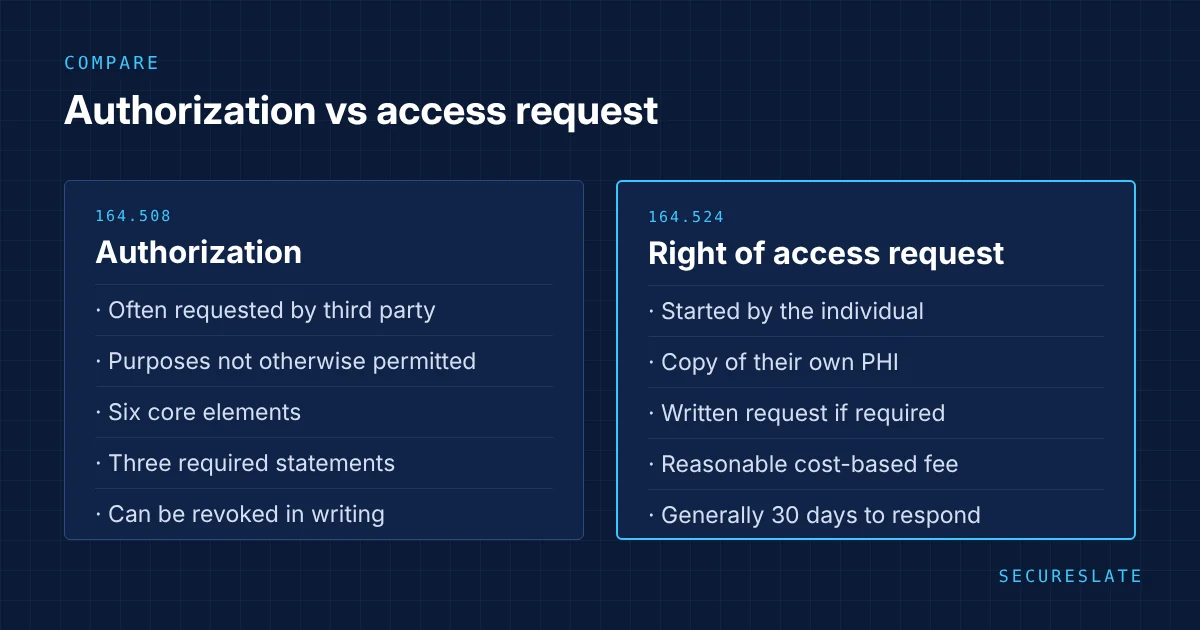
| Authorization (release form) | Right of access request | |
|---|---|---|
| Rule | 45 CFR 164.508 | 45 CFR 164.524 |
| Who starts it | Often a third party or the covered entity | The individual |
| Purpose | Any purpose not otherwise permitted | Getting a copy of one's own PHI |
| Content requirements | Six core elements, three statements | Written request, if the entity requires one |
| Can the entity refuse? | It may choose not to disclose | Only on limited grounds in the rule |
| Fees | Not restricted the same way | Limited to a reasonable, cost-based fee |
| Deadline | None set in HIPAA | Generally 30 days, with one 30-day extension |
In our experience, a common mistake is forcing patients to fill in a full authorization form before releasing their own records, which can delay access. Our guide to the HIPAA right of access covers fees and timelines.
What makes a release form invalid?
Under 164.508(b)(2), an authorization is defective, and cannot be relied on, if any of these are true:
- The expiration date has passed or the expiration event is known to have happened.
- The form is not filled out completely for any core element or required statement.
- The individual has revoked it.
- It is improperly combined with another document (a compound authorization not allowed by the rule).
- Any material information in it is known by the covered entity to be false.
Compound authorizations are mostly not allowed. For example, an authorization for psychotherapy notes can only be combined with another authorization for psychotherapy notes. Research authorizations have more flexibility, which the Omnibus Rule expanded.
Can you require someone to sign?
Generally no. A covered entity cannot condition treatment, payment, enrollment in a health plan or eligibility for benefits on signing an authorization. There are three narrow exceptions in 164.508(b)(4):
| Exception | Example |
|---|---|
| Research-related treatment | A clinical trial can require authorization to use PHI for the research |
| Health plan enrollment or eligibility | A plan can ask for authorization before enrollment for underwriting or risk rating, but not for psychotherapy notes, and not to use genetic information for underwriting |
| Services provided solely to create PHI for a third party | A pre-employment physical can be conditioned on authorization to send results to the employer |
Revocation must be in writing. It stops future disclosures but does not undo disclosures already made in reliance on the form.
How to process and store release forms
A simple, consistent workflow prevents most release form problems:
- Verify identity and authority. Confirm who the individual is, and for a representative, check documents that show their authority.
- Check the form against the checklist. Every core element and statement must be complete. Return incomplete forms rather than guessing.
- Confirm it is still valid. Check the expiration and whether a revocation is on file.
- Disclose only what is described. Pull only the records the form covers. The minimum necessary rule does not apply to disclosures made under an authorization, but the scope of the form does.
- Send securely. Use encrypted email, a portal or tracked mail.
- Log the disclosure. Record what was sent, to whom and when.
- Retain the form. Keep the signed authorization for at least six years from the date it was created or last in effect, as 45 CFR 164.530(j) requires. State law may require longer.
How SecureSlate helps
SecureSlate includes HIPAA as a built-in framework, so authorization policies, workforce training and documentation controls are mapped and tracked alongside your other HIPAA safeguards. Audit management keeps procedures and evidence in one place, access reviews help confirm only the right staff can reach records systems, and agentless read-only cloud integrations collect evidence that systems holding forms and PHI are configured securely. Vendor risk management tracks the business associates who handle release requests on your behalf.
Start a free trial to organize your HIPAA program. SecureSlate does not provide legal advice or review individual forms.
FAQ
Is a HIPAA release form the same as an authorization?
Yes. "Release form" is the everyday name. HIPAA uses the term "authorization" and sets the requirements in 45 CFR 164.508.
Does a HIPAA authorization have to expire?
It must include an expiration date or event. The event must relate to the individual or the purpose. For research, "end of the research study" or "none" is allowed.
Can a HIPAA authorization be signed electronically?
Yes. HHS has said electronic signatures can be valid under HIPAA if they meet applicable law, such as federal and state e-signature laws.
How does a patient revoke a HIPAA release?
In writing, following the process described on the form or in the notice of privacy practices. Revocation does not cover disclosures already made in reliance on the form.
Do I need a release form to send records to another provider?
Not for treatment. Disclosures for treatment are permitted without authorization, although state laws for some record types can be stricter.
Disclaimer (legal note)
This article is for general information only and is not legal, regulatory, or professional advice. Requirements vary by framework, industry, and jurisdiction. Consult qualified advisors for your specific obligations.
Need compliance without the complexity?
SecureSlate automates ISO 27001, SOC 2, GDPR, HIPAA, and more. Built for growing teams. See it in action.
Find compliance gaps in 30 seconds