
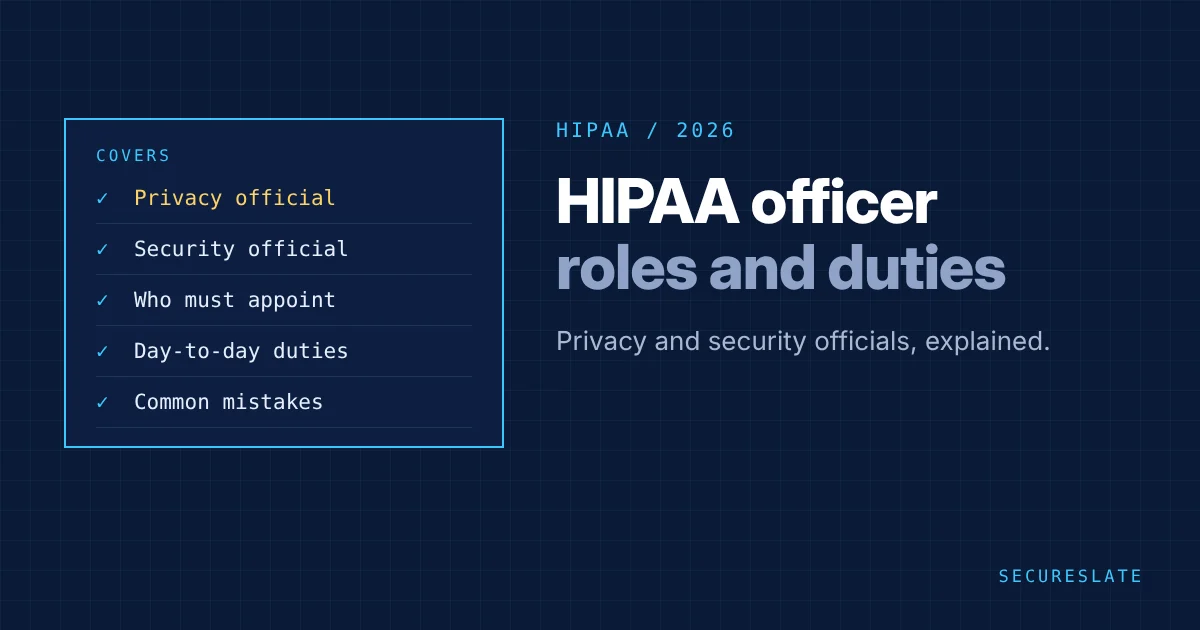
Short answer: A HIPAA officer is the person an organization names as responsible for its HIPAA program. The rules require two designations: a privacy official under the Privacy Rule and a security official under the Security Rule. One person can hold both roles. They own policies, risk analysis, training, complaints and breach response, and they must be documented in writing.
Related guides: HIPAA administrative safeguards · HIPAA security risk assessment template · HIPAA incident response plan
Key takeaways
- HIPAA requires a security official for covered entities and business associates, and a privacy official plus a complaint contact for covered entities.
- HHS guidance confirms the privacy and security official can be the same person, which is common in small practices and startups.
- The officer is accountable for the program, but specific tasks can be delegated to IT, engineering, HR or outside advisors.
- The designation must be documented and the records kept for six years.
- An officer without authority, time or a budget is a paper role. Auditors and investigators look at whether the program actually runs.
What is a HIPAA officer?
A HIPAA officer is the named individual who is accountable for developing and running the policies and procedures HIPAA requires. The regulation itself does not use the job title "HIPAA officer". It uses two terms:
- Privacy official. Under 45 CFR 164.530(a), a covered entity must designate a privacy official responsible for developing and implementing its privacy policies and procedures. It must also designate a contact person or office that receives complaints and can answer questions about the Notice of Privacy Practices.
- Security official. Under 45 CFR 164.308(a)(2), a covered entity or business associate must identify the security official responsible for developing and implementing the policies and procedures required by the Security Rule.
In practice, "HIPAA officer", "HIPAA compliance officer", "privacy officer" and "security officer" are all used for these designations. What matters legally is that someone is clearly named for each, and that the naming is written down.
Privacy officer vs security officer: what is the difference?
The privacy officer governs how protected health information (PHI) is used and disclosed in any form, while the security officer protects electronic PHI (ePHI) through administrative, physical and technical safeguards.
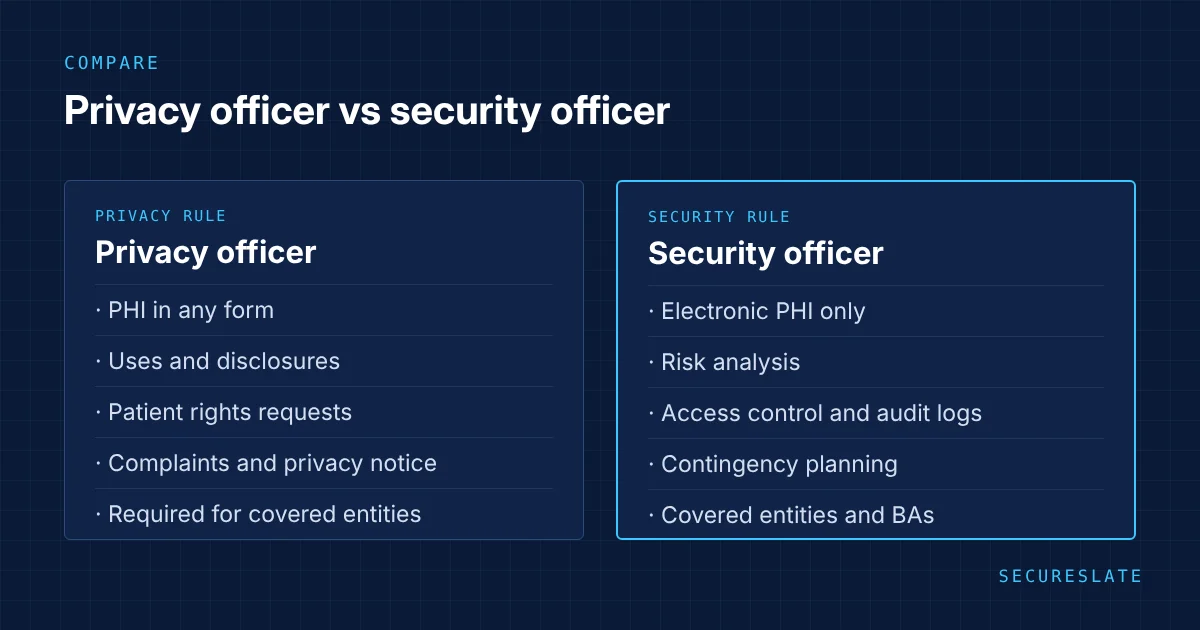
| Area | Privacy officer | Security officer |
|---|---|---|
| Rule | Privacy Rule (45 CFR Part 164, Subpart E) | Security Rule (45 CFR Part 164, Subpart C) |
| Scope of data | PHI in any form: paper, spoken, electronic | Electronic PHI only |
| Who must designate | Covered entities | Covered entities and business associates |
| Core focus | Uses and disclosures, patient rights, notice of privacy practices, complaints | Risk analysis, access control, audit logs, encryption, contingency planning |
| Typical partners | Legal, front office, HR, customer support | IT, engineering, DevOps, vendors that host ePHI |
| Typical evidence | Privacy policies, disclosure logs, complaint records, training records | Risk analysis, risk management plan, access reviews, system activity reviews |
Both roles meet in the middle on breach response, workforce training, vendor management and documentation. That overlap is why many smaller organizations give both designations to one person.
HHS says this directly. Its administrative safeguards guidance states that the security official and privacy official can be the same person, but are not required to be.
Does every organization need a HIPAA officer?
Every covered entity needs both designations, and every business associate needs at least a security official.
| Organization type | Privacy official | Security official |
|---|---|---|
| Health care provider that bills electronically (covered entity) | Required | Required |
| Health plan or clearinghouse (covered entity) | Required | Required |
| Business associate, such as a SaaS vendor hosting ePHI | Not required by 164.530, often named anyway | Required |
| Subcontractor of a business associate that handles ePHI | Not required by 164.530, often named anyway | Required |
A HealthTech startup that stores PHI for clinics is usually a business associate. It must name a security official, and in our experience most also name a privacy lead, because their business associate agreements commit them to privacy obligations and customers ask who owns them.
Size changes how the role looks, not whether it exists. HHS describes a small practice where the privacy official is an office manager with other duties, and a large plan where it is a full-time position with staff. If you are unsure whether you are a covered entity or business associate, start with our HIPAA regulations and rules explained guide.
What does a HIPAA officer do day to day?
The officer keeps the HIPAA program running between audits: policies current, risks assessed, people trained and incidents handled on time.
Use this checklist to see whether the role is doing its job:
- Maintain policies and procedures. Keep privacy and security policies current, approved and available to the workforce, and update them when systems or law change.
- Run the security risk analysis. The Security Rule requires an accurate and thorough risk analysis of ePHI (164.308(a)(1)(ii)(A)) and ongoing risk management.
- Train the workforce. Covered entities must train workforce members on privacy policies (164.530(b)), and the Security Rule requires a security awareness and training program.
- Handle complaints and patient rights requests. Route access, amendment and accounting requests, and log complaints and how they were resolved.
- Manage business associates. Make sure a business associate agreement is in place before a vendor touches PHI, and review vendor security.
- Lead incident and breach response. Assess incidents, decide whether a breach of unsecured PHI occurred, and meet notification deadlines. Covered entities must notify affected individuals without unreasonable delay and no later than 60 calendar days after discovery (164.404).
- Review access and activity. Make sure access to ePHI follows least privilege and that system activity is reviewed.
- Keep documentation. Policies, risk analyses, training records and designations must be retained for six years from creation or last effective date, whichever is later.
A practical tip: write these duties into the officer's job description with a cadence for each, such as quarterly access reviews and yearly policy review. It makes the role easier to hand over and easier to evidence.
How do you appoint a HIPAA officer?
You appoint a HIPAA officer by naming the person in writing, giving them authority and time, and recording the designation in your HIPAA documentation.
- Decide on one role or two. Small teams usually combine them. Larger organizations or those with heavy patient interaction often split them.
- Pick someone with authority. The officer must be able to change processes and escalate to leadership. A junior hire without a reporting line to the executive team will struggle.
- Write the designation. A short memo or board resolution naming the person, the role, the start date and the scope is enough. 164.530(a)(2) requires covered entities to document personnel designations.
- Name a backup. Breaches do not wait for holidays. Name a deputy who can act when the officer is away.
- Tell the workforce and customers. Staff need to know who to report incidents to, and customers will ask in security questionnaires.
- Review the appointment yearly and whenever the person leaves or changes role.
Some organizations use an outside consultant as a virtual HIPAA officer. That can work, but accountability still sits with your organization, and someone internal should own day-to-day decisions.
What skills and background should a HIPAA officer have?
A good HIPAA officer combines working knowledge of the HIPAA rules with enough operational and technical understanding to see where PHI actually flows.
There is no certification required by law. Useful traits include:
- Familiarity with the Privacy, Security and Breach Notification Rules
- Understanding of the systems that store or transmit PHI, such as EHRs, cloud hosting, email and support tools
- Ability to run a risk analysis and translate findings into a plan
- Clear writing for policies and training
- Calm judgment in incidents, and comfort working with legal counsel
For the security role in a software company, someone from security or platform engineering often fits best. For the privacy role in a clinic, the practice manager or compliance lead is common. See our guide to HIPAA administrative safeguards for the safeguards the security officer typically owns.
Common mistakes with the HIPAA officer role
The most common mistake is naming an officer on paper and never giving them the time or authority to run the program.
- No written designation. Everyone "knows" who handles HIPAA, but nothing is documented.
- Stale ownership. The named person left the company and no one updated the record.
- Security delegated to a vendor entirely. Cloud and IT providers help, but your organization still has to identify its own security official.
- Risk analysis done once. The analysis should be reviewed and updated as systems and risks change, not filed after the first audit.
- No incident path. Staff do not know who to call, so incidents surface late and notification clocks run down.
- Evidence scattered across inboxes. When OCR or a customer asks, the officer cannot show training, reviews or decisions.
How SecureSlate helps
SecureSlate gives your HIPAA officer one place to run the program. The built-in HIPAA framework maps controls to the Privacy and Security Rule requirements and to SOC 2 or ISO 27001 if you need them too. You can run access reviews, manage business associates through vendor risk management, keep a risk register, and collect evidence through agentless, read-only cloud integrations and a device agent. A trust center and security questionnaire automation help answer the "who owns HIPAA here?" question for customers. SecureSlate does not perform audits or make legal determinations.
FAQ
Is a HIPAA officer required by law?
Yes. Covered entities must designate a privacy official and a complaint contact, and both covered entities and business associates must identify a security official.
Can the privacy officer and security officer be the same person?
Yes. HHS guidance states the two roles can be held by the same person but do not have to be. Many small practices and startups combine them.
Can a HIPAA officer be outsourced?
An outside consultant can perform much of the work, but the organization remains responsible for compliance. Keep an internal owner who can make decisions and approve changes.
Do business associates need a privacy officer?
The privacy official requirement in 45 CFR 164.530 applies to covered entities. Business associates must name a security official, and many also name a privacy lead to manage obligations in their business associate agreements.
How long must HIPAA officer records be kept?
HIPAA documentation, including personnel designations, must be retained for six years from the date it was created or last in effect, whichever is later.
Disclaimer (legal note)
This article is for general information only and is not legal, regulatory, or professional advice. Requirements vary by framework, industry, and jurisdiction. Consult qualified advisors for your specific obligations.
Need compliance without the complexity?
SecureSlate automates ISO 27001, SOC 2, GDPR, HIPAA, and more. Built for growing teams. See it in action.
Find compliance gaps in 30 seconds