
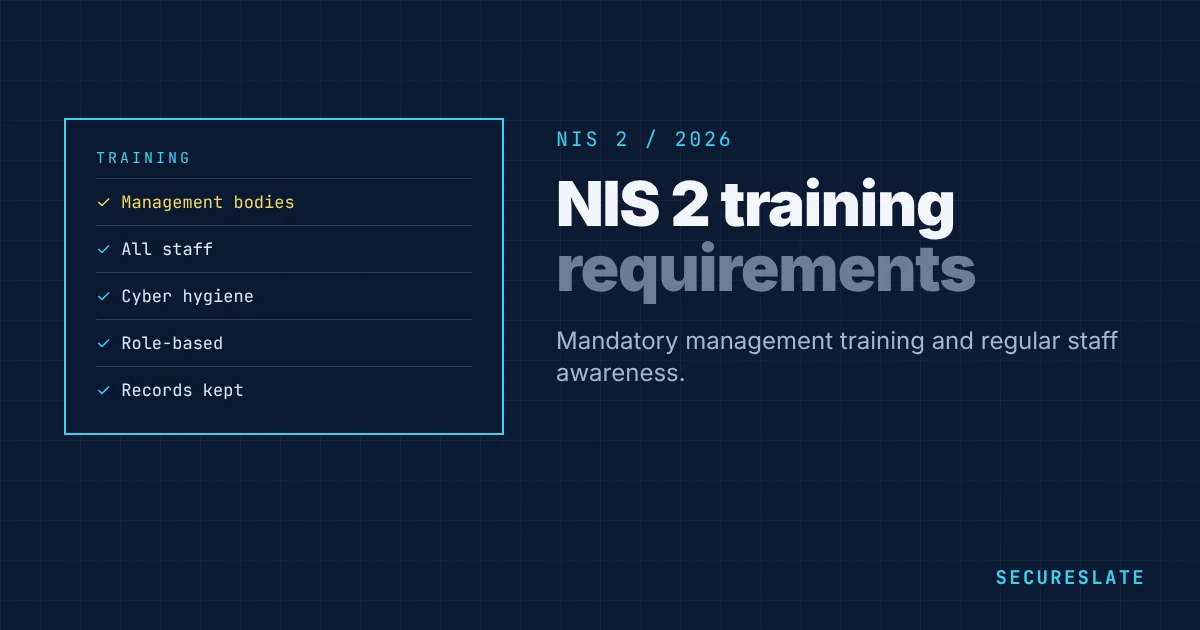
NIS 2 training requirements apply at two levels. Article 20(2) of Directive (EU) 2022/2555 says members of the management bodies of essential and important entities are required to follow training so they can identify risks and assess cybersecurity risk management practices. It also says entities should encourage similar training for employees on a regular basis. Article 21(2)(g) adds basic cyber hygiene practices and cybersecurity training as one of the ten minimum security measures. This guide explains what each requirement means, what training should cover, how often to run it and how to keep evidence for supervisors.
Related guides: NIS 2 controls · Incident management policy · Does your team need SOC 2 training? · GRC career roadmap
National transposition laws can add detail, such as training frequency. Check the law in each member state where you operate.
Key takeaways
- Management body members must be trained to understand and assess cybersecurity risks and measures.
- Employee training should be offered regularly, and cyber hygiene and training are part of the Article 21 measures.
- Management training focuses on governance, risk, oversight and liability; staff training focuses on daily practices and reporting.
- Keep records of attendance, content, dates and assessments.
- Some national laws set specific frequencies; in the absence of rules, yearly training is a sensible minimum.
What the directive says
| Provision | Requirement |
|---|---|
| Article 20(1) | Management bodies approve cybersecurity risk management measures, oversee implementation and can be held liable |
| Article 20(2) | Members of management bodies are required to follow training; entities are encouraged to offer similar training to employees regularly |
| Article 21(2)(g) | Basic cyber hygiene practices and cybersecurity training are among the minimum measures |
Management bodies include boards and executive leadership as defined by national corporate law. Liability rules, and in some cases temporary bans on exercising managerial functions for essential entities, make this training important for executives personally.
Management body training
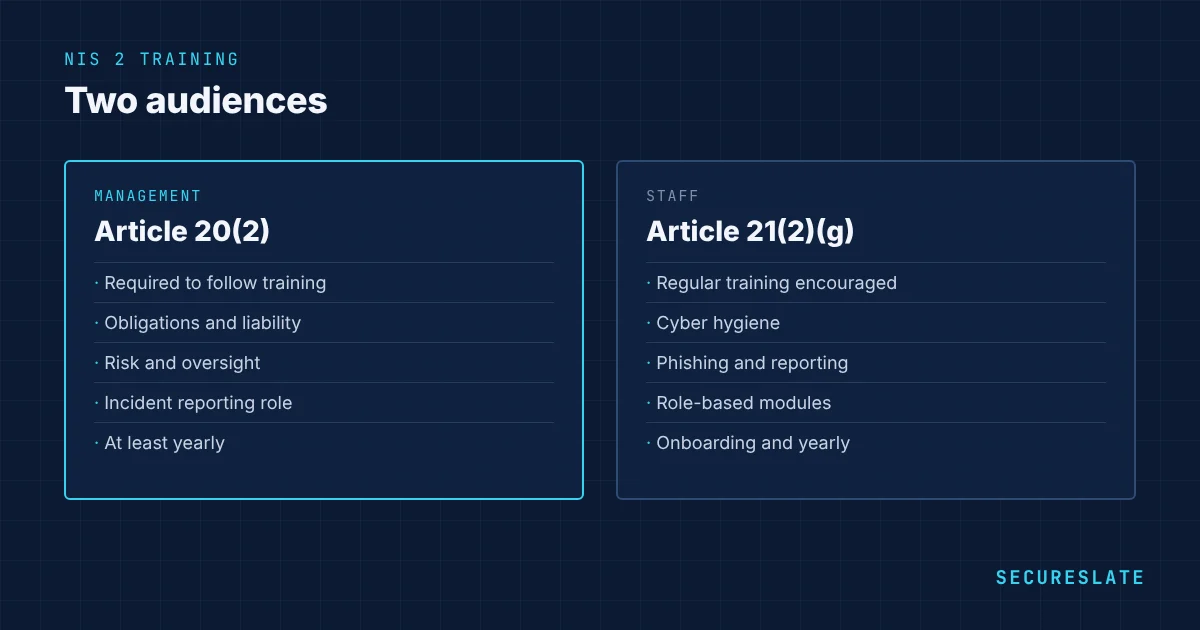
Management training should give leaders enough knowledge to make informed decisions and challenge their teams. Typical topics:
| Topic | What leaders should understand |
|---|---|
| NIS 2 obligations | Scope, entity category, supervision, fines and personal liability |
| Threat landscape | Current threats to the sector, such as ransomware and supply chain attacks |
| Risk management | How cyber risks are identified, assessed and treated; risk appetite |
| The ten Article 21 measures | What each requires and the organization's status |
| Incident reporting | 24-hour, 72-hour and one-month timelines and leadership's role |
| Supply chain | Dependence on critical suppliers and how they are assessed |
| Business continuity | Recovery capabilities and crisis decision-making |
| Oversight | Which metrics to review and questions to ask |
Format: a half-day workshop or a series of shorter sessions, ideally with a tabletop exercise in which leaders practice decisions during a simulated incident.
Employee training
Employee training should cover cyber hygiene and role-specific responsibilities:
| Audience | Topics |
|---|---|
| All staff | Phishing and social engineering, passwords and MFA, device security, safe data handling, reporting incidents |
| IT and engineering | Secure configuration, patching, secure development, access management, logging |
| Incident responders | Incident procedures, evidence handling, reporting timelines |
| Procurement | Supplier security requirements and assessments |
| Executives' assistants and finance | Business email compromise and payment fraud |
Cyber hygiene practices
Cyber hygiene usually includes:
- Using strong, unique passwords and MFA
- Keeping devices and software updated
- Locking screens and protecting devices
- Recognizing and reporting phishing
- Using approved tools and storage
- Backing up data according to policy
- Following least privilege
- Reporting lost devices and suspected incidents immediately
ENISA publishes guidance on cyber hygiene and awareness that can help shape programs.
Frequency
| Training | Recommended frequency |
|---|---|
| Management body training | At onboarding to the board or leadership role and at least yearly |
| All-staff awareness | At onboarding and at least yearly, with short monthly or quarterly refreshers |
| Phishing simulations | Regularly, for example monthly or quarterly |
| Role-based technical training | Yearly and when tools or threats change |
| Incident response exercises | At least yearly |
Evidence to keep
- Training plan approved by management
- Attendance records with names, roles and dates
- Course content and version
- Assessment or quiz results
- Phishing simulation results and follow-up
- Management body training records and minutes of discussions
- Records of tabletop exercises and lessons learned
Supervisory authorities may ask for this evidence, particularly for essential entities subject to proactive supervision.
Building the program
- Identify audiences and their responsibilities.
- Define learning objectives for each audience.
- Choose formats: workshops for leaders, short e-learning for staff, hands-on sessions for technical teams.
- Schedule onboarding, yearly and refresher training.
- Track completion and results in one system.
- Measure effectiveness through phishing results, incident reports and assessments.
- Update content when threats, systems or laws change.
Common mistakes
- Treating management training as a one-off slide deck
- Generic content that ignores the organization's sector and risks
- No records, so compliance cannot be shown
- Training without follow-up on phishing failures
- Excluding contractors who have system access
Sample yearly training plan
| Month | Activity | Audience |
|---|---|---|
| January | Management body workshop on NIS 2 duties and current threats | Board and executives |
| February | All-staff awareness module and policy acknowledgment | All staff and contractors |
| March | Phishing simulation and follow-up micro-training | All staff |
| April | Secure development training | Engineering |
| May | Incident response tabletop including 24-hour and 72-hour reporting | Management and responders |
| June | Phishing simulation | All staff |
| September | Supplier security training | Procurement and business owners |
| October | Refresher for management on risk metrics and oversight | Board and executives |
| November | Phishing simulation and awareness month activities | All staff |
| December | Review of training results and plan for next year | Security and management |
Measuring training effectiveness
| Measure | Target example |
|---|---|
| Completion within deadline | Above 95% |
| Phishing simulation click rate | Falling over time |
| Phishing report rate | Rising over time |
| Management attendance | 100% of management body members |
| Incident reporting time by staff | Faster after training |
| Assessment scores | Above an agreed pass mark |
Training for third parties
Contractors, managed service providers and other third parties with access to in-scope systems should receive relevant training or provide evidence of equivalent training. Include this in contracts and onboarding checklists, and track completion alongside employee training so supervisors see a complete picture.
How SecureSlate helps
SecureSlate helps NIS 2 entities run and evidence training. Assign security awareness training to staff and contractors, track completion and policy acknowledgments, record management body training, and connect training evidence to Article 21 measures and ISO 27001 controls through multi-framework mapping, at a price suited to small and mid-size organizations.
FAQ
Is cybersecurity training mandatory under NIS 2?
Yes for members of management bodies, who are required to follow training. Entities are encouraged to train employees regularly, and cyber hygiene and training are part of the Article 21 minimum measures.
How often should NIS 2 training happen?
The directive does not set a frequency, but national laws may. Yearly training with regular refreshers is a common baseline.
What should management training cover?
NIS 2 obligations and liability, threats, risk management, the Article 21 measures, incident reporting, supply chain risk, continuity and oversight.
Do contractors need NIS 2 training?
If contractors access systems or data in scope, they should receive relevant training under your security measures.
What evidence of training should we keep?
Training plans, attendance records, content versions, assessment results, phishing simulation results and exercise records.
Can training be delivered online?
Yes. Online modules work well for staff awareness. Management training benefits from interactive sessions where leaders can ask questions and practice decisions.
Does NIS 2 specify training content?
No. The directive sets the obligation; content should reflect your risks, sector and the Article 21 measures.
Disclaimer (legal note)
This article is for general information only and is not legal, regulatory, or professional advice. Requirements vary by framework, industry, and jurisdiction. Consult qualified advisors for your specific obligations.
Need compliance without the complexity?
SecureSlate automates ISO 27001, SOC 2, GDPR, HIPAA, and more. Built for growing teams. See it in action.
Find compliance gaps in 30 seconds