
Short answer: SOC 2 expects a documented, tested disaster recovery plan whenever the Availability category is in scope, through criteria A1.2 and A1.3. Even a Security-only report touches recovery through CC7.5 and CC9.1. Auditors want to see backups that work, recovery objectives tied to your commitments, and at least one recorded recovery test in the period.
Related guides: How to develop a disaster recovery plan · Business continuity vs disaster recovery · Backup and recovery policy
Key takeaways
- Disaster recovery is explicitly covered by the Availability criteria: A1.2 covers backups and recovery infrastructure, and A1.3 requires testing recovery plan procedures.
- The Security category still matters: CC7.5 covers recovery from security incidents and CC9.1 covers risks from business disruption.
- SOC 2 does not set fixed RTO or RPO values. You set them from your customer commitments and then prove you can meet them.
- For a Type 2 report, auditors test whether backups and recovery tests actually happened during the observation period.
- Your cloud provider's resilience helps, but it does not replace your own plan, backups and tests.
Is disaster recovery required for SOC 2?
Disaster recovery is required if Availability is in scope, and it is strongly expected even when it is not. The AICPA Trust Services Criteria put recovery in several places:
| Criterion | Category | What it covers | What it means for DR |
|---|---|---|---|
| A1.1 | Availability | Monitoring capacity and planning for demand | Know your capacity limits before an outage, not during it |
| A1.2 | Availability | Environmental protections, software, data backup processes and recovery infrastructure | Backups, redundant infrastructure and recovery tooling must be designed, run and monitored |
| A1.3 | Availability | Testing recovery plan procedures | You must test the plan, not just write it |
| CC7.5 | Security (common criteria) | Activities to recover from identified security incidents | Restoring systems after incidents such as ransomware |
| CC9.1 | Security (common criteria) | Risk mitigation for potential business disruptions | DR and business continuity as answers to disruption risk |
If your customers rely on uptime commitments in contracts or SLAs, auditors and buyers will usually expect Availability in scope. If you leave it out, be ready to explain why.
What should a SOC 2 disaster recovery plan include?
A SOC 2 disaster recovery plan should explain how you restore the in-scope system, who does it and how fast. Keep it short enough that someone can follow it at 3 a.m.
| Section | What to include |
|---|---|
| Scope | Systems, data stores and environments covered, matching the SOC 2 system description |
| Roles | Incident commander, technical leads, communications owner, backups for each |
| Recovery objectives | RTO and RPO per critical service |
| Disaster scenarios | Region outage, data corruption, ransomware, loss of a key vendor, accidental deletion |
| Backup approach | What is backed up, frequency, retention, encryption, location and separation from production |
| Recovery procedures | Step-by-step runbooks for each scenario, with links to infrastructure as code where possible |
| Communication | How and when you notify customers, staff and vendors |
| Testing and review | Test schedule, who approves results, review cycle after changes |
The plan should sit alongside your business continuity plan. The difference matters: business continuity keeps the business running, disaster recovery restores the technology. Our guide to business continuity plan testing covers the wider exercise program.
How do you set RTO and RPO for SOC 2?
Set recovery objectives from your commitments, then design backups and infrastructure to meet them. SOC 2 does not prescribe numbers.
- Recovery time objective (RTO): how long a service can be down before the impact is unacceptable. Start from your SLA and contract terms.
- Recovery point objective (RPO): how much data you can afford to lose, measured in time. A service with frequent writes needs a tighter RPO than a reporting system updated nightly.
Write the objectives into the plan for each critical service and make sure the backup frequency and replication setup can actually meet them. An RPO that is tighter than your backup interval is a gap auditors will spot quickly.
How do you test a disaster recovery plan for SOC 2?
Test the plan at least once in each audit period, record what happened and fix what failed. Criterion A1.3 is about testing, so a plan with no test record is a likely exception.
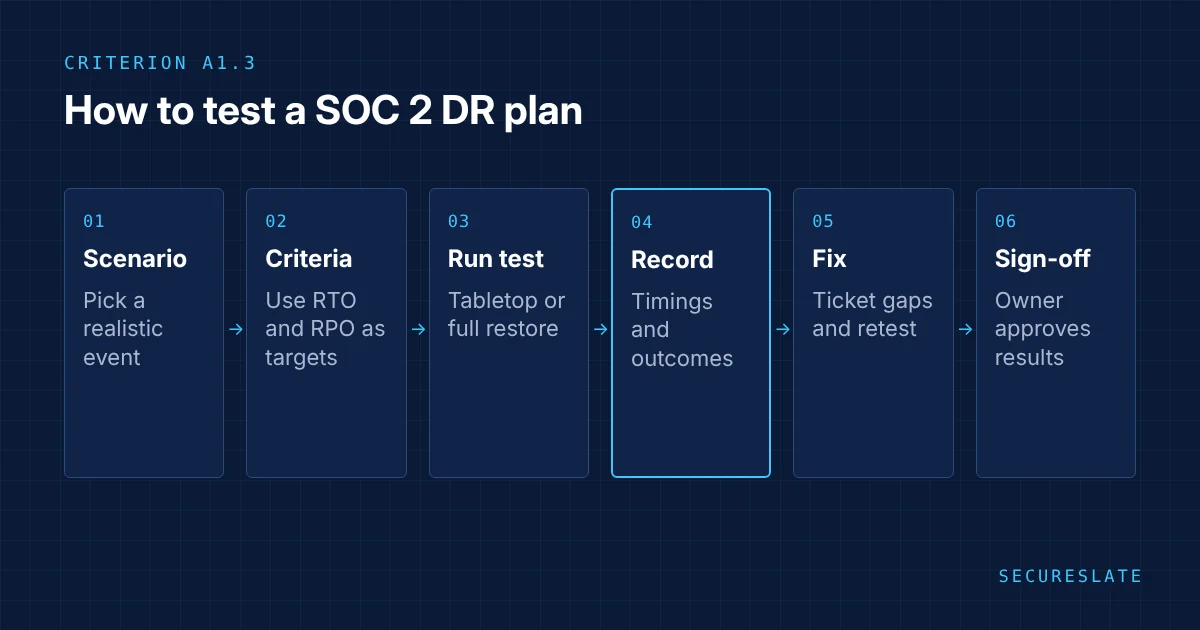
- Choose the scenario. Pick a realistic event, such as loss of the primary database or a cloud region.
- Set success criteria. Use the RTO and RPO from the plan as pass or fail thresholds.
- Run the test. Options range from a tabletop walk-through to a full restore into a separate environment. A restore test proves more than a discussion.
- Record results. Capture timings, who took part, what worked and what did not.
- Fix and retest. Open tickets for gaps, update runbooks and retest the parts that failed.
- Get sign-off. Have the plan owner approve the results and the updated plan.
Restore tests for individual backups are a separate, more frequent control. Many teams run small restore checks monthly or quarterly and a fuller DR test annually. Choose a cadence you can sustain, write it down and follow it.
What evidence do SOC 2 auditors ask for?
Auditors ask for proof that the plan exists, that backups ran and that recovery was tested. For a Type 1 report they look at design at a point in time. For a Type 2 report they sample evidence across the observation period.
Evidence checklist:
- Approved disaster recovery plan with version history
- Business impact analysis or risk assessment that covers disruption
- Backup configuration screenshots or exports showing frequency, retention and encryption
- Backup job logs or alerts showing failures were noticed and handled
- Restore test records with dates and results
- Annual DR test report with findings and remediation tickets
- Evidence that roles were assigned and people knew them
- Monitoring of capacity and availability for the in-scope system
Keep the evidence linked to the criteria from the start. Rebuilding it at the end of the period is where most of the effort goes.
How does disaster recovery work with cloud providers?
Cloud providers give you resilient building blocks, but you remain responsible for configuring and testing recovery. Under the shared responsibility model, the provider runs the physical infrastructure. You decide whether data is replicated across zones or regions, how backups are retained and how fast you can rebuild.
In your SOC 2 report, providers like your cloud host are usually treated as subservice organisations. In our experience, most reports use the carve-out method, which means the provider's controls are excluded and you list the complementary controls you expect from them. Review their own SOC 2 reports each year and note the controls you rely on. Your auditor will expect to see that review.
Common SOC 2 disaster recovery mistakes
The most frequent problems are simple and avoidable:
- A plan written for the audit that no engineer has read.
- RTO and RPO values that the backup setup cannot meet.
- Backups stored in the same account or region as production, with the same access.
- No restore test, only proof that backup jobs succeeded.
- Test results recorded with no follow-up tickets.
- A plan that still lists people who have left the company.
How SecureSlate helps
SecureSlate maps your disaster recovery controls to SOC 2 and to other frameworks you run, such as ISO 27001 or HIPAA, so one test can support several audits. Agentless, read-only cloud integrations collect backup and configuration evidence automatically. Risk management records disruption risks and links them to your DR controls. Vendor risk management tracks subservice providers and their reports, and audit management keeps the evidence organised for your CPA firm, which performs the SOC 2 examination.
Start a free trial to organise your SOC 2 disaster recovery evidence.
FAQ
Does a Security-only SOC 2 report need a disaster recovery plan?
The Availability criteria will not be tested, but CC7.5 and CC9.1 still cover recovery from incidents and disruption risk. Most auditors expect at least backups, a recovery procedure and some form of test.
How often should we test disaster recovery for SOC 2?
SOC 2 does not set a frequency. Testing at least once in each audit period is the common expectation for A1.3, with more frequent backup restore checks.
Is a tabletop exercise enough?
It can satisfy a test requirement if it is well documented, but a technical restore proves more. Many teams combine an annual tabletop with regular restore tests.
What is the difference between a DR plan and a business continuity plan?
A business continuity plan covers keeping the whole business running. A disaster recovery plan covers restoring systems and data. SOC 2 auditors often review both.
Can we rely on our cloud provider's SOC 2 report for disaster recovery?
Only for the parts the provider controls. You still need your own backups, replication choices, runbooks and tests for the systems you build on their platform.
Disclaimer (legal note)
This article is for general information only and is not legal, regulatory, or professional advice. Requirements vary by framework, industry, and jurisdiction. Consult qualified advisors for your specific obligations.
Need compliance without the complexity?
SecureSlate automates ISO 27001, SOC 2, GDPR, HIPAA, and more. Built for growing teams. See it in action.
Find compliance gaps in 30 seconds