
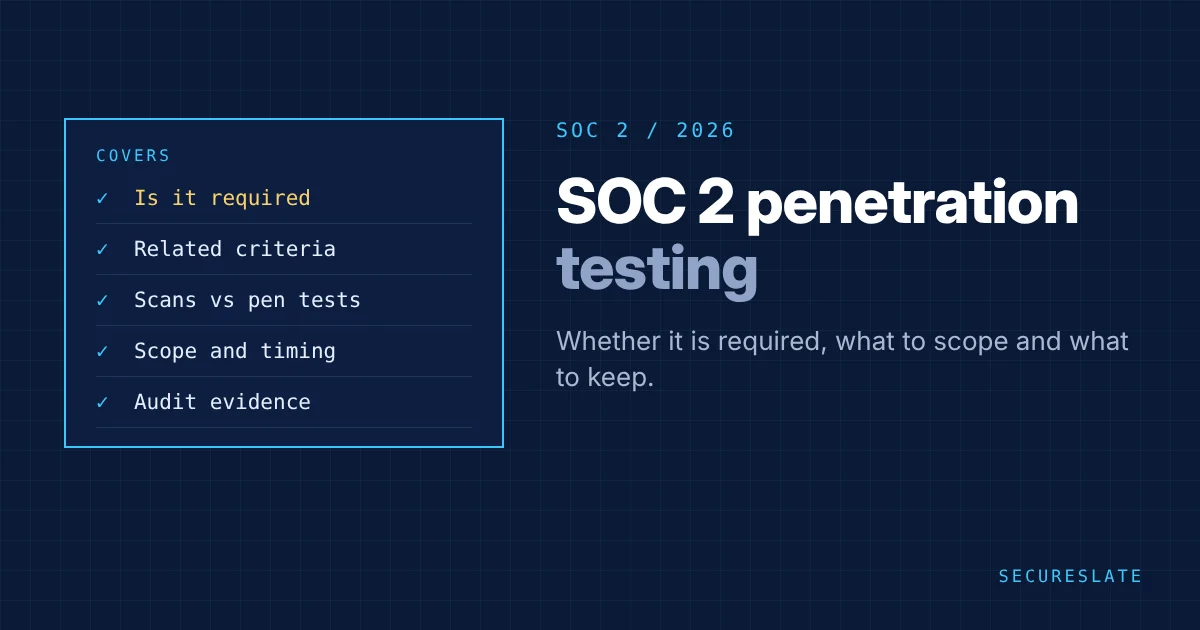
Short answer: SOC 2 does not explicitly require a penetration test. The Trust Services Criteria name penetration testing only as one example of how to evaluate controls. In practice, most auditors and enterprise customers expect an independent test of in-scope systems about once a year, with findings tracked through to remediation.
Related guides: Penetration testing vs vulnerability scanning · SOC 2 Trust Services Criteria · How to prepare for a SOC 2 audit
Key takeaways
- No SOC 2 criterion says "perform a penetration test". It appears as an example in a point of focus, and points of focus are guidance, not requirements.
- A penetration test is still the most common way to show that you independently evaluate your security controls and find vulnerabilities before attackers do.
- Scope the test to the system in your SOC 2 report: the production application, its APIs, and the cloud environment that hosts it.
- Auditors care less about a clean report than about what you did with the findings: triage, remediation within your own policy timelines, and a retest.
- For a Type 2 report, plan the test so it falls inside the observation period.
Is a penetration test required for SOC 2?
No, a penetration test is not a mandatory SOC 2 requirement, but skipping it usually means you need another convincing way to meet the same criteria.
SOC 2 is not a checklist of prescribed controls. The AICPA's Trust Services Criteria set out outcomes, and each organization designs its own controls to achieve them. Your auditor then gives an opinion on whether those controls are suitably designed (Type 1) and, for a Type 2 report, whether they operated effectively over a period.
Penetration testing shows up in the criteria as an illustration, not an obligation. That leaves three practical reasons why most teams still run one:
- Auditor expectations. In our experience, most audit firms expect to see a penetration test for an internet-facing SaaS product, and will ask what compensating activity you perform if you do not have one.
- Customer expectations. Enterprise security questionnaires routinely ask for a recent penetration test summary, regardless of what SOC 2 says.
- Your own policies. If your vulnerability management policy says you run an annual penetration test, the auditor will test you against that statement. A control you wrote down and did not perform becomes an exception in the report.
Which SOC 2 criteria does a penetration test support?
A penetration test mainly supports the monitoring criterion CC4.1 and the system operations criterion CC7.1, both of which are part of the common criteria that every SOC 2 report includes.
| Criterion | What it asks for | How a penetration test helps |
|---|---|---|
| CC4.1 | Ongoing and separate evaluations to confirm that internal controls are present and functioning | Its points of focus list penetration testing as one type of separate evaluation, alongside independent certifications and internal audit assessments |
| CC4.2 | Control deficiencies are communicated to the people responsible for corrective action | Findings are reported to system owners and management, with tracked remediation |
| CC7.1 | Detection and monitoring procedures identify new vulnerabilities and configuration changes that introduce them | Manual testing finds weaknesses that automated tools miss. The points of focus here refer to periodic vulnerability scans |
| CC3.2 | Risks to the achievement of objectives are identified and analyzed | Test results feed the risk assessment with real, demonstrated weaknesses |
Two points are worth noting. First, points of focus are not requirements. The AICPA describes them as important characteristics of the criteria that may not all apply to every organization. Second, the criteria never set a frequency. Phrases like "annual penetration test" come from your own control wording and from market practice, not from the standard.
Is a vulnerability scan enough?
A vulnerability scan alone can satisfy the criteria on paper, but it answers a different question than a penetration test, and most auditors expect to see both for a customer-facing product.
A scan is automated and broad. It compares your systems against known vulnerabilities and misconfigurations and should run frequently. A penetration test is manual and deep. A tester chains weaknesses together, tests business logic and authorization, and shows what an attacker could actually reach. For a longer comparison, see our guide to penetration testing vs vulnerability scanning.
| Vulnerability scan | Penetration test | |
|---|---|---|
| Method | Automated tooling | Human tester, supported by tools |
| Finds | Known vulnerabilities, missing patches, misconfigurations | Exploitable paths, broken access control, logic flaws |
| Typical cadence | Continuous, weekly or monthly, and after significant changes | Periodic, commonly once a year and after major changes |
| Performed by | Internal team or a tool | Independent tester, internal or external |
| SOC 2 link | CC7.1 points of focus | CC4.1 points of focus |
| Evidence | Scan results and remediation tickets | Report, remediation tickets, retest results |
If you skip the penetration test, document why and show the alternative, such as authenticated scanning, code review or a bug bounty program. Whether that is enough is your auditor's judgment, so raise it during readiness.
What should a SOC 2 penetration test cover?
The test should cover the same system that your SOC 2 report describes, because a test of something else does not provide evidence about the controls being examined.
Start from the system boundary in your report and work outward. A typical scope for a SaaS company includes:
- The production web application, tested with authenticated accounts at each role level, including tenant isolation checks between customer accounts
- Public and partner APIs, including authentication, authorization and rate limiting
- External network exposure, such as public IP addresses, load balancers, DNS and exposed management interfaces
- Cloud configuration, such as storage permissions, identity and access settings, and network rules
- Mobile applications, if they are part of the service covered by the report
Internal corporate networks, office Wi-Fi and social engineering are optional for most cloud-native companies. Include them when they are a realistic route to production data or when a customer contract asks for them.
If you test a staging environment instead of production, be ready to show the auditor how it matches production. Also check your cloud provider's current security testing policy before you start.
When and how often should you test?
Test at least as often as your own policy states, which for most organizations is once a year, and again after major changes to the application or infrastructure.
Timing matters more for Type 2 reports than many teams expect:
- Type 1. The report describes controls at a point in time. A recent test with remediation complete, or clearly in progress under your policy, supports the design of the control.
- Type 2. The auditor tests whether controls operated during the observation period. If your control says "a penetration test is performed annually", the test should take place within that period. A test finished two weeks before the period started can leave the control without evidence.
- Renewals. Keep the test at a similar point each year so that every observation period contains one. Booking a reputable firm can take several weeks, so schedule early.
For the difference between the two report types, see SOC 2 Type 1 vs Type 2.
How do you run a penetration test for SOC 2?
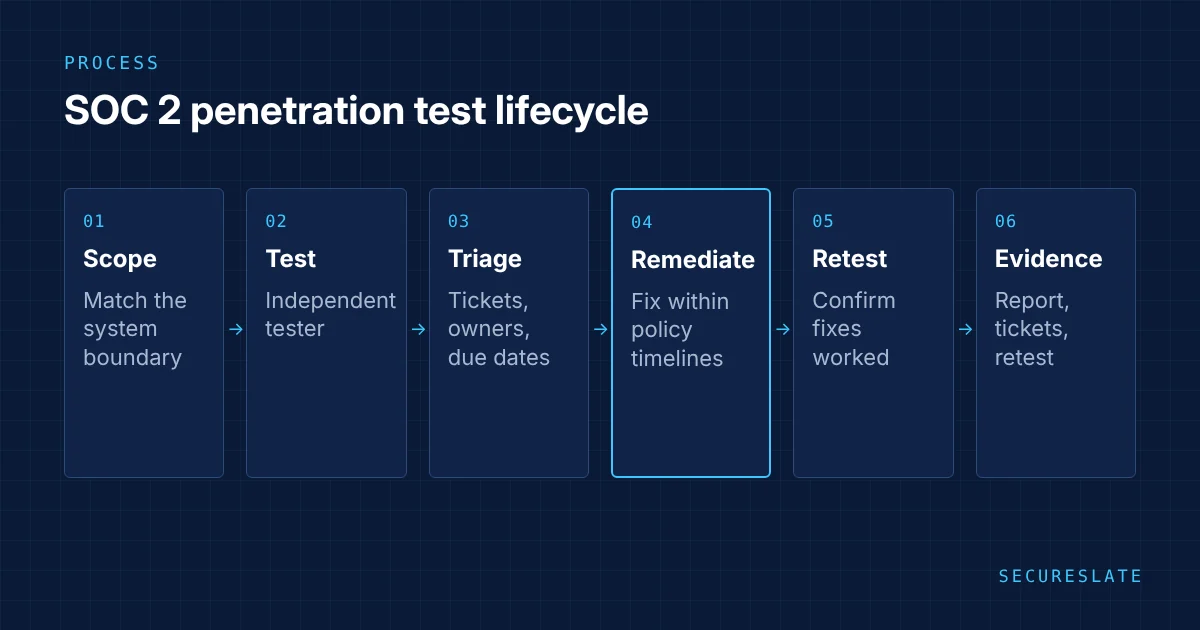
Treat the test as a small project with a defined scope, an independent tester, and a remediation cycle that ends in a retest.
- Define scope and rules of engagement. List targets, environments, test accounts, testing windows and anything that is off limits. Align the scope with your SOC 2 system boundary.
- Choose an independent tester. Independence means the tester did not build or operate the system. An external firm is the usual choice. Ask about methodology, tester experience and a sample report.
- Prepare the environment. Create test accounts for each role, notify your cloud and monitoring teams, and confirm backups.
- Run the test. Stay available for questions. Ask to be told immediately about critical findings instead of waiting for the final report.
- Triage the findings. Log each finding as a ticket with a severity, an owner and a due date drawn from your vulnerability management policy.
- Remediate and retest. Fix the issues, then have the tester confirm the fixes. Keep the retest letter or updated report.
- Accept residual risk formally. If a finding will not be fixed, record the reason and the approval in your risk register.
- File the evidence. Store the report, tickets and retest results where the auditor can reach them.
Our guide to penetration testing best practices goes deeper on methodology and tester selection.
What evidence will the auditor ask for?
Auditors want proof that the test happened, that it covered the system in scope, and that findings were handled according to your policy.
- The penetration test report, or an executive summary, showing the tester, dates, scope, methodology and findings
- Remediation tickets for each finding, with severity, owner, dates opened and closed, and links to the fix
- Retest results confirming that fixes worked
- Risk acceptance records for anything left open, with management approval
- The policy that defines testing frequency and remediation timelines by severity
- Evidence of management review, such as meeting notes or a sign-off on the report
Open findings do not automatically cause an exception. What causes problems is a critical finding with no ticket, a missed remediation deadline that you set yourself, or a test that never happened despite the control saying it would.
How SecureSlate helps
SecureSlate does not perform penetration tests or audits. It helps you connect the test to your SOC 2 program so the evidence is ready when your auditor asks.
- Multi-framework control mapping links your penetration testing and vulnerability management controls to SOC 2 and to other built-in frameworks such as ISO 27001, HIPAA and PCI DSS, so one test supports several requirements.
- Risk management lets you record accepted findings with an owner and approval.
- Agentless, read-only cloud integrations and code security with secrets detection give continuous visibility between annual tests.
- Audit management keeps the report, tickets and retest results attached to the right controls for your auditor.
- A trust center lets you share a penetration test summary with customers under controlled access.
Start a free SecureSlate trial to map your testing program to SOC 2.
FAQ
Does SOC 2 Type 1 need a penetration test?
Not by rule. A Type 1 report covers the design of controls at a point in time. If your controls include penetration testing, the auditor will expect evidence that the process exists, which usually means a completed test.
Who can perform a SOC 2 penetration test?
Anyone qualified and independent of the system being tested. SOC 2 does not require a specific certification or an external firm. Most companies use an external tester because independence is easier to demonstrate and customers prefer it.
Can automated penetration testing tools replace a manual test?
Automated tools are useful for frequent coverage, but they are weaker at business logic and authorization flaws. Whether an automated test is enough depends on your auditor's judgment and your customers' expectations, so confirm before relying on it.
Do all findings have to be fixed before the audit?
No. Findings need to be triaged, tracked and resolved within the timelines in your policy, or formally risk-accepted. Auditors look for a working process, not a report with zero findings.
Should we share the penetration test report with customers?
Share a summary or attestation letter that confirms the scope, dates and remediation status. Keep the detailed findings internal, or release them only under NDA when a customer contract requires it.
Disclaimer (legal note)
This article is for general information only and is not legal, regulatory, or professional advice. Requirements vary by framework, industry, and jurisdiction. Consult qualified advisors for your specific obligations.
Need compliance without the complexity?
SecureSlate automates ISO 27001, SOC 2, GDPR, HIPAA, and more. Built for growing teams. See it in action.
Find compliance gaps in 30 seconds