
Short answer: A SOC 2 system description is the section of a SOC 2 report, written by management, that explains what service is in scope, what you promise customers, which infrastructure, software, people, procedures and data deliver it, and which controls meet the Trust Services Criteria. The auditor tests it against the AICPA description criteria.
Related guides: How to prepare for a SOC 2 audit · SOC 2 Type 1 vs Type 2 · SOC 2 compliance checklist
Key takeaways
- The system description is management's document, not the auditor's. You write it, and you assert that it is fairly presented.
- It must meet the nine AICPA description criteria, from the services you provide to significant changes during the period.
- The boundaries you draw in it decide what the auditor tests, so scope decisions come first.
- It must be accurate and specific. Describing a control you do not operate creates a finding.
- Start early. In our experience, the description is one of the most frequently rewritten parts of a first SOC 2.
What is a SOC 2 system description?
A SOC 2 system description is management's written account of the system being examined, and it forms the backbone of the SOC 2 report.
A SOC 2 report typically has several parts: the independent service auditor's report, management's assertion, the system description, and, for a Type 2, the auditor's tests of controls and results. Many reports label the description as Section 3. Readers such as your customers' security teams use it to understand exactly what was examined and what their own responsibilities are.
The auditor gives an opinion on whether the description is fairly presented, as well as on whether the controls were suitably designed (and, for a Type 2, operated effectively). That means the description is itself under examination. It is not marketing copy.
The benchmark is the AICPA's 2018 SOC 2 Description Criteria (with revised implementation guidance, 2022), often referred to as DC 200. The controls themselves are evaluated against the Trust Services Criteria.
As of November 2026, the AICPA has published an exposure draft of proposed 2027 Trust Services Criteria and description criteria. These are proposals open for comment, not current requirements, so write to the 2018 criteria unless your auditor tells you otherwise.
What must a system description include?
A system description must address each of the nine description criteria, or explain why one does not apply.
| Criterion | What it asks you to describe | Practical tip |
|---|---|---|
| DC 1: Types of services provided | The services in scope | Name the product and versions, not the whole company |
| DC 2: Principal service commitments and system requirements | What you promise customers and what the system must do to keep those promises | Pull commitments from your contracts, SLAs and security pages |
| DC 3: System components | Infrastructure, software, people, procedures and data | Match this to your real architecture diagram |
| DC 4: System incidents | Significant incidents that caused a failure to meet commitments | Decide with your auditor what counts as significant |
| DC 5: Applicable criteria and related controls | The Trust Services Criteria in scope and the controls that address them | Security is always included |
| DC 6: Complementary user entity controls | What customers must do for your controls to work | Keep the list short and realistic |
| DC 7: Subservice organizations | Vendors such as cloud providers that perform controls for you, and whether they are carved out or included | Most companies use the carve-out method |
| DC 8: Criteria not relevant | Any specific criterion that does not apply, and why | Give a real reason, not a blanket statement |
| DC 9: Significant changes | Material changes to the system during the period | Applies to Type 2 reports |
Two of these trip up first-time companies more than the others.
Service commitments (DC 2) must match what you actually tell customers. If your contract promises encryption of customer data or a recovery time, the description should reflect it, and the controls should support it.
Subservice organizations (DC 7) matter for almost every SaaS company because cloud hosting providers operate physical and infrastructure controls on your behalf. Under the carve-out method, you describe what you rely on them for and list the complementary subservice organization controls you expect them to have, then monitor them, usually by reviewing their own SOC reports. Our guide on reviewing a vendor's SOC report covers that review.
How do you describe the system components?
Describe the five system components in enough detail that a reader could picture the boundary of what was tested.
| Component | What to include | Example for a HealthTech SaaS |
|---|---|---|
| Infrastructure | Cloud accounts, regions, networks, managed services | Production account in one cloud region, managed database, private subnets |
| Software | Applications, services, key third-party tools | Patient scheduling app, API, CI/CD pipeline, monitoring tooling |
| People | Teams and roles that operate the system | Engineering, security, support, leadership oversight |
| Procedures | Automated and manual processes | Change management, access provisioning, incident response, backups |
| Data | Types of data processed and how it flows | Customer account data, appointment data that may include PHI |
Keep it factual. You do not need to list every server or microservice, but the reader should be able to tell which environments are in scope and which are not. A staging environment that holds no customer data is often outside the boundary. Say so explicitly.
If you handle protected health information, remember that a SOC 2 does not by itself show HIPAA compliance. Many HealthTech companies map their SOC 2 controls to the HIPAA Security Rule safeguards so the same evidence serves both.
How do you write a system description?
Write the description after you fix the scope and before fieldwork, then update it as the system changes.
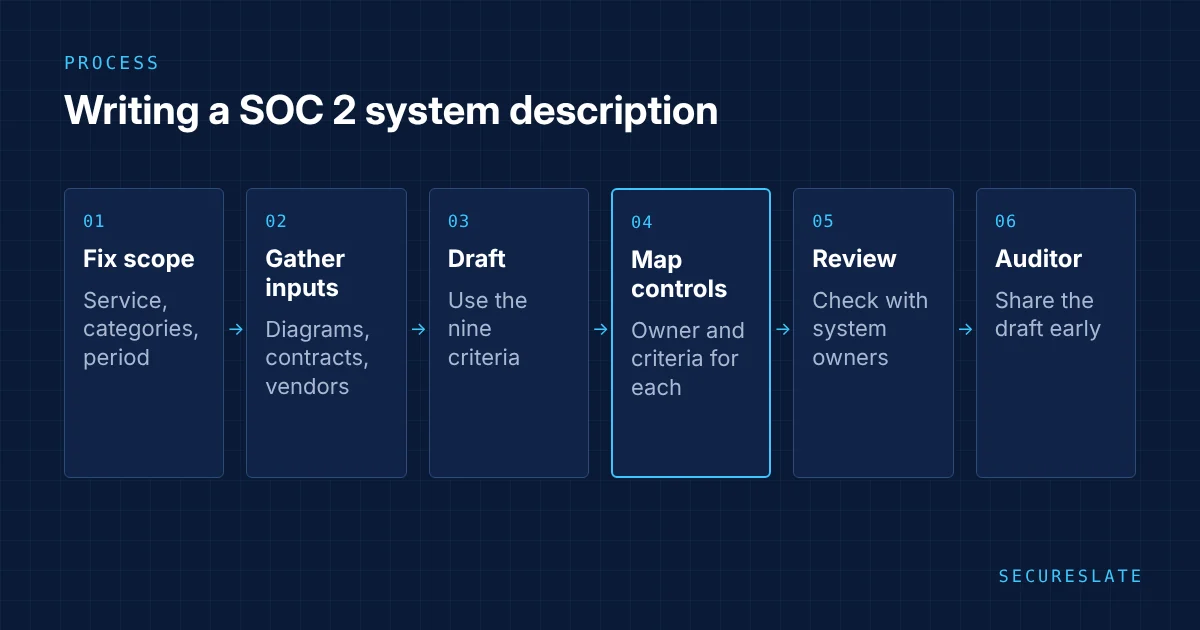
- Fix the scope. Choose the service, the Trust Services Categories and, for a Type 2, the review period. A SOC 2 readiness assessment is a good place to settle this.
- Gather source material. Collect architecture diagrams, data flow diagrams, customer contracts, policies and your vendor list.
- Draft against the nine criteria. Use the criteria as headings so nothing is missed. Many auditors share a template or an illustrative example.
- Map controls to criteria. List each control once, with an owner, and link it to the criteria it supports.
- Review with the people who run the system. Engineers and operations staff will catch descriptions of processes that no longer work that way.
- Send the draft to your auditor early. Their comments before fieldwork are cheaper than corrections after it.
Write in plain language and the present tense. "The company reviews production access quarterly" is testable. "The company strives to maintain appropriate access" is not.
Does the description differ for Type 1 and Type 2?
Yes: a Type 1 describes the system as of a single date, while a Type 2 describes it throughout a period and must disclose significant changes.
| Topic | Type 1 | Type 2 |
|---|---|---|
| Point of reference | A specific date | A review period |
| Significant changes (DC 9) | Not applicable in the same way | Disclose material changes during the period |
| System incidents (DC 4) | Incidents relevant as of the date | Significant incidents during the period |
| Control descriptions | Must be in place on the date | Must have operated across the period |
If you move from a Type 1 to a Type 2, do not simply reuse the old description. Tools, teams and vendors usually change in between, and those changes need to be reflected. See SOC 2 Type 1 vs Type 2 for the wider differences.
What mistakes slow the audit down?
Most delays come from descriptions that do not match reality, so check the draft against how the system actually runs.
- Aspirational controls. Describing a control you plan to adopt, rather than one you operate, leads to exceptions or a rewrite.
- Vague boundaries. If the reader cannot tell which accounts, environments or products are included, the auditor will ask, and fieldwork stalls.
- Missing subservice organizations. Forgetting a vendor that runs a relevant control, such as an identity provider or payment processor, is a common gap.
- Copied templates. Text from another company's report rarely fits your architecture and is easy for an auditor to spot.
- Outdated diagrams. An architecture diagram from last year undermines the rest of the section.
- Unrealistic user entity controls. A long list of customer responsibilities looks like shifting your controls onto customers. Keep only what is genuinely needed.
How SecureSlate helps
SecureSlate helps you build and maintain the program your system description explains. It does not write your assertion for you, perform audits or issue reports. A licensed CPA firm does the examination.
- Built-in SOC 2 framework with controls mapped to the Trust Services Criteria, and to ISO 27001, HIPAA and HITRUST, so control lists in your description stay consistent across frameworks.
- Agentless, read-only cloud integrations that show which cloud resources exist, which helps you describe infrastructure accurately.
- Vendor risk management to keep your subservice organization list and their SOC report reviews current.
- Access reviews, risk management and a device agent that produce evidence for the controls you describe.
- Audit management to share the draft description and evidence with your auditor.
Start a free trial to map your current controls to the SOC 2 criteria.
FAQ
Who writes the SOC 2 system description?
Management of the service organization writes it. The auditor may give feedback and examples, but the company owns the content and signs an assertion that it is fairly presented.
How long is a SOC 2 system description?
There is no set length. It needs enough detail to meet the nine description criteria and show the boundaries of the system. In our experience, it often runs from a dozen to a few dozen pages, depending on how complex the service is.
Is the system description included in a SOC 3 report?
A SOC 3 report includes a much shorter summary of the system, not the full description. The detailed description appears only in the SOC 2 report.
Can we reuse our system description each year?
You can start from last year's version, but you must update it for changes to the service, infrastructure, vendors, people and controls, and disclose significant changes in a Type 2.
What happens if the description is inaccurate?
The auditor may require corrections before issuing the report. If inaccuracies remain, the auditor's opinion on the description can be modified, which customers will see.
Disclaimer (legal note)
This article is for general information only and is not legal, regulatory, or professional advice. Requirements vary by framework, industry, and jurisdiction. Consult qualified advisors for your specific obligations.
Need compliance without the complexity?
SecureSlate automates ISO 27001, SOC 2, GDPR, HIPAA, and more. Built for growing teams. See it in action.
Find compliance gaps in 30 seconds