
Short answer: SOX testing is the work management and auditors do to prove that internal controls over financial reporting (ICFR) are designed well and operate as intended. It covers scoping significant accounts, walking through processes, testing design and operating effectiveness of key controls, including IT general controls, and evaluating any deficiencies before the annual Section 404 assessment.
Related guides: SOX controls playbook · Internal control audit · Audit risk model
Key takeaways
- SOX testing supports Section 404(a) management's assessment and, for larger filers, the Section 404(b) auditor attestation.
- Every key control gets two questions: is it designed to stop a material misstatement, and did it actually operate throughout the period?
- The auditor's work follows PCAOB AS 2201, which uses a top-down, risk-based approach starting at the financial statements.
- IT general controls (access, change management, operations) underpin most automated controls, so ITGC failures ripple widely.
- Failed tests are not the end: deficiencies are evaluated for severity, remediated and retested.
What is SOX testing?
SOX testing is the gathering and evaluation of evidence that a company's key financial reporting controls work, so management and auditors can conclude on the effectiveness of ICFR.
It comes from Section 404 of the Sarbanes-Oxley Act. Section 404(a) requires management's annual report on ICFR. Section 404(b) requires the external auditor to attest to that assessment. The SEC's 2010 final rule confirms that all issuers remain subject to 404(a), while the 404(b) attestation does not apply to issuers that are neither accelerated nor large accelerated filers.
Management must evaluate ICFR against a suitable, recognized control framework. The SEC's 2003 rule notes that the COSO framework meets that bar without mandating it, and in practice most US public companies use COSO's Internal Control: Integrated Framework.
Even private companies planning an IPO, or companies selling to public company customers, often run SOX-style testing early, because building the habit takes longer than writing the controls.
Who performs SOX testing, and when?
Management tests controls to support its own assessment, and the external auditor performs independent testing for the 404(b) opinion where it applies.
| Party | Role in SOX testing | Typical timing |
|---|---|---|
| Control owners | Perform controls and keep evidence | Continuously, as the control runs |
| Internal audit or SOX team | Tests key controls on management's behalf | Interim testing during the year, then a roll-forward to year end |
| Outsourced or co-sourced testers | Supplement internal capacity | Same as internal audit |
| External auditor | Tests controls for the ICFR opinion and may rely on others' work | Interim and year-end fieldwork |
| Audit committee | Oversees the process and deficiency reporting | Quarterly and at year end |
Under AS 2201, the external auditor can use the work of others, such as internal audit, to reduce its own testing, depending on their competence and objectivity. Clean, well-documented management testing therefore saves audit time directly.
How does the SOX testing process work?
The SOX testing process moves from risk assessment to scoping, walkthroughs, design testing, operating effectiveness testing and finally deficiency evaluation.
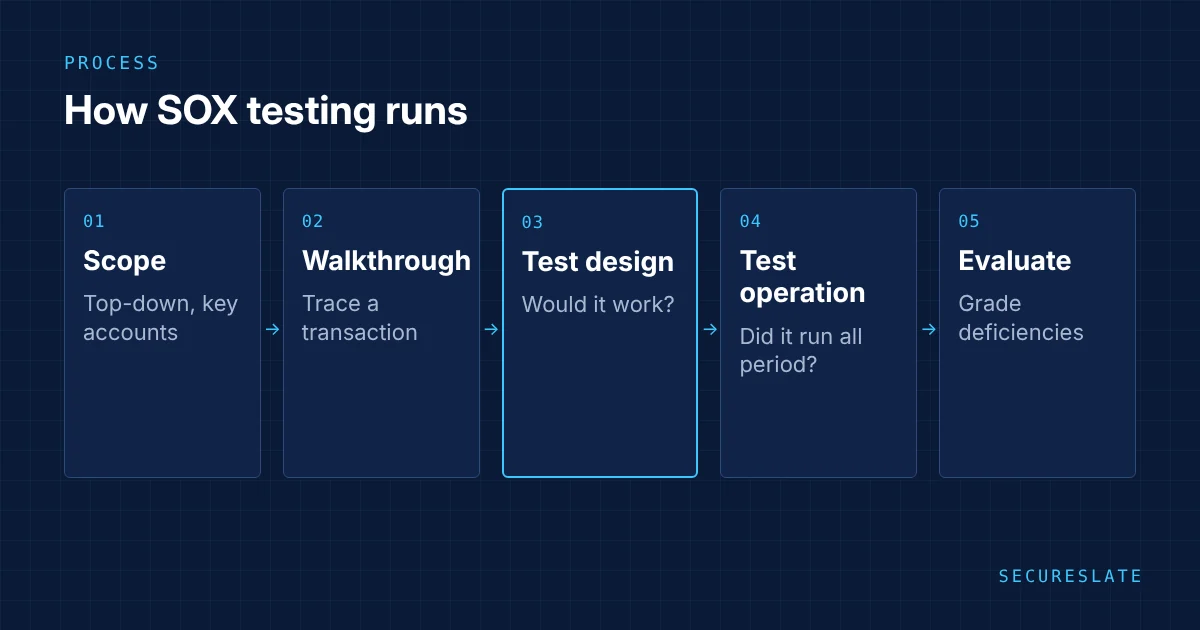
- Assess risk top-down. AS 2201 describes a top-down approach that begins at the financial statement level, moves to entity-level controls, and then to significant accounts, disclosures and their relevant assertions.
- Scope significant accounts and locations. Decide which accounts, processes, business units and systems are in scope based on the risk of material misstatement.
- Identify key controls. For each relevant assertion, choose the controls that address the risk. Not every control is key; focus on the ones you rely on.
- Perform walkthroughs. Follow a transaction from initiation to the general ledger using the same documents and systems staff use. AS 2201 says walkthroughs will frequently be the most effective way to confirm your understanding of the flow and identify where misstatements could occur.
- Test design effectiveness. Confirm the control, if performed as prescribed by someone with the right authority and competence, would actually prevent or detect a material misstatement.
- Test operating effectiveness. Select samples across the period and check that the control ran as designed every time it should have.
- Roll forward. If you tested at an interim date, gather evidence that controls kept operating through year end.
- Evaluate deficiencies. Classify any exceptions by severity and agree remediation with control owners.
Sample sizes depend on how often a control runs, how risky it is and the methodology of your auditor, so agree them with your auditor upfront instead of using a generic table.
Which test methods count as evidence?
SOX testing relies on four methods, and the more risk a control addresses, the more persuasive the evidence needs to be.
| Method | What it looks like | Strength |
|---|---|---|
| Inquiry | Asking the control owner how the control works | Weakest. Inquiry alone is not enough to conclude a control is effective |
| Observation | Watching the control being performed | Good for point-in-time activities, limited for a full period |
| Inspection | Reviewing documents, approvals, reports and system records | Common and reliable when records are complete |
| Reperformance | Independently redoing the control and comparing results | Strongest, used for higher-risk controls |
Tester tips that make evidence hold up:
- Capture who performed the control, when, and what they reviewed, not just a signature.
- For reports used in a control, test the completeness and accuracy of the report itself (often called IPE, information produced by the entity).
- For review controls, keep evidence of the precision of the review: thresholds, what was investigated and how follow-ups were resolved.
- Label evidence with the control ID and period so it can be reused by the external auditor.
How are IT general controls tested?
IT general controls (ITGCs) are tested the same way as business controls, but they get extra attention because automated controls and system reports are only reliable if the systems behind them are controlled.
Most ITGC programs cover four areas:
- Logical access: user provisioning, timely removal of leavers, privileged access restriction and periodic access reviews for financially significant applications, databases and infrastructure.
- Change management: changes to in-scope systems are requested, tested, approved and deployed by someone other than the developer, or with compensating monitoring.
- IT operations: job scheduling, backups and incident handling for systems that feed financial reporting.
- Program development: controls over new systems or major implementations, such as data migration testing.
Testing an ITGC usually means pulling a population from the system, such as all users added or all changes deployed in the period, and sampling from it. A complete population is critical, so testers often extract it directly from system logs rather than from a ticket queue. Our SOX controls playbook lists example ITGCs in more detail.
For SaaS and HealthTech companies, the same access and change evidence often supports SOC 2 and ISO 27001 as well, which is a good reason to collect it once in a shared control library.
What happens when a SOX test fails?
A failed test becomes a control deficiency, which is evaluated for severity, reported to the right people, remediated and retested.
AS 2201 defines three tiers. A deficiency exists when a control's design or operation does not allow timely prevention or detection of misstatements. A significant deficiency is less severe than a material weakness but merits the attention of those overseeing financial reporting. A material weakness is a deficiency, or combination of deficiencies, where there is a reasonable possibility that a material misstatement will not be prevented or detected on a timely basis.
The consequences differ sharply. The auditor must communicate material weaknesses and significant deficiencies in writing to the audit committee, and if a material weakness exists at year end, the auditor must express an adverse opinion on ICFR. Management is not permitted to conclude ICFR is effective if a material weakness exists. Our guide to internal control audits covers how to remediate and retest.
Practical next steps when a test fails:
- Confirm the exception is real, not a documentation gap.
- Check whether a compensating control mitigates the risk.
- Assess whether the issue is isolated or systemic by expanding the sample if needed.
- Fix the root cause, then allow enough time for the remediated control to operate before retesting.
How SecureSlate helps
SecureSlate is not an audit firm and does not issue opinions, but it helps the people doing SOX testing keep evidence organized. You can set up your SOX key controls as a custom framework and map them to SOC 2 and ISO 27001 controls you already run. Agentless, read-only cloud integrations and the device agent gather ITGC evidence such as access and configuration data, access reviews record reviewer decisions, and audit management tracks requests, test results and remediation. Risk management ties each key control back to the risks it addresses.
FAQ
What is the difference between SOX 404(a) and 404(b) testing?
404(a) is management's own assessment of ICFR, which all issuers must provide. 404(b) is the external auditor's attestation, which applies to accelerated and large accelerated filers.
What is a test of design versus a test of operating effectiveness?
A design test asks whether the control, if performed as intended, would stop a material misstatement. An operating effectiveness test checks that it actually ran that way across the period.
How often should SOX controls be tested?
Key controls are tested every year. Many companies test at an interim date and then roll forward to year end, and some test higher-risk controls more often.
Are ITGCs part of SOX testing?
Yes. IT general controls support automated controls and system reports, so most SOX programs test access, change management and IT operations for in-scope systems.
Can a company use SOC reports from vendors in SOX testing?
Yes, many companies rely on SOC 1 reports from service organizations that process financial data, while testing their own complementary user entity controls.
Disclaimer (legal note)
This article is for general information only and is not legal, regulatory, or professional advice. Requirements vary by framework, industry, and jurisdiction. Consult qualified advisors for your specific obligations.
Need compliance without the complexity?
SecureSlate automates ISO 27001, SOC 2, GDPR, HIPAA, and more. Built for growing teams. See it in action.
Find compliance gaps in 30 seconds