
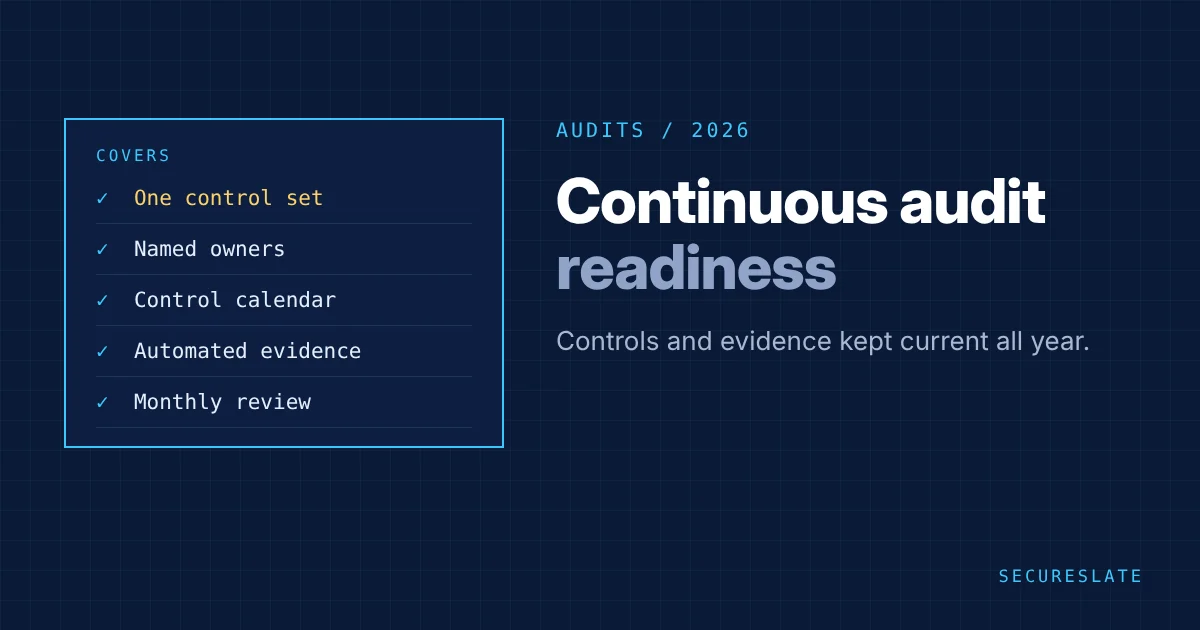
Short answer: Continuous audit readiness is a way of running your compliance program so that controls operate and evidence is collected as part of normal work, all year. Instead of a scramble before each audit, every control has an owner, a schedule and an automatic or routine evidence source, so an auditor could start on short notice.
Related guides: Continuous control monitoring · Audit readiness checklist · Audit fatigue
Key takeaways
- Audits that cover a period of time, such as SOC 2 Type 2, cannot be passed with last-minute preparation. A control that lapsed in month three is still an exception in month twelve.
- Readiness rests on four things: a single control set, named owners, a control calendar and evidence captured when the control runs.
- Automate what a system can check and schedule what a person must do. Both need a visible status.
- Track a few leading metrics, such as overdue control tasks and failing automated checks, and review them monthly.
- Continuous readiness lowers audit effort. It does not remove the audit, and it does not guarantee a clean report.
What is continuous audit readiness?
Continuous audit readiness is the state in which your organization could hand an auditor current, complete evidence for every in-scope control at any point in the year. It is an operating model, not a project with an end date.
It is closely related to two other terms. Continuous control monitoring is the technical part: automated checks that test whether a configuration or control is still in place. Continuous compliance is the broader goal of always meeting your obligations. Continuous audit readiness sits between them and adds the audit view: for each requirement, is there evidence an independent person would accept, covering the whole period, and can you find it quickly?
A simple test: pick a control at random, such as offboarding. Can you show, within an hour, every leaver in the last six months and proof that access was removed on time for each? If yes, you are ready for that control. If it would take a week of digging through tickets, you are not.
How is continuous readiness different from point-in-time preparation?
The difference is when the work happens: point-in-time preparation gathers evidence shortly before the audit, while continuous readiness gathers it as each control operates.
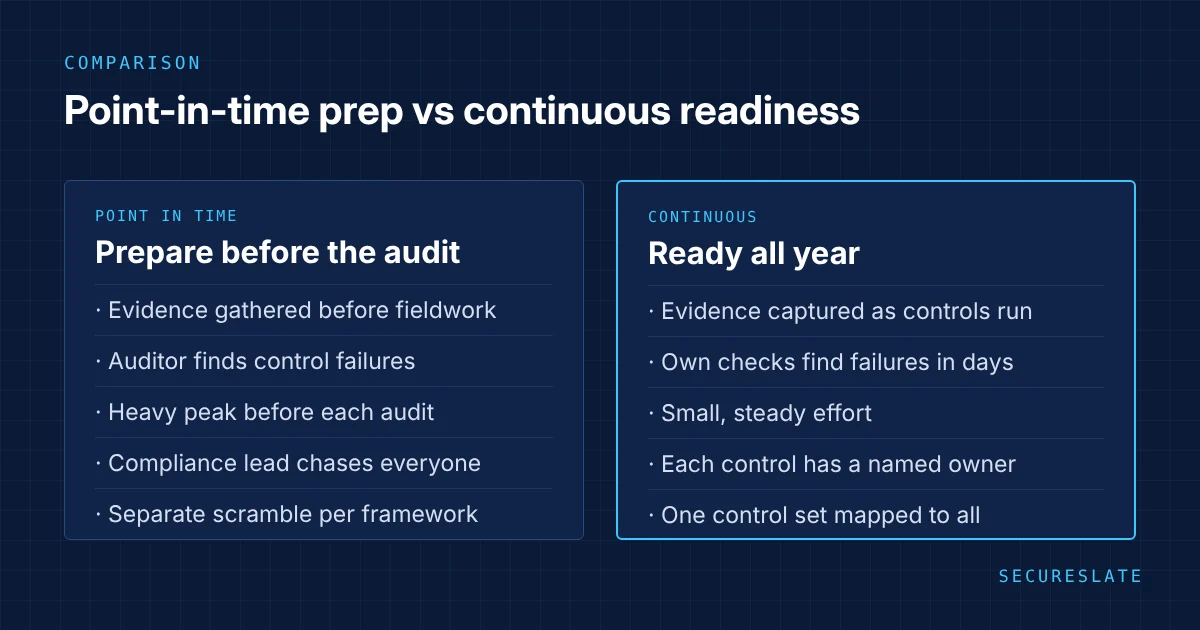
| Aspect | Point-in-time preparation | Continuous readiness |
|---|---|---|
| Evidence collection | Screenshots and exports gathered before fieldwork | Captured automatically or when the task is done |
| Control failures | Found by the auditor, months later | Found by your own checks, within days |
| Workload | Heavy peak before each audit | Small, steady effort |
| Ownership | Compliance lead chases everyone | Each control has a named owner |
| Multiple frameworks | Separate scramble for each | One control set mapped to all |
| Customer questions | Answered from the last report | Answered from current status |
Point-in-time preparation can work for a first SOC 2 Type 1, which reports on the design of controls at a single date. It breaks down for anything that tests operation over time.
Why do audits now demand year-round readiness?
Most assurance frameworks test whether controls operated consistently over a period, so gaps in the middle of the year are visible to the auditor.
| Framework | What makes it ongoing |
|---|---|
| SOC 2 Type 2 | The auditor tests operating effectiveness across an observation period, commonly between three and twelve months, by sampling from the whole period against the Trust Services Criteria. CC4.1 also expects ongoing or separate evaluations of controls |
| ISO 27001 | Certification runs on a three-year cycle with surveillance audits at least once a year between certification and recertification. Clauses 9.1, 9.2 and 9.3 of ISO 27001 require monitoring, internal audits at planned intervals and management review |
| HIPAA Security Rule | 45 CFR 164.308(a)(8) requires periodic technical and nontechnical evaluation, and 164.308(a)(1)(ii)(D) requires regular review of system activity records. There is no certificate, so you must be able to show compliance whenever asked |
| PCI DSS v4.0.1 | Validation is annual, but many requirements carry their own frequency, such as quarterly scans and periodic reviews. See the PCI SSC document library |
Two more pressures apply outside formal audits. Enterprise buyers send security questionnaires and ask for current evidence at any time of year. And when several frameworks apply, audits overlap, so there is rarely a quiet season in which to prepare. See ISO 27001 annual obligations for what one framework alone expects each year.
What does a control calendar look like?
A control calendar lists every recurring control activity with its frequency, owner and the evidence it produces. The frequencies below are common practice for small and mid-sized companies, not fixed rules. Where a framework sets a frequency, such as in PCI DSS, use that.
| Frequency | Typical control activities | Evidence |
|---|---|---|
| Continuous or daily | Cloud configuration checks, endpoint encryption and patch status, alert triage, backups | Automated check results, alert tickets, backup job logs |
| On each event | Onboarding, offboarding, access requests, code changes, incidents, new vendors | Tickets with approvals, pull request reviews, incident records, vendor assessments |
| Monthly | Vulnerability scan review, patching, metrics review | Scan reports, remediation tickets, meeting notes |
| Quarterly | User access reviews for sensitive systems, risk register review, backup restore test | Review records with decisions, updated register, restore test result |
| Annually | Risk assessment, policy review and approval, security awareness training, penetration test, incident response and continuity exercises, internal audit, management review, critical vendor reviews | Reports, approval records, completion records, exercise notes, minutes |
Event-driven controls cause the most trouble, because nobody schedules them. Their evidence has to be a by-product of the workflow: if offboarding always goes through a ticket with a checklist, the evidence exists without extra effort.
How do you build continuous audit readiness?
Build it in stages, starting with ownership and the control set, then automation, then routine review.
- Fix the scope. List the frameworks, systems, teams and locations in scope. Unclear scope is the root of most wasted effort.
- Create one control set. Write each control once and map it to every framework requirement it satisfies, so one access review serves SOC 2, ISO 27001 and HIPAA together.
- Assign an owner to every control. The owner is the person who performs or supervises the activity, not the compliance lead.
- Define the evidence for each control. State exactly what proves it operated, where it comes from and how often. See evidence mapping.
- Automate what a system can check. Connect cloud, identity, device, code and HR systems so configuration evidence is collected and tested without screenshots.
- Schedule what a person must do. Put manual controls on the control calendar with reminders and due dates.
- Route failures like any other work. A failing check or overdue task becomes a ticket with an owner and a deadline.
- Run a monthly readiness review. Thirty minutes on overdue items, failing checks, open findings and upcoming audits.
- Test yourself. Use an internal audit or spot checks to sample evidence the way an auditor would.
- Handle change deliberately. New systems, vendors, products and reorganizations should trigger an update to scope, controls and owners.
A first-time team does not need all ten at once. Steps one to four give most of the benefit and can be done with a spreadsheet. Automation matters more as systems and frameworks multiply.
Which metrics show that you are audit-ready?
The best readiness metrics are leading indicators that show a control slipping before an auditor samples it. Keep the list short enough to review every month.
- Controls with a named owner: should be all of them.
- Automated checks passing: share of checks currently passing, and how long failures stay open.
- Overdue control tasks: number and age of manual tasks past their due date.
- Evidence freshness: controls whose latest evidence is older than the control's frequency allows.
- Onboarding and offboarding on time: completed within the time your policy states.
- Open findings past due: from internal audits, external audits, penetration tests and risk treatment plans.
- Policy and training status: policies past their review date, people with overdue training.
- Vendor reviews current: critical vendors without a review in the defined period.
Report trends rather than a single score. A rising count of overdue tasks in one team says more than an overall percentage.
What gets in the way of continuous readiness?
The usual obstacle is not tooling but ownership: controls that belong to "compliance" rather than to the people doing the work. Other patterns to watch for:
- Policies that promise more than you do. If the policy says weekly and the practice is monthly, every sample is an exception. Write what you will actually do.
- Automation without follow-up. A dashboard of failing checks that nobody acts on is evidence against you.
- Screenshots as the default. Manual captures go stale and consume time. Prefer system-generated records.
- Forgetting the middle of the period. Controls run well just after an audit and just before the next. Samples are drawn from the whole period.
- Scope changes nobody recorded. A new cloud account or acquired product outside the control set is a common source of findings.
- One person holding it all. When the compliance lead leaves, readiness leaves too. Document the calendar and spread ownership.
Constant requests also wear people down. Reusing one piece of evidence across frameworks is the most direct way to reduce that load.
How SecureSlate helps
SecureSlate is built for teams that want to stay ready between audits rather than rebuild evidence each time. It does not perform audits or issue certifications.
- Multi-framework control mapping: one control set mapped to built-in frameworks including SOC 2, ISO 27001, HIPAA, HITRUST, GDPR, PCI DSS and NIST CSF, with custom frameworks and controls for anything else.
- Agentless, read-only cloud integrations and a device agent: configuration and endpoint evidence is collected and checked continuously.
- Access reviews: run and record periodic reviews with reviewer decisions.
- Vendor risk management: keep vendor assessments and review dates current.
- Risk management and audit management: maintain the risk register, track findings and give auditors organized evidence.
- Trust center and security questionnaire automation: answer customer questions from current program status.
Start a free trial to see your controls and evidence status in one place.
FAQ
What is the difference between continuous audit readiness and continuous compliance?
Continuous compliance means you meet your obligations at all times. Continuous audit readiness means you can also prove it at any time, with evidence an independent auditor would accept. You can be compliant and still unready if the proof is scattered or missing.
Do small companies need continuous audit readiness?
Any company with a SOC 2 Type 2, ISO 27001 certification or regular customer security reviews benefits, because those test controls over time. A small team can start with a control list, owners and a calendar before investing in automation.
How long does it take to become continuously audit-ready?
It depends on how mature your controls already are. In our experience, teams with a completed first audit can establish owners, a calendar and basic automation within a few months. Teams starting from nothing need to implement the controls first.
Does continuous readiness replace the readiness assessment before an audit?
It makes it shorter. A brief pre-audit check is still useful to confirm scope, sample evidence and close open items. It should confirm what you already know rather than reveal surprises.
Can continuous audit readiness be fully automated?
No. Configuration checks and evidence collection can be automated, but activities such as risk assessments, access review decisions, management reviews and incident exercises need people. The aim is to automate collection and reminders so people spend their time on judgment.
Disclaimer (legal note)
This article is for general information only and is not legal, regulatory, or professional advice. Requirements vary by framework, industry, and jurisdiction. Consult qualified advisors for your specific obligations.
Need compliance without the complexity?
SecureSlate automates ISO 27001, SOC 2, GDPR, HIPAA, and more. Built for growing teams. See it in action.
Find compliance gaps in 30 seconds