
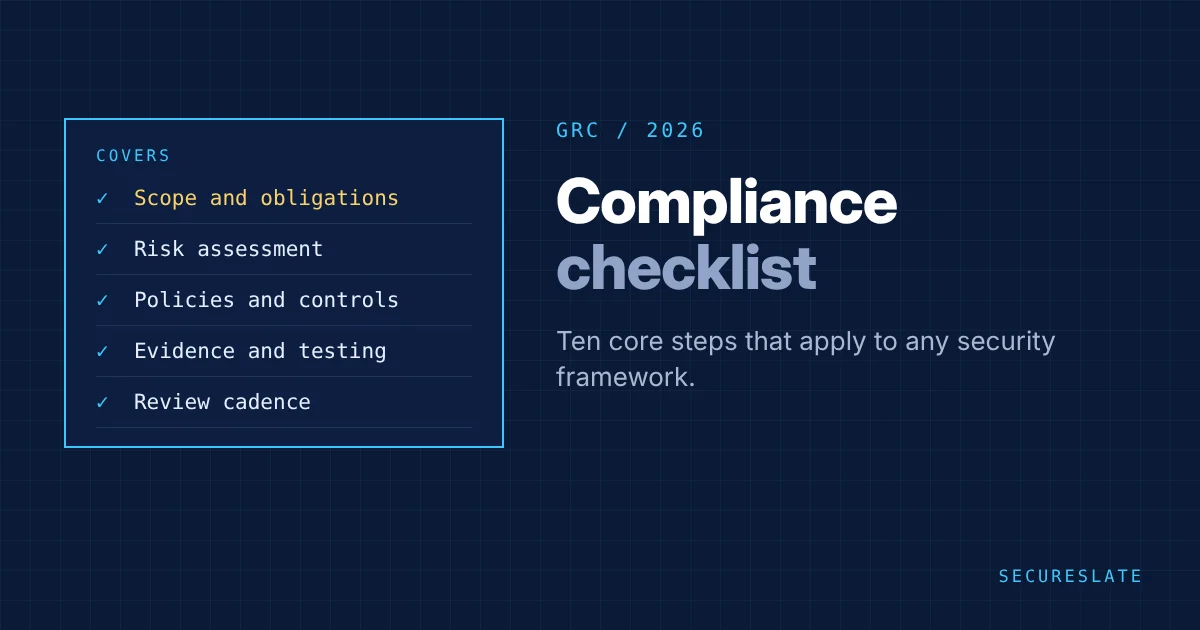
Short answer: A compliance checklist lists what your organization must do to meet a law or security framework and how you will prove it. Whatever the framework, the core is the same: define scope, assess risk, assign owners, write policies, implement controls, train people, manage vendors, collect evidence, test the result and review it on a schedule.
Related guides: SOC 2 compliance checklist · ISO 27001 checklist · HIPAA compliance checklist
Key takeaways
- Most security and privacy frameworks share one core checklist. The differences sit in a small number of framework-specific items.
- Start with scope and risk. A checklist applied to the wrong systems produces evidence nobody needs.
- Every item needs an owner, a frequency and a piece of evidence. Without those three, it is a wish list.
- Build one control set and map it to several frameworks instead of running a separate checklist for each.
- A checklist is a tool for staying compliant between audits, so review it on a calendar, not only before an assessment.
What is a compliance checklist?
A compliance checklist is a structured list of the requirements you must meet, the controls that meet them and the evidence that shows they work. It turns a long standard or regulation into tasks that named people can complete and an assessor can verify.
A useful checklist answers four questions for each line:
- What is required, in plain language, with a reference to the source clause or criterion.
- Who owns it.
- How often it happens: once, continuously, quarterly or yearly.
- What proof exists: a configuration, a ticket, a signed document, a log or a report.
A checklist is not the compliance program itself. Ticking every box while ignoring your actual risks leads to controls that look complete and do little. Use the checklist to organize the work, and use your risk assessment to decide where depth matters.
Which frameworks belong on your checklist?
The frameworks that belong on your checklist are the ones triggered by your data, your customers and your markets. Work that out before writing a single task.
| Trigger | Framework or law | What an assessment produces |
|---|---|---|
| B2B customers ask for independent assurance over your service | SOC 2 | An attestation report from a licensed CPA firm against the AICPA Trust Services Criteria |
| International customers want a certified security management system | ISO/IEC 27001 | A certificate from an accredited certification body |
| You create, receive, maintain or transmit protected health information for US healthcare | HIPAA | No official certification. You document compliance and sign business associate agreements |
| You process personal data of people in the EU | GDPR | No single certificate. You must be able to demonstrate compliance (Article 5(2)) |
| You store, process or transmit payment card data | PCI DSS | A self-assessment questionnaire or a report on compliance, depending on volume and role |
| You follow a voluntary cybersecurity baseline | NIST CSF or NIST SP 800-53 | Self-assessed profile unless a contract requires more |
If more than one applies, do not build parallel programs. A common control framework lets one control, such as multi-factor authentication, satisfy the matching requirement in each framework.
The 10-step compliance checklist
These ten steps apply to any security or privacy framework. Work through them in order the first time. After that they become a cycle.
- Identify your obligations. List the laws, frameworks and contract clauses that apply, and who is asking for proof.
- Define scope. Name the products, systems, locations, teams and data types covered. Record what is out of scope and why.
- Inventory assets and data. List systems, cloud accounts, devices, vendors and the categories of data each holds.
- Assess risk. Identify threats to that data, rate likelihood and impact, and record decisions in a risk register.
- Assign ownership. Give the program an accountable leader and give every control a named owner.
- Write and approve policies. Keep them short and true to how you operate. Have management approve them and staff acknowledge them.
- Implement controls. Put technical and procedural safeguards in place for the risks and requirements you identified.
- Train your people. Run security and privacy training at onboarding and at least yearly, and keep completion records.
- Collect evidence and monitor. Gather proof that each control operates, automatically where you can, and alert on failures.
- Test, audit and improve. Run an internal review or readiness assessment, fix gaps, complete the external assessment if one applies, and schedule the next cycle.
What should each control area include?
Each control area should include a small set of safeguards that nearly every framework expects, plus the evidence that proves them. The six areas below cover most of what assessors test.
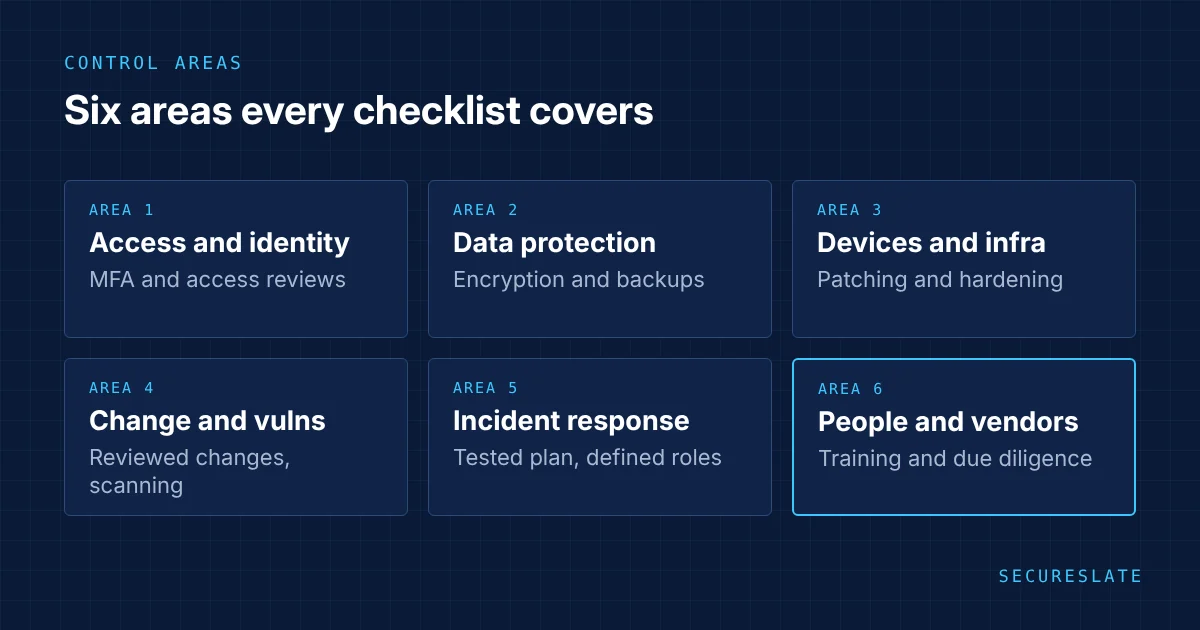
| Control area | Minimum items to check | Typical evidence |
|---|---|---|
| Access and identity | Unique accounts, MFA, least privilege, prompt removal of leavers, periodic access reviews | Identity provider settings, offboarding tickets, review records |
| Data protection | Encryption in transit and at rest, classification, retention and deletion rules, backups tested | Configuration exports, backup restore records |
| Devices and infrastructure | Disk encryption, screen lock, patching, endpoint protection, hardened cloud configuration | Device inventory, cloud configuration checks |
| Change and vulnerability management | Reviewed code changes, separate environments, scanning, remediation within defined timelines | Pull request history, scan reports, remediation tickets |
| Incident response and continuity | Documented plan, defined roles, tested at least yearly, lessons recorded | Plan document, tabletop exercise notes, incident log |
| People and vendors | Background checks where lawful, training, acceptable use, vendor due diligence and contracts | Training reports, signed agreements, vendor reviews |
Treat the timelines in your own policies as part of the checklist. If your policy says critical vulnerabilities are fixed within a set number of days, the assessor will test against that number, not a general idea of what is reasonable.
Which items are specific to each framework?
A handful of items are specific to each framework and cannot be covered by the shared core. Add the relevant rows to your checklist.
| Framework | Items to add |
|---|---|
| SOC 2 | Choose the Trust Services Criteria categories in scope (Security is always included). Write the system description. Decide between a Type 1 report (design at a point in time) and Type 2 (operation over a period). |
| ISO 27001:2022 | Define the ISMS scope and context (Clause 4). Produce a Statement of Applicability covering the 93 Annex A controls. Run an internal audit (Clause 9.2) and a management review (Clause 9.3) before certification. |
| HIPAA | Conduct an accurate and thorough risk analysis (45 CFR 164.308(a)(1)(ii)(A)). Sign business associate agreements. Retain required documentation for six years (45 CFR 164.316(b)(2)(i)). |
| GDPR | Record a lawful basis for each processing purpose (Article 6). Keep records of processing activities (Article 30). Be ready to notify the supervisory authority of a personal data breach without undue delay and, where feasible, within 72 hours (Article 33). Run a data protection impact assessment for high-risk processing (Article 35). |
| PCI DSS v4.0.1 | Define the cardholder data environment. Address all 12 requirements that apply to your scope. Complete the correct self-assessment questionnaire or an assessor-led report. |
For the full detail on a single framework, use a dedicated list such as our PCI DSS compliance checklist.
How often should you review the checklist?
Review the checklist on a fixed cadence, because most controls are recurring and audits of operating effectiveness test them across a period. A simple calendar keeps recurring items from slipping.
- Continuously: configuration monitoring, logging and alerting, onboarding and offboarding, change review.
- Monthly: vulnerability scan review, open remediation items, failed control checks.
- Quarterly: access reviews for sensitive systems, risk register updates, vendor changes.
- Yearly: policy review and approval, risk assessment, security training, incident response and continuity tests, penetration test, internal audit, external audit or surveillance.
- On change: new product, new data type, new region, new critical vendor, acquisition or a significant incident.
These frequencies are common practice, not universal rules. Your framework, auditor and own policies set the binding intervals.
What mistakes make a checklist fail?
Checklists fail when they describe a program that does not match reality. Watch for these patterns:
- Copying a generic list without tailoring scope, so half the items do not apply and important ones are missing.
- No owner per item, which means nobody notices when a recurring task stops.
- Policies that promise more than you do. Assessors test what you wrote.
- Evidence gathered once, just before the audit, for controls that should run all year.
- Ignoring vendors. Data handled by a subprocessor is still your responsibility to govern.
- Treating the audit as the finish line. Controls drift the week after if nothing monitors them.
How SecureSlate helps
SecureSlate turns this checklist into a live program. It includes built-in frameworks such as SOC 2, ISO 27001, HIPAA, HITRUST, GDPR, PCI DSS and NIST CSF with controls mapped across them, so one control counts toward every framework it satisfies. Requirements that have no built-in framework can be set up as a custom framework with your own controls.
Agentless, read-only cloud integrations and a device agent collect evidence and flag failing checks. Access reviews, vendor risk management, risk management and audit management cover the recurring items, each with an owner and a due date. SecureSlate does not perform audits or issue certifications. Your independent auditor does that, using the evidence you have organized.
FAQ
What should a compliance checklist include?
The requirement and its source, the control that meets it, a named owner, how often it runs and the evidence that proves it. Group items by control area so nothing is duplicated across frameworks.
Is there one compliance checklist that covers every framework?
The ten core steps apply to all of them, and most technical controls overlap. Each framework still adds its own documents and rules, such as the ISO 27001 Statement of Applicability or HIPAA business associate agreements.
How long does it take to complete a compliance checklist?
It depends on scope, existing controls and the framework. Small teams with modern cloud tooling can often implement the core controls in weeks to a few months, while reports that test operation over a period take longer by design.
Who should own the compliance checklist?
One accountable person, often a security, compliance or operations lead, with individual controls owned by the teams that run them, such as engineering, IT and HR.
Is a compliance checklist enough to pass an audit?
No. Auditors test whether controls are designed well and, for many assessments, whether they operated consistently. The checklist organizes that work but the evidence has to be real.
Disclaimer (legal note)
This article is for general information only and is not legal, regulatory, or professional advice. Requirements vary by framework, industry, and jurisdiction. Consult qualified advisors for your specific obligations.
Need compliance without the complexity?
SecureSlate automates ISO 27001, SOC 2, GDPR, HIPAA, and more. Built for growing teams. See it in action.
Find compliance gaps in 30 seconds