
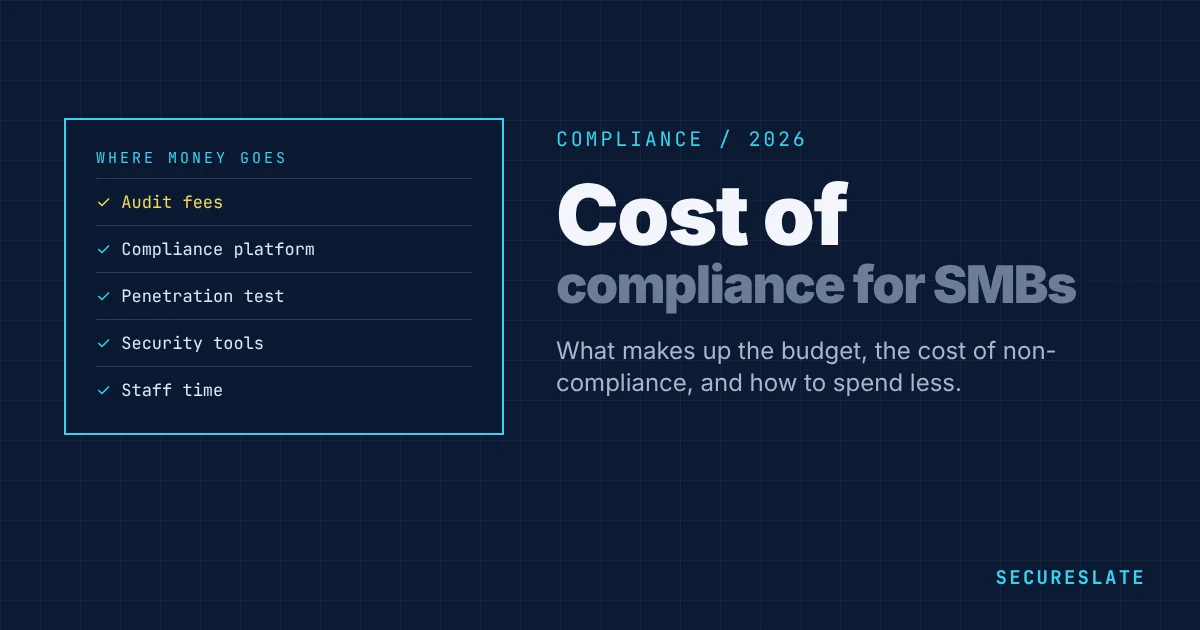
The cost of compliance for a small or mid-sized company is the total of audit fees, tools, penetration tests, staff time and any outside help needed to meet a framework such as SOC 2, ISO 27001 or HIPAA. It varies widely, but most of it is predictable once you know the parts. This guide breaks down typical cost ranges, compares them with the cost of non-compliance, and shows practical ways to lower your budget.
Related guides: How much does a SOC 2 audit cost · How much ISO 27001 costs · ISO 42001 certification cost · CMMC certification cost
Key takeaways
- The main costs are the audit, a compliance platform, a penetration test, security tools and internal staff time.
- Staff time is often the largest hidden cost, especially in the first year.
- The cost of non-compliance, including lost deals, breaches and fines, is usually far higher than the cost of compliance.
- Reusing one control set across frameworks is the most effective way to lower costs.
What makes up the cost of compliance?
| Cost item | Typical range for a small SaaS company | Notes |
|---|---|---|
| Audit or certification fees | Several thousand to tens of thousands of dollars per year | Depends on framework, scope, auditor and company size |
| Compliance platform | A few thousand to tens of thousands of dollars per year | Automates evidence, policies and monitoring |
| Penetration test | Several thousand to tens of thousands of dollars | Usually yearly, scope drives price |
| Security tools | Varies | MFA, device management, endpoint protection, logging, backups |
| Consultants or vCISO | Optional | Useful for the first program, less so later |
| Internal staff time | Often the largest cost | Engineering, IT and leadership hours |
| Training | Low | Security awareness platform or in-house sessions |
Exact prices change often and depend on scope, so get current quotes. Our dedicated guides to SOC 2 audit costs and ISO 27001 costs go into more detail.
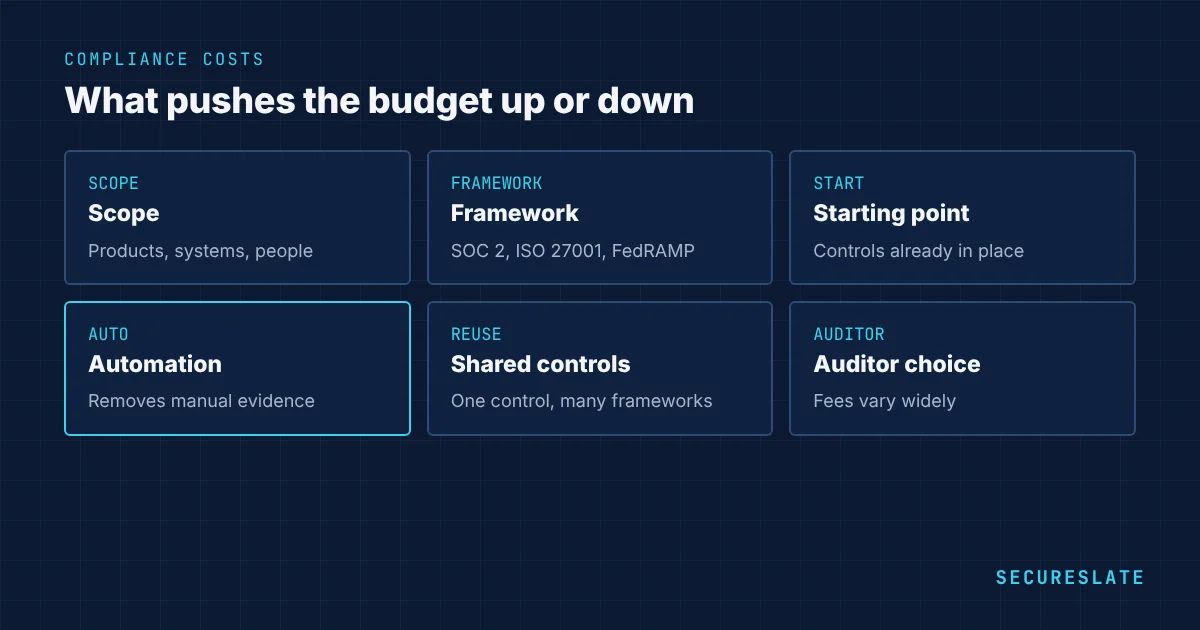
What drives the cost up or down?
- Scope: more products, systems, locations and people mean more controls, more evidence and more audit days.
- Framework: a SOC 2 Type 2 or ISO 27001 certification costs more than a self-assessment. FedRAMP and CMMC Level 2 cost much more.
- Starting point: a company with MFA, encryption, logging and documented processes already in place needs far less work.
- Automation: collecting screenshots by hand takes many hours each audit. Automated evidence collection removes most of it.
- Number of frameworks: each additional framework adds cost, but much less if controls are shared.
- Auditor choice: fees vary widely between firms for similar scope.
The cost of non-compliance
Non-compliance has its own price, often much higher:
- Lost revenue: enterprise deals stall or are lost when you cannot show a SOC 2 report or ISO 27001 certificate.
- Longer sales cycles: each security review without a report takes weeks of questionnaires.
- Fines: GDPR fines can reach 20 million euros or 4% of worldwide annual turnover, whichever is higher. HIPAA civil penalties are tiered and adjusted each year.
- Breach costs: investigation, notification, legal fees, downtime and lost customers. Industry studies consistently put the average cost of a data breach in the millions of dollars.
- Contract penalties: customers may terminate or claim damages if you breach security terms.
Typical first-year budget for a small SaaS company
| Scenario | What is included | Budget level |
|---|---|---|
| Lean SOC 2 Type 1 | Platform, Type 1 audit, basic security tools | Lowest |
| SOC 2 Type 2 | Platform, Type 2 audit, penetration test, security tools | Moderate |
| SOC 2 plus ISO 27001 | Shared controls, two audits, penetration test | Moderate to high |
| Regulated (HIPAA, PCI DSS) on top | Additional assessments and controls | Higher |
The second year is usually cheaper than the first, because policies, processes and tooling are already in place.
How to lower compliance costs
- Start with the framework your customers ask for most, not every framework at once.
- Keep the scope tight. Include the product and systems customers care about.
- Automate evidence collection with integrations to your cloud, identity provider, HR and code tools.
- Use one control set mapped to several frameworks through a common control framework.
- Bundle the audit and penetration test where possible to reduce coordination and cost.
- Use templates for policies, then adapt them, rather than writing from scratch.
- Fix issues before the audit with a readiness check, so you avoid exceptions and re-work.
- Compare auditors on fees, experience with startups and the full multi-year cost.
Hidden costs to plan for
- Remediation work: fixing gaps found during readiness, such as adding logging, enforcing MFA everywhere or setting up device management
- Tool upgrades: some security features, such as SSO or audit logs, sit in higher pricing tiers of the SaaS tools you already use
- Audit preparation time: meetings, walkthroughs and evidence requests during fieldwork
- Ongoing maintenance: quarterly access reviews, yearly policy reviews, training, vendor reviews and risk assessments
- Customer security reviews: questionnaires and calls that continue even after you have a report, though far fewer
Build vs buy: manual compliance vs a platform
| Manual (spreadsheets and folders) | Compliance platform | |
|---|---|---|
| Upfront cost | Low | Subscription fee |
| Staff time | High, especially before each audit | Much lower, evidence collected automatically |
| Risk of gaps | Higher, controls drift between audits | Lower, continuous monitoring flags failures |
| Adding frameworks | Mostly repeated work | Shared controls and mapped evidence |
| Auditor experience | Many requests and screenshots | Evidence organized and linked to controls |
For most companies, the platform pays for itself in staff time within the first audit cycle.
How to build a compliance budget
- List the frameworks customers and regulators require in the next 12 to 24 months.
- Get quotes for audits, penetration tests and a platform, covering the full cycle, not just year one.
- Estimate internal hours for readiness, remediation and audit support, and put a cost on them.
- Add a contingency for remediation of around 10 to 20 percent.
- Compare the total with the revenue tied to deals that require compliance. That comparison usually makes the business case on its own.
How SecureSlate helps
SecureSlate keeps compliance affordable for SMBs. Plans start at $2,688 a year (Starter) and $4,788 a year (Pro), and the Ultra plan at $8,500 a year includes the audit and a penetration test. Automated evidence, multi-framework mapping and built-in policies cut the staff time that usually drives costs up.
FAQ
How much does compliance cost for a small business?
It depends on the framework and scope. For a small SaaS company, a first SOC 2 program including platform, audit and penetration test commonly costs from the low thousands to tens of thousands of dollars, plus staff time.
What is the biggest hidden cost of compliance?
Internal staff time, especially engineering hours spent collecting evidence, writing policies and fixing gaps. Automation and templates reduce it the most.
Is the second year of compliance cheaper?
Usually yes. Policies, controls and tooling are in place, so the main costs are the audit, platform, penetration test and ongoing maintenance.
What is the cost of non-compliance?
Lost deals, slower sales, regulatory fines, breach costs and contract penalties. For most B2B companies, lost revenue is the most immediate cost.
Can we get compliant without a consultant?
Yes. Many small companies use a compliance platform with templates and guidance instead of a consultant, bringing in outside help only for specific gaps.
Does compliance cost more for regulated industries?
Usually yes. Health care, payments, government and financial services add frameworks such as HIPAA, PCI DSS, FedRAMP or DORA, each with their own assessments and controls.
How long does it take to see a return on compliance spending?
Often within the first few enterprise deals. Many B2B companies find that a single deal unblocked by a SOC 2 report or ISO 27001 certificate covers the full first-year cost.
Should we pay for SOC 2 and ISO 27001 at the same time?
Only if customers need both soon. Doing them together with shared controls costs less than two separate projects, but starting with the one your buyers ask for most spreads the cost.
Disclaimer (legal note)
This article is for general information only and is not legal, regulatory, or professional advice. Requirements vary by framework, industry, and jurisdiction. Consult qualified advisors for your specific obligations.
Need compliance without the complexity?
SecureSlate automates ISO 27001, SOC 2, GDPR, HIPAA, and more. Built for growing teams. See it in action.
Find compliance gaps in 30 seconds