
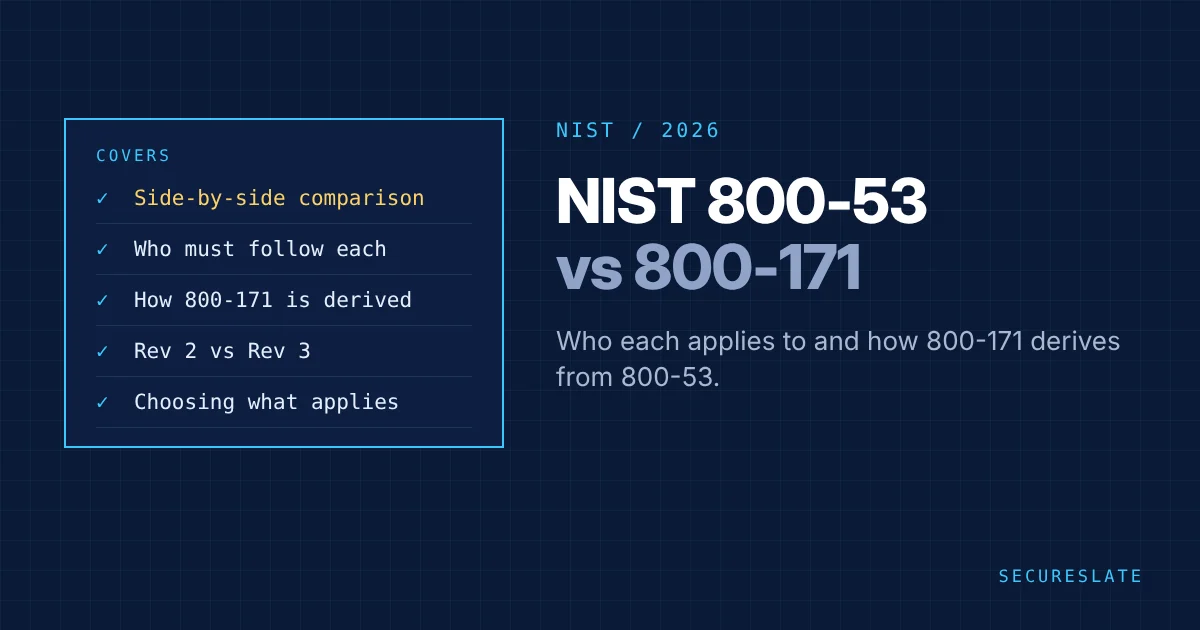
Short answer: NIST SP 800-53 is the full catalog of security and privacy controls for federal information systems and the providers that run them. NIST SP 800-171 is a much shorter set of requirements, derived from 800-53, for protecting Controlled Unclassified Information (CUI) in nonfederal systems such as contractor networks. Which one applies depends on whose system it is and what data it holds.
Related guides: The ultimate guide to NIST 800-53 · The ultimate guide to NIST 800-171 · CMMC vs NIST 800-53
Key takeaways
- 800-53 is a control catalog for federal systems, used with baselines and tailoring. 800-171 is a fixed requirement set for CUI on nonfederal systems.
- 800-171 was built by starting from the 800-53 Moderate baseline and keeping what matters for protecting the confidentiality of CUI.
- Federal agencies and FedRAMP cloud providers work with 800-53. Defense and other federal contractors that hold CUI work with 800-171.
- 800-171 Revision 3 (May 2024) has 97 requirements in 17 families, but DoD contracts and CMMC still use the 110 requirements of Revision 2 as of November 2026.
- Many organisations use 800-53 as a reference even when 800-171 is their obligation, because each 800-171 requirement traces back to 800-53 controls.
What is the difference between NIST 800-53 and 800-171?
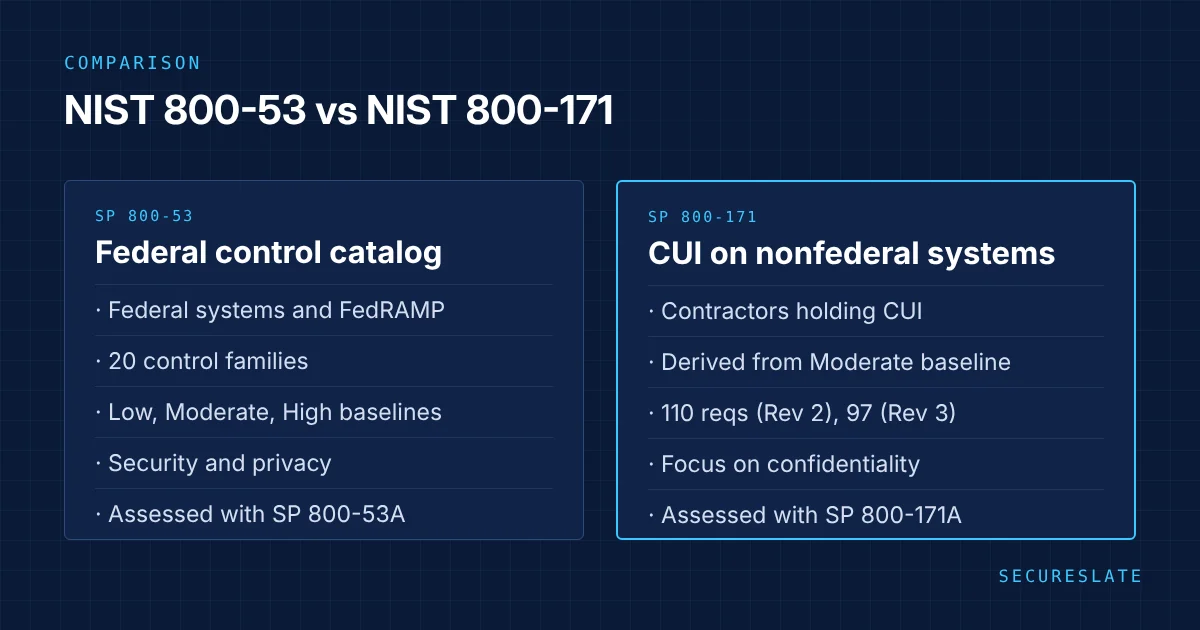
The core difference is scope: 800-53 secures federal systems broadly, and 800-171 protects one category of federal data held by others.
| NIST SP 800-53 | NIST SP 800-171 | |
|---|---|---|
| Full name | Security and Privacy Controls for Information Systems and Organizations | Protecting Controlled Unclassified Information in Nonfederal Systems and Organizations |
| Current revision | Revision 5 | Revision 3, with Revision 2 still used by DoD |
| Main audience | Federal agencies, their systems and cloud providers serving them | Nonfederal organisations that process, store or transmit CUI |
| Size | A large catalog of controls and enhancements in 20 families | 110 requirements (Rev 2) or 97 requirements (Rev 3) |
| Goal | Security and privacy across confidentiality, integrity and availability | Mainly confidentiality of CUI |
| How it is applied | Pick a baseline (Low, Moderate, High) from SP 800-53B, then tailor | Implement all applicable requirements |
| Assessment guide | SP 800-53A | SP 800-171A |
| Typical driver | FISMA, FedRAMP, agency policy | Contract clauses such as DFARS 252.204-7012, and CMMC for DoD |
Who must follow each one?
You follow 800-53 if you operate a federal system or sell cloud services to agencies. You follow 800-171 if a contract puts federal CUI in your systems.
- Federal agencies apply 800-53 to their information systems under FISMA, with baselines chosen by system impact level.
- Cloud service providers seeking FedRAMP authorization implement 800-53 based baselines, because their service effectively becomes part of agency systems.
- Defense contractors and subcontractors that handle CUI must implement 800-171 through DFARS 252.204-7012, and CMMC Level 2 verifies those requirements.
- Other federal contractors, universities and research organisations may be required to follow 800-171 by the agency that shares CUI with them.
CUI is information the government creates or owns that needs safeguarding under law, regulation or government-wide policy, but is not classified. The National Archives maintains the CUI Registry, which lists the categories. Contract documents and markings usually tell you when you are receiving CUI. If you are unsure, ask your contracting officer before you scope your systems.
A company can face both. A SaaS provider pursuing FedRAMP for one product while also holding CUI under a defense contract would need to handle each obligation for the systems in its scope.
How is NIST 800-171 derived from 800-53?
NIST built 800-171 by tailoring the 800-53 Moderate baseline for nonfederal organisations. It removed controls that only make sense inside government, controls focused on integrity or availability rather than confidentiality, and controls that most organisations are expected to have anyway.
The result is a set of requirements written for organisations that are not federal agencies. Each 800-171 requirement lists the 800-53 controls it came from. That traceability is useful in two ways:
- If 800-171 wording is unclear, the source 800-53 control and its discussion often explain the intent.
- If you later move toward FedRAMP or an agency system, much of your 800-171 work maps onto 800-53 controls, although you will have more to add.
Which revisions apply as of November 2026?
For 800-53 the answer is simple: Revision 5. For 800-171 it depends on who you answer to.
| 800-171 Revision 2 | 800-171 Revision 3 | |
|---|---|---|
| Published | February 2020 | May 2024 |
| Requirements | 110 | 97 |
| Families | 14 | 17, adding Planning, System and Services Acquisition, and Supply Chain Risk Management |
| Organisation-defined parameters | No | Yes, for many requirements |
| Used by DoD contracts and CMMC Level 2 | Yes | Not yet |
According to the DoD CIO's CMMC alignment guidance, CMMC Level 2 and DFARS 252.204-7012 assessments use Revision 2, and DoD will adopt Revision 3 through future rulemaking. Organisations may move toward Revision 3 voluntarily, but they still have to meet Revision 2 for contract compliance. If you answer to a non-defense agency, check what your contract specifies.
How different is the compliance effort?
800-53 compliance is usually a much larger program than 800-171 compliance. The differences show up in four places:
- Control volume. An 800-53 Moderate baseline contains far more controls than the 800-171 requirement set, and it covers areas like contingency planning and privacy that 800-171 Rev 2 does not address as families.
- Documentation. Federal systems need a full authorization package, including a system security plan, assessment report and plan of action and milestones, leading to an authorization to operate. 800-171 also expects a system security plan and plans of action, but the package is lighter.
- Assessment. 800-53 controls are assessed by agency assessors or, for FedRAMP, by third-party assessment organisations. 800-171 may be self-assessed or assessed by a third party under CMMC, depending on the contract.
- Continuous monitoring. Both expect ongoing monitoring. Federal programs typically have more formal reporting schedules.
For a small or mid-sized contractor, 800-171 is the realistic target. Trying to implement all of 800-53 when your contract only asks for 800-171 adds cost without changing what you must prove.
How do you decide which one you need?
Start from your contracts and data, not from the frameworks. Work through these steps:
- Identify who owns the system. If it is operated on behalf of a federal agency, 800-53 likely applies.
- Identify the data. If you receive or create CUI under a federal contract, 800-171 likely applies to the systems that touch it.
- Read the clauses. Look for DFARS 252.204-7012, CMMC clauses or agency-specific requirements in your contracts.
- Scope tightly. Put CUI in an enclave or a defined set of systems so fewer assets fall under 800-171.
- Map once. Use the 800-53 references inside 800-171 so other frameworks you run, such as ISO 27001 or SOC 2, share evidence where controls overlap.
- Check for change. Track DoD and NIST announcements on Revision 3 adoption so you are not surprised by a contract update.
Our guide to NIST 800-171A assessment objectives explains how assessors test each requirement.
How SecureSlate helps
SecureSlate has built-in support for NIST CSF, CMMC and FedRAMP, and can hold NIST 800-53 or 800-171 control sets as custom frameworks mapped to the controls you already run for SOC 2 or ISO 27001. Agentless, read-only cloud integrations and the device agent collect evidence for access, configuration and endpoint requirements. Access reviews, risk management and audit management keep your system security plan evidence current for whoever assesses you. SecureSlate does not perform assessments or issue certifications.
Start a free trial to map your NIST controls in one place.
FAQ
Is NIST 800-171 a subset of NIST 800-53?
Effectively yes. It was derived from the 800-53 Moderate baseline and rewritten for nonfederal organisations, and each requirement lists its 800-53 sources.
Does complying with 800-53 mean I comply with 800-171?
Implementing the 800-53 Moderate baseline covers most of the intent of 800-171, but you still need to show each 800-171 requirement is met in the format your contract or assessor expects.
Do private companies need NIST 800-53?
Only if they operate federal systems, sell cloud services under FedRAMP or have a contract that requires it. Some private companies use it voluntarily as a reference catalog.
Should I implement 800-171 Revision 2 or Revision 3?
For DoD contracts and CMMC, Revision 2 as of November 2026. Track Revision 3, since DoD has said it will adopt it through future rulemaking.
Can I get certified in NIST 800-53 or 800-171?
NIST does not certify organisations. Compliance is shown through agency authorizations, FedRAMP authorization or, for 800-171 in defense contracts, CMMC assessments.
Disclaimer (legal note)
This article is for general information only and is not legal, regulatory, or professional advice. Requirements vary by framework, industry, and jurisdiction. Consult qualified advisors for your specific obligations.
Need compliance without the complexity?
SecureSlate automates ISO 27001, SOC 2, GDPR, HIPAA, and more. Built for growing teams. See it in action.
Find compliance gaps in 30 seconds