
Short answer: A NIST 800-53 control is a safeguard from the catalog in NIST Special Publication 800-53, identified by a family code and number such as AC-2. Each control has a base statement, a discussion, related controls, optional enhancements and organization-defined parameters that you fill in. You select controls through a baseline, tailor them and prove them with evidence.
Related guides: The ultimate guide to NIST 800-53 · CMMC vs NIST 800-53 · Best NIST compliance software
Key takeaways
- Every control has an identifier (for example AC-2), a control statement, a discussion, related controls, optional control enhancements such as AC-2(1), and references.
- Organization-defined parameters in brackets are values you must set, such as review frequencies or time periods.
- Controls sit in 20 families in Revision 5, from Access Control (AC) to Supply Chain Risk Management (SR).
- Baselines in SP 800-53B tell you where to start, and tailoring adjusts them to your system.
- Assessors test controls with examine, interview and test methods described in SP 800-53A, so plan your evidence around those.
What is a NIST 800-53 control?
A NIST 800-53 control is one safeguard or countermeasure, described in a standard format, that protects the confidentiality, integrity or availability of a system or the privacy of individuals.
The catalog is published as NIST SP 800-53 Revision 5. NIST updates it through minor releases; for example, Release 5.2.0 in August 2025 added and revised content on software updates, patching and secure development. Revision 5 made two changes that matter when you read a control. First, control statements are written as outcomes without naming who performs them, so they apply to any organization, not only federal agencies. Second, privacy controls and supply chain controls were integrated into the main catalog, and the baselines moved to a separate document, SP 800-53B.
If you want the full picture of scope, FISMA and authorization, start with our ultimate guide to NIST 800-53. This article zooms in on a single control: how to read it, how to adapt it and how to prove it.
How is a control structured?
Each control follows the same layout, so once you can read one you can read them all.
| Part | What it contains | What you do with it |
|---|---|---|
| Identifier and name | Family code, number and title, such as AC-2 Account Management | Use as the key in your control library and evidence |
| Control statement | The required outcome, often split into lettered items (a, b, c...) | Treat each lettered item as something to implement and evidence |
| Organization-defined parameters | Bracketed text such as [Assignment: organization-defined frequency] or [Selection: ...] | Set a concrete value and record it in policy or the system security plan |
| Discussion | Explanation, context and implementation ideas | Read it to understand intent; it is not an extra requirement |
| Related controls | Other controls that interact with this one | Check them so your implementation is consistent |
| Control enhancements | Numbered additions such as AC-2(1), each strengthening or extending the base control | Implement those your baseline or risk analysis selects |
| References | Laws, standards and guidance behind the control | Use for deeper research |
Two details trip people up. Withdrawn controls still appear in the catalog with a note saying where their content moved, so you will see gaps in numbering. And enhancements are separate selections: implementing AC-2 does not mean you must implement every AC-2 enhancement.
How are controls grouped into families?
Controls are grouped into 20 families, each with a two-letter code that tells you the subject area.
| Code | Family | Code | Family |
|---|---|---|---|
| AC | Access Control | MP | Media Protection |
| AT | Awareness and Training | PE | Physical and Environmental Protection |
| AU | Audit and Accountability | PL | Planning |
| CA | Assessment, Authorization and Monitoring | PM | Program Management |
| CM | Configuration Management | PS | Personnel Security |
| CP | Contingency Planning | PT | PII Processing and Transparency |
| IA | Identification and Authentication | RA | Risk Assessment |
| IR | Incident Response | SA | System and Services Acquisition |
| MA | Maintenance | SC | System and Communications Protection |
| SI | System and Information Integrity | SR | Supply Chain Risk Management |
Families are for organization, not ownership. A single team, such as platform engineering, often owns controls in AC, AU, CM, SC and SI at the same time.
Which controls apply to your system?
The controls that apply come from a baseline chosen by the system's impact level, then tailored to your environment and risk.
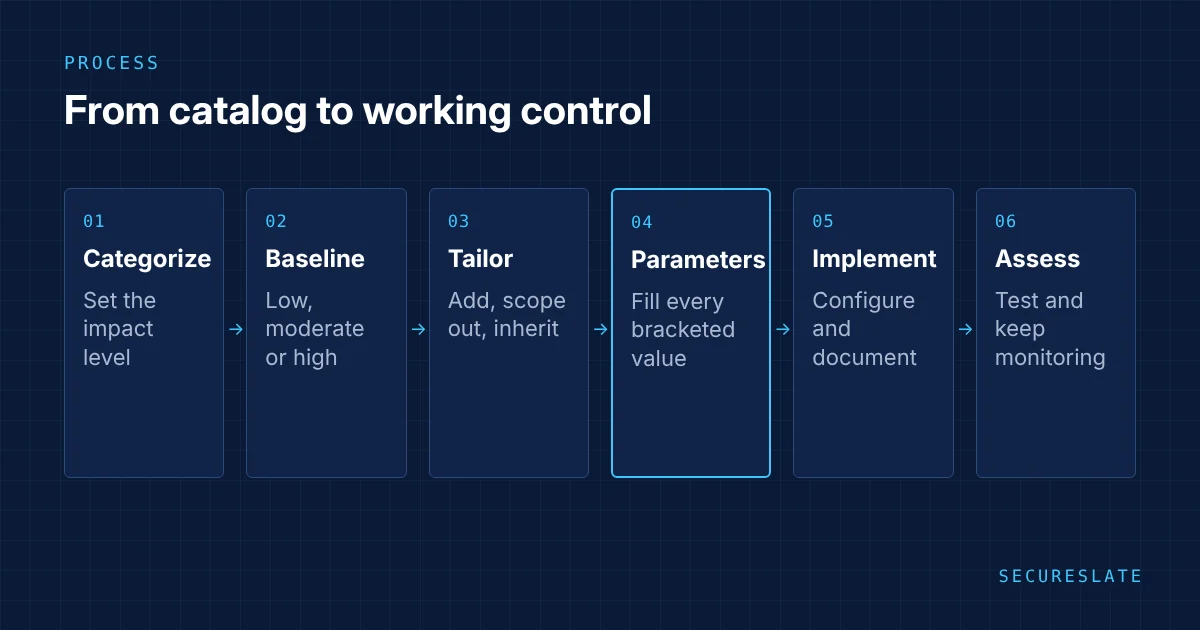
NIST SP 800-53B defines low, moderate and high security baselines and a separate privacy baseline. The steps below show how a control goes from the catalog to your system.
- Categorize the system. Decide its impact level based on the information it processes and the harm a breach would cause.
- Select the baseline. Start from the matching low, moderate or high baseline, plus the privacy baseline where personal data is involved.
- Tailor. Add controls or enhancements for specific risks, scope out controls that do not apply with a written rationale, and identify common controls inherited from a cloud provider or shared service.
- Set parameters. Fill every organization-defined parameter with a value you can actually meet, such as a review frequency.
- Implement. Configure systems and processes, and describe how each control is met in the system security plan.
- Assess and monitor. Test the controls, fix gaps and keep checking them over time.
Programs built on 800-53, such as FedRAMP, publish their own baselines and may set some parameter values for you, so always check the program's requirements before choosing your own.
Worked example: AC-2 Account Management
AC-2 is a good example because nearly every system needs it and it shows all the parts of a control.
The base control asks you to manage the full account lifecycle: define the types of accounts allowed, assign account managers, require approvals for account creation, monitor account use, disable or remove accounts when they are no longer needed, and review accounts for compliance. Several items contain parameters, such as how often accounts are reviewed and who must approve new accounts.
Here is how a small SaaS team might turn that into practice:
- Parameters set: privileged accounts reviewed quarterly, all accounts reviewed at least every six months, new accounts approved by the system owner.
- Process: access requests through a ticket, joiner and leaver steps tied to HR records, a scheduled access review in the identity provider.
- Enhancement selected: AC-2(1) Automated System Account Management, met by provisioning through the identity provider instead of by hand.
- Related controls checked: IA-2 for authentication, including IA-2(1) multi-factor authentication for privileged accounts, and AU-2 for logging account events.
The value you choose for a parameter becomes a promise. If your plan says quarterly reviews, an assessor will ask for four quarters of review records.
What evidence proves a control is working?
Evidence must show both that the control is designed correctly and that it operates over time, matching the assessment methods in NIST SP 800-53A.
SP 800-53A describes three assessment methods: examine (review documents, records and configurations), interview (talk to the people who run the control) and test (exercise the mechanism and compare results to expectations). Prepare for all three.
Use this checklist for each control:
- Policy or procedure that states the requirement and every parameter value
- System security plan entry describing how the control is implemented
- Configuration evidence, such as settings exports or screenshots with dates
- Records of the control operating, such as review tickets, logs or approvals
- Named owner who can explain the control in an interview
- Record of inherited or shared responsibility, if a provider meets part of it
- Open findings tracked in a plan of action and milestones
Evidence that is collected once and never refreshed is the most common weakness. Tie each control to a refresh schedule that matches its parameter values.
How SecureSlate helps
SecureSlate helps teams manage NIST 800-53 controls without spreadsheets:
- Custom frameworks and controls: set up NIST SP 800-53 as a custom framework with your selected baseline, enhancements and parameter values. FedRAMP and NIST CSF are built in.
- Multi-framework control mapping so one implemented control also counts toward SOC 2, ISO 27001, HIPAA, CMMC and others where they overlap.
- Agentless, read-only cloud integrations and a device agent to collect configuration evidence on a schedule.
- Access reviews to run and record reviews like those in AC-2.
- Risk management and audit management to track findings and assessor requests.
SecureSlate does not perform assessments or issue authorizations. Start a free trial to build your control library.
FAQ
How many controls are in NIST 800-53?
Revision 5 contains more than a thousand controls and control enhancements across 20 families. The exact count changes with minor releases and withdrawn items, so check the current catalog on the NIST site.
What is a control enhancement?
A control enhancement is a numbered addition to a base control, written as AC-2(1) for example. It adds strength or extra function and is selected separately from the base control.
What are organization-defined parameters?
They are bracketed placeholders in a control, such as a frequency or time period, that your organization fills in. The values you choose become requirements that assessors will check.
Do I need to implement every NIST 800-53 control?
No. You start from a baseline that matches your system's impact level and then tailor it. Controls you scope out need a documented rationale.
What is the difference between SP 800-53, 800-53A and 800-53B?
SP 800-53 is the control catalog, SP 800-53A gives assessment procedures for testing the controls, and SP 800-53B defines the control baselines and tailoring guidance.
Disclaimer (legal note)
This article is for general information only and is not legal, regulatory, or professional advice. Requirements vary by framework, industry, and jurisdiction. Consult qualified advisors for your specific obligations.
Need compliance without the complexity?
SecureSlate automates ISO 27001, SOC 2, GDPR, HIPAA, and more. Built for growing teams. See it in action.
Find compliance gaps in 30 seconds