
PII vs PHI vs PCI is a common source of confusion because the three overlap and are often mentioned together. PII (personally identifiable information) is any information that can identify a person. PHI (protected health information) is health-related information about a person that is created or held by a HIPAA covered entity or business associate. PCI data refers to payment card data protected under the PCI Data Security Standard (PCI DSS). Knowing which type you handle tells you which laws, contracts and controls apply. This guide defines each, gives examples, shows where they overlap and explains how to protect them.
Related guides: HIPAA encryption requirements · Data classification policy · GDPR lawful bases · HIPAA Security Rule update
Key takeaways
- PII is a broad category of data that identifies a person, governed by many privacy laws.
- PHI is a subset of identifiable health information held by HIPAA-regulated entities.
- PCI data is cardholder data and sensitive authentication data, governed by the industry standard PCI DSS v4.0.1.
- One record can be all three, for example a patient's name, diagnosis and card number on a billing record.
- Protect each with classification, access control, encryption, minimization and monitoring, plus the specific rules for each.
Definitions
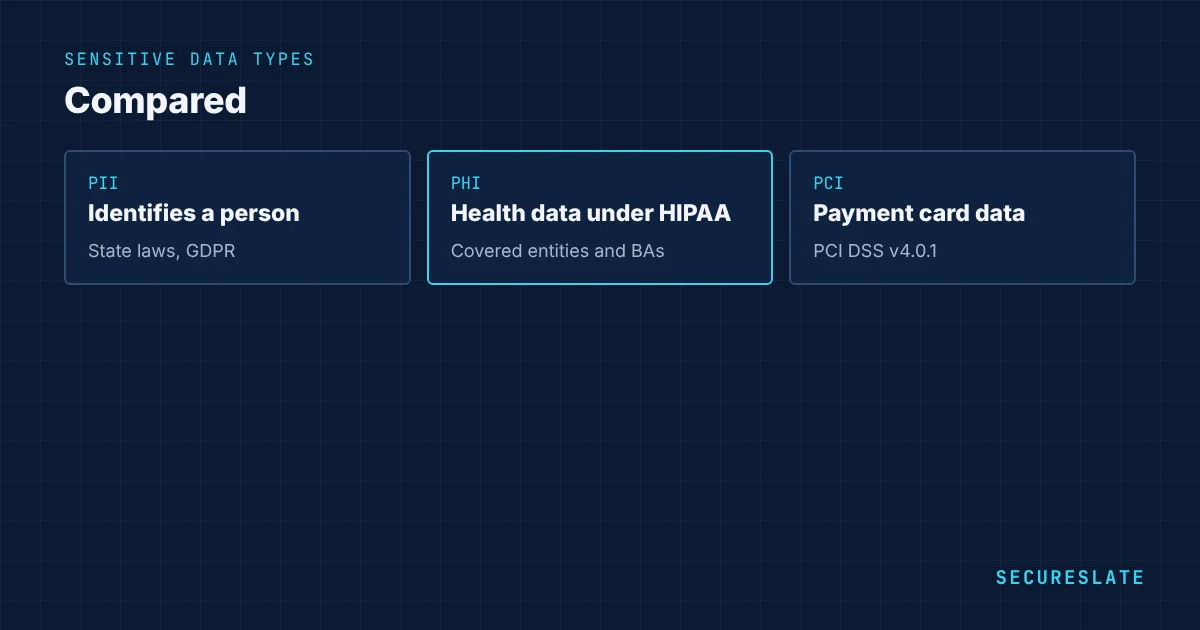
| Type | Definition | Main rules |
|---|---|---|
| PII | Information that can identify an individual directly or when combined with other data | US state privacy and breach laws, GDPR (as "personal data"), sector laws, FTC Act |
| PHI | Individually identifiable health information held or transmitted by a covered entity or business associate, in any form | HIPAA Privacy, Security and Breach Notification Rules |
| PCI data | Cardholder data (PAN, plus name, expiration date and service code when stored with PAN) and sensitive authentication data | PCI DSS, card brand rules, merchant agreements |
Examples
| PII | PHI | PCI |
|---|---|---|
| Full name with address | Patient name with diagnosis | Primary account number (PAN) |
| Email address | Medical record number | Cardholder name stored with PAN |
| Social Security number | Lab results linked to a patient | Expiration date stored with PAN |
| Driver's license number | Health insurance member ID | Service code |
| Date of birth with name | Appointment dates for an identified patient | Full track data (sensitive authentication data) |
| IP address or device ID (in some laws) | Billing records for treatment | CVV2 or CVC2 code (sensitive authentication data) |
| Biometric data | Prescription records | PIN and PIN block (sensitive authentication data) |
What makes health information PHI
Health information becomes PHI when it is individually identifiable and created, received, maintained or transmitted by a covered entity (health plans, healthcare clearinghouses and providers that conduct standard electronic transactions) or a business associate. A fitness app collecting heart rate data directly from consumers is usually not handling PHI under HIPAA, although the FTC and state laws such as Washington's My Health My Data Act may apply. HIPAA's de-identification standards include the Safe Harbor method, which removes 18 types of identifiers, and the Expert Determination method.
PCI data in detail
PCI DSS applies to any entity that stores, processes or transmits cardholder data or sensitive authentication data, or can affect its security. Key rules:
- Sensitive authentication data such as full track data, card verification codes and PINs must not be stored after authorization, even if encrypted.
- PAN must be rendered unreadable wherever stored, for example by strong cryptography, truncation, tokenization or hashing.
- PCI DSS v4.0.1 is the current version, and requirements that were future-dated became mandatory on March 31, 2025.
- Many merchants reduce scope by using hosted payment pages or tokenization so card data never touches their systems.
How they overlap
| Scenario | PII | PHI | PCI |
|---|---|---|---|
| Hospital billing record with card payment | Yes | Yes | Yes |
| Online store customer account | Yes | No | Yes, if card data is stored or processed |
| Telehealth app operated by a provider | Yes | Yes | Possibly |
| HR employee file | Yes | Usually not PHI (employment records are excluded) | No |
| Marketing email list | Yes | No | No |
Breach notification differences
| Data | Notification rules |
|---|---|
| PII | State breach laws (all 50 states have them), GDPR 72-hour regulator notification for EU personal data |
| PHI | HIPAA: individuals without unreasonable delay and no later than 60 days; HHS; media for breaches affecting more than 500 residents of a state or jurisdiction |
| PCI | Card brands and acquiring bank per merchant agreements; forensic investigation may be required |
How to protect each
| Control | PII | PHI | PCI |
|---|---|---|---|
| Classification | Confidential or Restricted | Restricted | Restricted |
| Minimization | Collect only what is needed | Minimum necessary standard | Do not store SAD; avoid storing PAN |
| Encryption | Strongly recommended, required by some laws | Addressable today, proposed to be required | Required for stored PAN and transmission over open networks |
| Access control | Need to know | Role-based, minimum necessary | Restricted by business need to know (Requirement 7) |
| Logging | Recommended | Audit controls required | Requirement 10 |
| Vendors | DPAs, contracts | Business associate agreements | Service provider PCI compliance |
| Assessments | Privacy assessments | HIPAA risk analysis | SAQ or ROC, quarterly ASV scans where required |
Practical steps
- Map your data. Find where each type is collected, stored and shared.
- Classify. Tag systems by PII, PHI and PCI.
- Reduce scope. Tokenize card data, de-identify health data where possible, and delete what you do not need.
- Apply controls. Encryption, access control and logging matched to each data type.
- Manage vendors. Contracts and evidence for each type.
- Train staff. Make sure people recognize each type and handle it correctly.
Common mistakes
- Assuming all health-related data is PHI, even when the organization is not a covered entity or business associate
- Storing card verification codes "temporarily" in logs or support tickets
- Forgetting that data in backups, exports and analytics tools is still in scope
- Treating PII in employee records as less important than customer PII
- Applying HIPAA rules but ignoring state privacy and breach laws that also apply
Data mapping example
| System | PII | PHI | PCI | Key controls |
|---|---|---|---|---|
| Patient portal | Yes | Yes | No | MFA, encryption, audit logs, BAA with hosting provider |
| Billing system | Yes | Yes | Tokenized only | Tokenization, access limited to billing team |
| Payment processor | Yes | No | Yes, handled by processor | Service provider PCI attestation |
| CRM | Yes | No | No | Role-based access, DPA |
How SecureSlate helps
SecureSlate helps organizations protect PII, PHI and PCI data with one program. Multi-framework mapping covers HIPAA, PCI DSS, GDPR and SOC 2, continuous checks confirm encryption and access controls, the device agent enforces endpoint protections and vendor risk tracks BAAs, DPAs and service provider evidence, at SMB-friendly pricing.
FAQ
What is the difference between PII and PHI?
PII is any information that identifies a person. PHI is identifiable health information held or transmitted by a HIPAA covered entity or business associate.
Is PCI data the same as PII?
Cardholder data includes PII such as the cardholder name, but PCI refers specifically to payment card data protected under PCI DSS.
Can data be PII, PHI and PCI at once?
Yes. A healthcare billing record with a patient's name, treatment and card number contains all three.
Is PCI DSS a law?
No. It is an industry standard enforced through card brand rules and merchant agreements, though some state laws reference it.
What is sensitive authentication data?
Full track data, card verification codes and PINs. PCI DSS prohibits storing it after authorization.
Is de-identified health data still PHI?
No. Health information properly de-identified under HIPAA's Safe Harbor or Expert Determination methods is no longer PHI, although other privacy laws may still apply in some cases.
Disclaimer (legal note)
This article is for general information only and is not legal, regulatory, or professional advice. Requirements vary by framework, industry, and jurisdiction. Consult qualified advisors for your specific obligations.
Need compliance without the complexity?
SecureSlate automates ISO 27001, SOC 2, GDPR, HIPAA, and more. Built for growing teams. See it in action.
Find compliance gaps in 30 seconds