
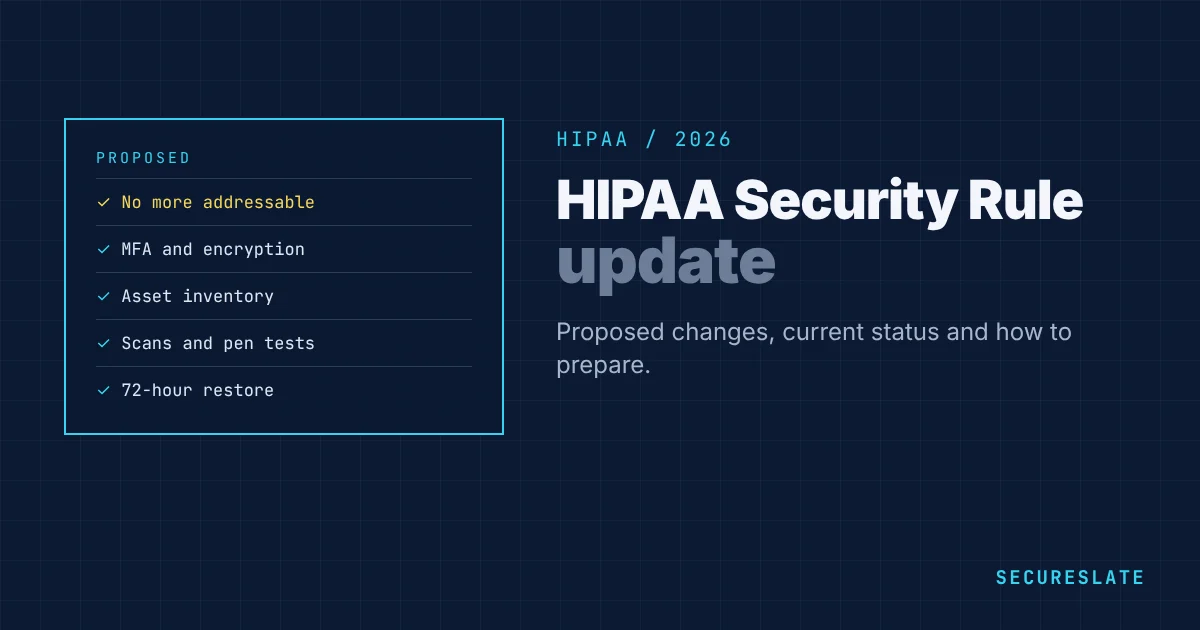
The HIPAA Security Rule update is the most significant proposed change to HIPAA security requirements since the rule took effect in 2005. On January 6, 2025, the HHS Office for Civil Rights (OCR) published a notice of proposed rulemaking that would make many safeguards mandatory, including multifactor authentication, encryption, asset inventories, network maps, regular vulnerability scanning and penetration testing, and would remove the long-standing distinction between "required" and "addressable" specifications. The comment period closed on March 7, 2025. As of November 2026, the rule is not final: the federal regulatory agenda moved it to long-term actions, with final action listed for no earlier than July 2027, according to Paubox's summary of the agenda. The current Security Rule remains in force. This guide explains what would change and why it makes sense to prepare now.
Related guides: HIPAA encryption requirements · PII vs PHI vs PCI · HIPAA compliance guide · Incident management policy
Regulatory timelines can change. Check HHS and the Federal Register for the latest status before making compliance decisions.
Key takeaways
- The proposal would remove "addressable" flexibility, making most safeguards required with limited exceptions.
- Proposed requirements include MFA, encryption at rest and in transit, asset inventories, network maps, vulnerability scans every six months and yearly penetration tests.
- Organizations would need to restore critical systems within 72 hours and keep written documentation of all policies and analyses.
- Business associates would face stronger verification and notification expectations.
- The rule is not final; the current Security Rule still applies. Most proposed controls are good practice and help with SOC 2 and ISO 27001 anyway.
Why HHS proposed changes
Healthcare has seen a sharp rise in large breaches and ransomware attacks, including incidents that disrupted care nationwide. HHS cited the outdated nature of some Security Rule provisions, inconsistent implementation of addressable specifications, and the need to align with modern cybersecurity practices such as those in NIST guidance and HHS's own Cybersecurity Performance Goals for the healthcare sector.
Main proposed changes
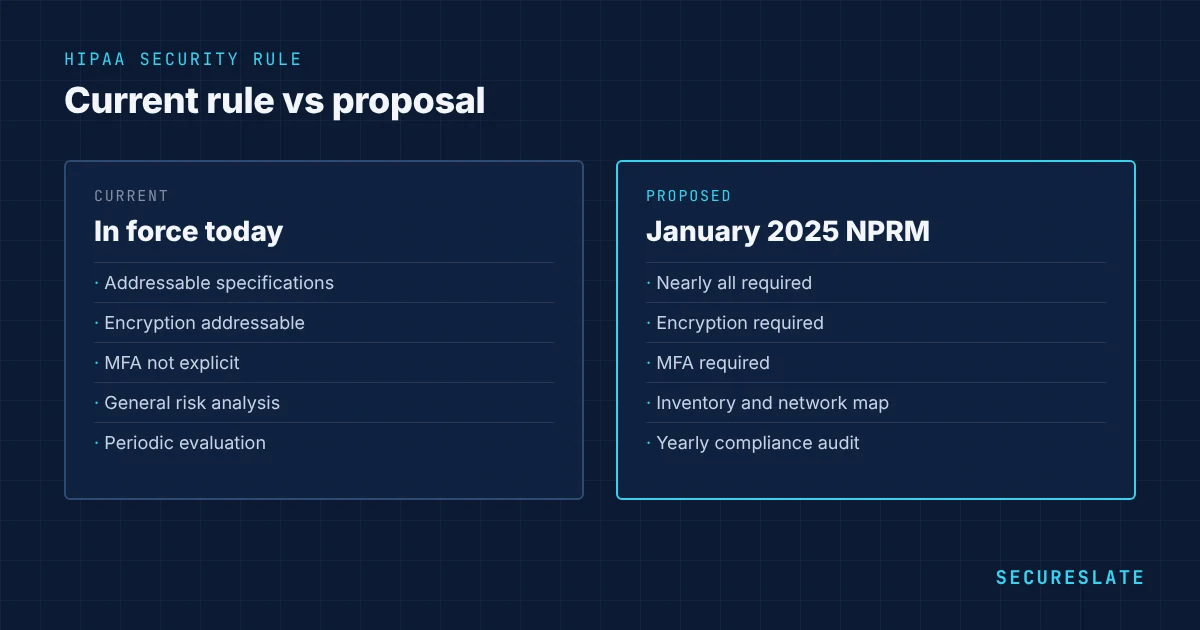
| Area | Current Security Rule | Proposed change |
|---|---|---|
| Required vs addressable | Addressable specifications can be implemented, replaced with alternatives or documented as not reasonable | Distinction removed; nearly all specifications required, with limited exceptions |
| Documentation | Policies and procedures must be documented | All policies, procedures, plans and analyses in writing, reviewed and updated |
| Asset inventory and network map | Not explicitly required | Written technology asset inventory and network map of ePHI movement, updated at least yearly |
| Risk analysis | Required, without detailed content | More specific content, reviewed at least every 12 months |
| Encryption | Addressable | Required for ePHI at rest and in transit, with limited exceptions |
| Multifactor authentication | Not explicitly required | Required, with limited exceptions |
| Vulnerability management | General security management | Vulnerability scanning at least every six months; penetration testing at least every 12 months |
| Network segmentation | Not explicit | Required |
| Contingency planning | Required, with addressable elements | Restore critical systems and data within 72 hours; criticality analysis |
| Compliance audit | Periodic evaluation | Compliance audit at least every 12 months |
| Business associates | BAAs required | Written verification of technical safeguards at least yearly; notification of contingency plan activation within 24 hours |
| Workforce access changes | Procedures required | Notify other entities within 24 hours of changes or termination of access in some cases |
These summaries are based on the proposed rule. The final rule, if adopted, may differ.
Current status and timeline
| Date | Event |
|---|---|
| December 27, 2024 | HHS announced the proposed rule |
| January 6, 2025 | Proposed rule published in the Federal Register |
| March 7, 2025 | Comment period closed, with thousands of comments filed |
| 2025 to 2026 | Regulatory agenda listed the rule at final rule stage, then moved it |
| Current agenda | Listed under long-term actions, with final action no earlier than July 2027 |
The proposal suggested a compliance date about 240 days after publication of a final rule (60 days to take effect plus 180 days to comply), with additional time to update business associate agreements. Timelines in the final rule may change.
What to do now
Even without a final rule, most proposed controls are expected by OCR in investigations, by cyber insurers and by customers. They also overlap with SOC 2 and ISO 27001. Practical steps:
- Inventory assets and map ePHI flows. You need this for an accurate risk analysis today.
- Update the risk analysis. OCR's Risk Analysis Initiative has led to repeated enforcement actions for missing or inadequate risk analyses.
- Enforce MFA for all remote access, email and systems with ePHI.
- Encrypt ePHI at rest and in transit. Encryption also supports the breach notification safe harbor today.
- Start regular vulnerability scanning and schedule a yearly penetration test.
- Test backups and restoration against a 72-hour recovery goal for critical systems.
- Review business associates. Collect security evidence and update BAAs.
- Document everything in writing with review dates.
Impact by organization type
| Organization | Likely impact |
|---|---|
| Small practices | Biggest change: formal inventories, MFA everywhere, testing and written documentation |
| Hospitals and health systems | Large scope: legacy systems, medical devices and segmentation |
| Health tech and SaaS business associates | More customer verification requests; SOC 2 and ISO evidence will help |
| Health plans | Vendor oversight and documentation expectations increase |
Enforcement today
While the proposal is pending, OCR continues to enforce the current rule. Recent enforcement has focused on risk analysis failures, ransomware incidents and right of access. Penalty amounts are adjusted for inflation each year. Strong documentation of your risk analysis and risk management remains the best protection.
Gap assessment against the proposal
| Proposed requirement | Questions to ask now |
|---|---|
| Asset inventory and network map | Do we have a current list of every system touching ePHI and how data moves between them? |
| MFA | Is MFA enforced for every user and system with ePHI access, including vendors? |
| Encryption | Is ePHI encrypted at rest and in transit everywhere, including backups and email? |
| Vulnerability scanning and pen testing | Do we scan at least every six months and test yearly? |
| 72-hour restoration | Have we tested restoring critical systems within 72 hours? |
| Compliance audit | Do we audit our Security Rule compliance every year? |
| Business associate verification | Do we receive written confirmation of safeguards from business associates each year? |
| Written documentation | Are policies, plans and analyses written, reviewed and current? |
Answering these now shows where effort is needed, whatever the final rule says.
How SecureSlate helps
SecureSlate helps covered entities and business associates prepare for current and proposed HIPAA Security Rule requirements. It maintains asset inventories, runs risk analyses in the risk register, continuously checks MFA, encryption and logging, monitors vulnerabilities and device security, and tracks business associate evidence, all mapped to HIPAA, SOC 2 and ISO 27001 at SMB-friendly pricing.
FAQ
Is the new HIPAA Security Rule in effect?
No. It was proposed in January 2025 and has not been finalized. The current Security Rule remains in effect.
When will the HIPAA Security Rule update be final?
The federal regulatory agenda lists final action no earlier than July 2027, but timelines can change.
Will MFA be required under HIPAA?
The proposed rule would require MFA with limited exceptions. Today, MFA is not explicitly required but is strongly expected as a reasonable safeguard.
Will encryption become mandatory under HIPAA?
The proposal would make encryption of ePHI at rest and in transit required, with limited exceptions. Today it is addressable, but encrypted data can qualify for the breach notification safe harbor.
Should we wait for the final rule?
No. The proposed controls address real threats and current OCR expectations. Implementing them now reduces risk and eases compliance later.
Does the proposed rule apply to business associates?
Yes. The Security Rule applies to covered entities and business associates, and the proposal would add specific verification and notification duties between them.
Where can I track the rule's status?
Check the HHS Office for Civil Rights website, the Federal Register and the Unified Agenda of regulatory actions on reginfo.gov.
Disclaimer (legal note)
This article is for general information only and is not legal, regulatory, or professional advice. Requirements vary by framework, industry, and jurisdiction. Consult qualified advisors for your specific obligations.
Need compliance without the complexity?
SecureSlate automates ISO 27001, SOC 2, GDPR, HIPAA, and more. Built for growing teams. See it in action.
Find compliance gaps in 30 seconds