
Related guides:
- FedRAMP 20x explained
- FedRAMP authorization costs and how to budget
- FedRAMP authorization checklist
- FedRAMP controls explained
Key takeaways
- FedRAMP is the US government program that authorizes cloud services for use by federal agencies. Without it, most agencies cannot use your SaaS product with federal data.
- For a startup, FedRAMP is a business decision before it is a security project. Pursue it when you have a credible federal buyer or a clear federal go-to-market plan.
- FedRAMP 20x, launched in 2025, aims to make authorization faster through automation and measurable security outcomes. Check fedramp.gov for the current status of each path.
- The work you do for SOC 2 or ISO 27001 gives you a head start, but FedRAMP is based on NIST SP 800-53 and goes much deeper.
What FedRAMP is
The Federal Risk and Authorization Management Program (FedRAMP) sets a standard approach to assessing and authorizing cloud products used by US federal agencies. A cloud service provider (CSP) implements a baseline of NIST SP 800-53 security controls, is assessed by an accredited third-party assessment organization (3PAO), and receives an authorization that agencies can rely on.
There are three main impact levels: Low, Moderate and High, plus a lighter LI-SaaS (Low Impact SaaS) baseline for simple, low-risk applications. Most SaaS products that handle non-public federal data fall under Moderate.
Should your startup pursue FedRAMP?
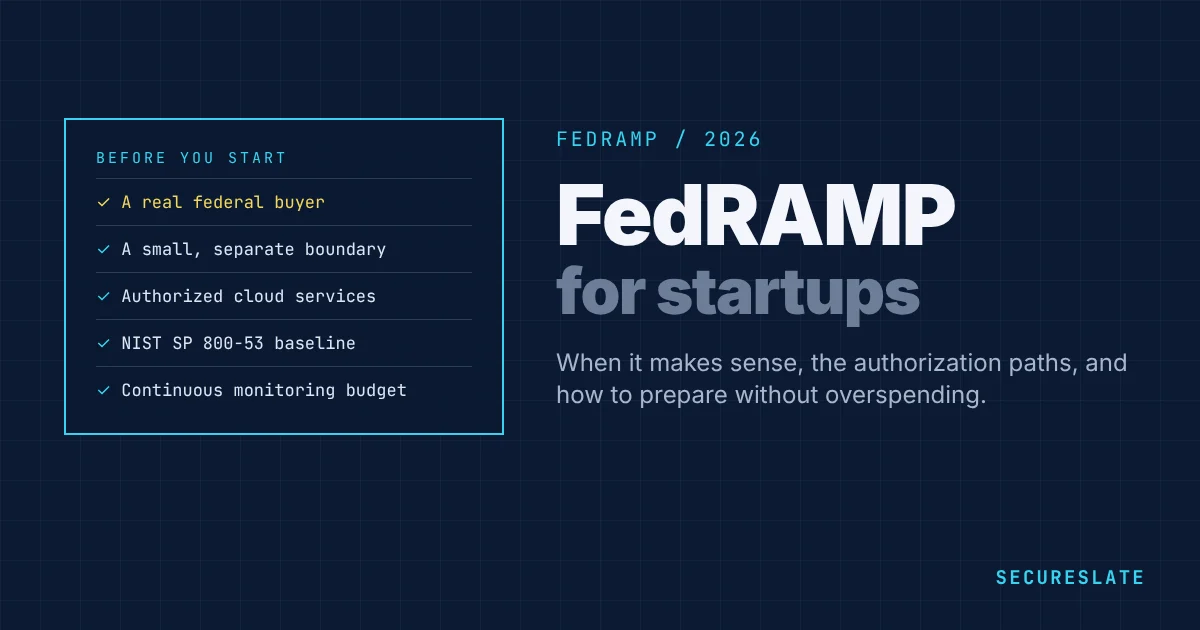
FedRAMP is a large, long commitment. It is usually worth it when most of these are true:
- A federal agency wants to buy your product and is willing to sponsor the authorization
- Federal or public sector revenue is a core part of your plan, not a one-off deal
- Your product handles federal data that is not public
- You have engineering capacity to build and run a separate, tightly controlled environment
- You can fund the assessment and ongoing continuous monitoring for several years
If you only have early interest, consider selling through a partner or reseller that already holds an authorization, or targeting state and local governments first. Many use frameworks such as GovRAMP (formerly StateRAMP) or accept SOC 2 for lower-risk use cases.
Authorization paths
| Path | How it works | Fit for startups |
|---|---|---|
| Agency authorization (Rev 5) | A federal agency sponsors you, reviews your package and issues an authorization to operate (ATO) | The traditional route. Needs a committed agency sponsor |
| FedRAMP 20x | A newer approach focused on automated validation and Key Security Indicators, piloted first for Low and then Moderate | Promising for cloud-native startups. Check eligibility and timing on fedramp.gov |
| FedRAMP Ready | A 3PAO readiness assessment shows you are prepared, before an agency commits | Useful signal for agencies, but not an authorization |
The program has changed quickly since 2024, including the move from the Joint Authorization Board to a FedRAMP Board. Confirm current requirements directly with the FedRAMP PMO before you plan.
How to prepare
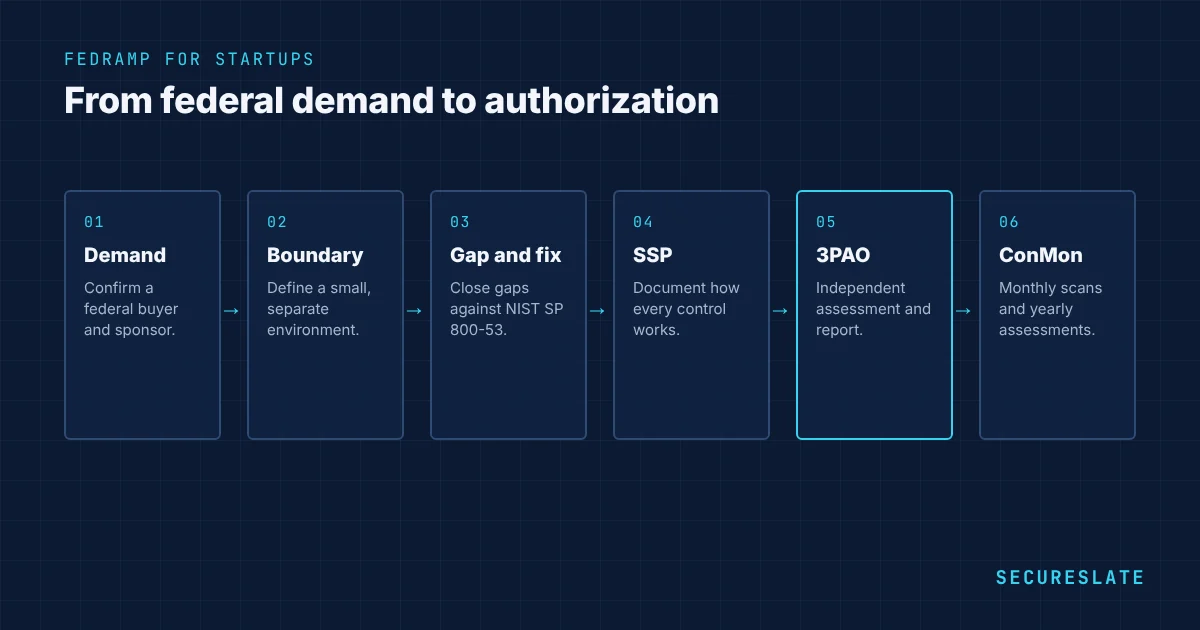
- Define the authorization boundary. Decide exactly which services, data stores and integrations are in scope. A smaller, separate environment is easier to authorize.
- Use FedRAMP authorized infrastructure. Build on a cloud provider region and services that already hold the right authorization, so you inherit many physical and infrastructure controls.
- Run a gap assessment against the baseline. Compare your controls with the NIST SP 800-53 baseline for your impact level.
- Close the big gaps. Common ones are FIPS 140 validated encryption, multi-factor authentication for all users, centralized logging and monitoring, vulnerability scanning, configuration baselines and supply chain controls.
- Write the System Security Plan (SSP). It describes how every control is implemented and is the core of the package.
- Engage a 3PAO. The 3PAO tests your controls and produces the Security Assessment Report.
- Plan continuous monitoring. After authorization you must report monthly vulnerability scans, track remediation and complete annual assessments.
Keeping cost and effort under control
- Keep the boundary small and separate from your commercial environment
- Reuse SOC 2 or ISO 27001 policies and evidence wherever they meet the requirement
- Automate evidence collection and vulnerability reporting from day one, because continuous monitoring is a permanent cost
- Budget for the assessment, remediation, tooling and the people who will run monthly reporting
- Talk to agency customers early so the authorization serves real demand
Our guide to FedRAMP authorization costs breaks down the budget in detail.
Controls that take startups the longest
Teams coming from SOC 2 are usually surprised by a handful of requirements:
| Area | Why it takes time |
|---|---|
| FIPS 140 validated cryptography | Every place data is encrypted, in transit and at rest, must use validated modules, including libraries inside your own code |
| Identity and MFA | Strong authentication for all users, including agency users, with phishing-resistant options for privileged access |
| Logging and audit | Detailed audit logs kept for set periods, centrally collected and reviewed |
| Vulnerability management | Authenticated scans of infrastructure, containers and web applications, with fixed remediation timelines reported monthly |
| Configuration management | Documented secure baselines for every component, checked automatically for drift |
| Supply chain | Every external service in the boundary must itself be appropriately authorized or justified |
| Incident response | Reporting to CISA and the agency within set timelines, plus tested response plans |
Start these early. They often need architectural changes, not just new policies.
Common mistakes
- Starting FedRAMP before there is a real federal buyer
- Trying to authorize the entire commercial platform instead of a focused boundary
- Underestimating continuous monitoring, which never stops after authorization
- Treating SOC 2 evidence as enough without mapping it to NIST SP 800-53
- Choosing tools or subprocessors that are not FedRAMP authorized
How SecureSlate helps
SecureSlate maps controls across FedRAMP, SOC 2, ISO 27001 and NIST frameworks, so work done for one counts toward the others. A dedicated compliance lead helps you scope the boundary and prepare the package, and automated evidence collection supports continuous monitoring after authorization.
FAQ
How long does FedRAMP authorization take for a startup?
Traditional agency authorizations have often taken a year or more from kickoff. FedRAMP 20x is designed to shorten this for cloud-native providers. Your timeline depends mostly on your starting maturity and the size of your boundary.
Do I need an agency sponsor?
For a traditional agency authorization, yes. Check the current FedRAMP 20x requirements, as the program has been changing how providers enter the process.
Can a startup without SOC 2 go straight to FedRAMP?
It is possible, but most startups find it easier to build their security program through SOC 2 or ISO 27001 first, then extend it to the NIST SP 800-53 baseline.
What is the difference between FedRAMP Low, Moderate and High?
They reflect the potential impact if the data were compromised. Low has the fewest controls, Moderate covers most non-public federal data, and High is for the most sensitive unclassified data, such as some law enforcement, health and financial systems.
Can we sell to state and local governments without FedRAMP?
Often, yes. Many state and local buyers use their own requirements, GovRAMP or a SOC 2 report, depending on the data involved. Check each buyer's procurement rules.
Disclaimer (legal note)
This article is for general information only and is not legal, regulatory, or professional advice. Requirements vary by framework, industry, and jurisdiction. Consult qualified advisors for your specific obligations.
Need compliance without the complexity?
SecureSlate automates ISO 27001, SOC 2, GDPR, HIPAA, and more. Built for growing teams. See it in action.
Find compliance gaps in 30 seconds
