
Short answer: ISO 27001 rests on a few core principles: protect the confidentiality, integrity and availability of information; choose controls based on assessed risk; make top management accountable; run security as a managed system that improves continually; involve the people who depend on your information; and back every claim with documented evidence. The clauses of ISO/IEC 27001 turn these ideas into auditable requirements.
Related guides: The ultimate ISO 27001 guide · Benefits of implementing an ISMS · Guide to the ISO 27001 Annex A controls
Key takeaways
- Confidentiality, integrity and availability (CIA) define what information security protects in the ISO 27000 family.
- ISO 27001 is risk-based: you assess risks first, then select controls and justify them in a Statement of Applicability.
- Leadership is a requirement, not a nice-to-have. Top management must set direction and provide resources.
- The standard follows a plan, operate, check and improve cycle, with internal audit and management review driving change.
- Documented evidence turns good intentions into something an auditor, customer or regulator can verify.
What are the core principles of ISO 27001?
ISO/IEC 27001 does not have a single numbered list called "principles", but its requirements are built on six ideas that run through every clause.
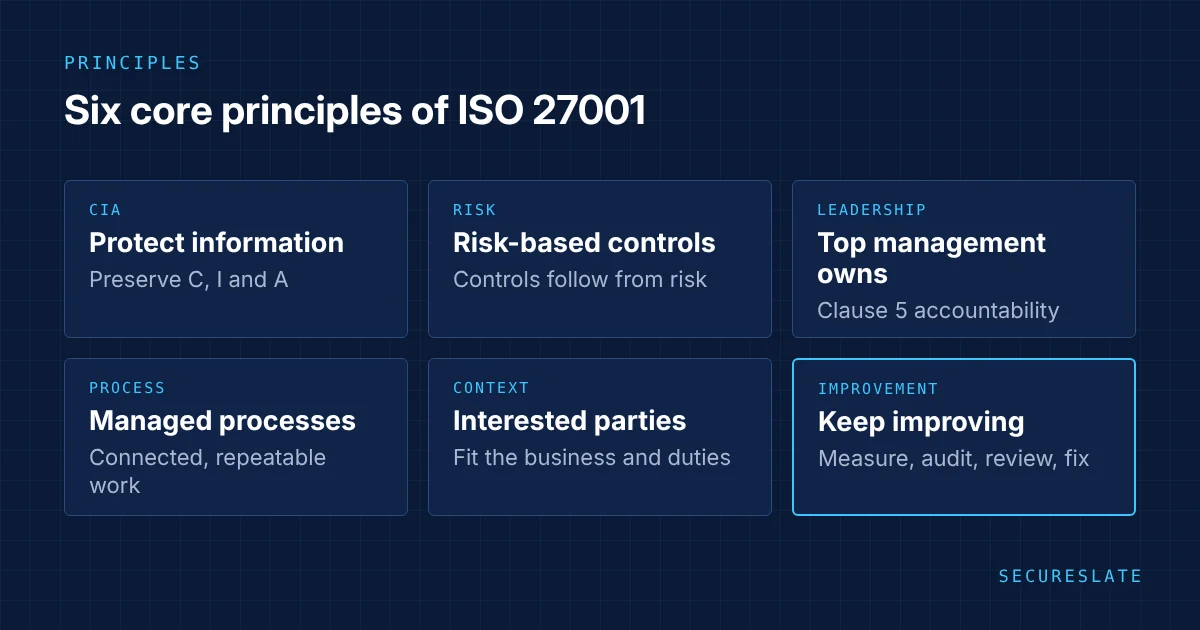
| Principle | What it means | Where it shows up in ISO/IEC 27001:2022 |
|---|---|---|
| Protect CIA | Preserve confidentiality, integrity and availability of information | Purpose of the ISMS, risk assessment criteria |
| Risk-based controls | Controls follow from assessed risk, not a fixed checklist | Clauses 6.1.2 and 6.1.3, Statement of Applicability |
| Leadership and accountability | Top management owns the ISMS and its results | Clause 5 |
| Process approach | Security is a set of managed, connected processes | Clause 4.4, clause 8 |
| Context and interested parties | The ISMS fits your business, customers and obligations | Clauses 4.1 to 4.3 |
| Continual improvement | Measure, audit, review and improve the ISMS over time | Clauses 9 and 10 |
The overview standard ISO/IEC 27000:2026 describes the concepts and principles behind an ISMS in more depth, and is a good companion to the requirements in ISO/IEC 27001.
What do confidentiality, integrity and availability mean?
Confidentiality, integrity and availability are the three properties of information that an ISMS is designed to preserve.
ISO/IEC 27000 defines them as follows, in short: confidentiality means information is not made available or disclosed to unauthorized individuals, entities or processes; integrity means accuracy and completeness; availability means being accessible and usable on demand by an authorized entity. Together they are often called the CIA triad.
| Property | Example threat | Example control | HealthTech example |
|---|---|---|---|
| Confidentiality | Stolen credentials expose customer data | MFA, encryption, least privilege | Patient records visible only to the care team and support staff with a need to know |
| Integrity | Unauthorized change to records or code | Change management, logging, code review | Medication data cannot be altered without a tracked, approved change |
| Availability | Ransomware or a cloud outage | Backups, redundancy, incident response | Clinicians can reach the scheduling system during an outage of one region |
In practice, every risk you record should say which of the three properties it threatens. That makes it much easier to decide which controls matter and to explain your choices to an auditor.
Why is ISO 27001 risk-based?
ISO 27001 is risk-based because organizations face different threats, so the standard asks you to choose controls that address your own assessed risks rather than apply one universal list.
The sequence is set out in clause 6.1. Under clause 6.1.2, you define and apply a risk assessment process with criteria for accepting risk and for performing assessments, and you identify risk owners. Under clause 6.1.3, you choose risk treatment options, determine the controls needed, compare them with Annex A to make sure nothing necessary is missed, and produce a Statement of Applicability that lists the controls, whether each is implemented and why each is included or excluded.
Annex A of ISO/IEC 27001:2022 contains 93 controls grouped into four themes: organizational (37), people (8), physical (14) and technological (34). It is a reference list. A small SaaS company with no offices may justify excluding some physical controls, while a company with data centers will not. Our guide on ISO 27001 risk management shows what auditors expect to see.
Why does ISO 27001 require leadership commitment?
ISO 27001 requires leadership commitment because security programs fail without authority, budget and priority from the top.
Clause 5 requires top management to demonstrate leadership by, among other things, making sure the information security policy and objectives fit the strategic direction, integrating ISMS requirements into business processes, providing resources, communicating the importance of security, and assigning responsibilities and authorities. Auditors look for evidence that this happens: an approved policy, named roles, budget decisions and management review minutes where leaders actually make decisions.
For a small company this does not mean a large committee. It means the CEO or another senior leader is clearly accountable, attends management review and acts on what it shows.
How does continual improvement work in ISO 27001?
Continual improvement works through a repeating cycle: plan the ISMS, operate it, check it with measurement and audits, then fix and improve what the checks reveal.
Earlier versions of the standard described this explicitly as Plan, Do, Check, Act. The current edition uses the common management system structure instead, but the cycle is still visible in the clauses:
| Stage | ISO/IEC 27001:2022 clauses | Typical outputs |
|---|---|---|
| Plan | 4 Context, 5 Leadership, 6 Planning | Scope, policy, risk assessment, Statement of Applicability, objectives |
| Do | 7 Support, 8 Operation | Training records, operating controls, risk treatment in progress |
| Check | 9 Performance evaluation | Metrics, internal audit reports, management review minutes |
| Act | 10 Improvement | Nonconformities, corrective actions, improvements |
The cycle keeps the ISMS current as the business, threats and customer demands change. That is why certification involves surveillance audits between recertifications rather than a single test.
Why does ISO 27001 depend on documented evidence?
ISO 27001 depends on documented evidence because the only way to show a control works, to yourself or to an auditor, is a record that it ran.
Clause 7.5 sets requirements for creating, updating and controlling documented information, and many other clauses require specific records, such as the scope, the risk assessment results, the Statement of Applicability, monitoring results, internal audit results and management review results. The aim is not paperwork for its own sake. Evidence lets you spot gaps early, answer customer security questionnaires quickly and pass audits without a last-minute scramble.
How can a small team apply these principles?
A small team can apply the principles by keeping each one concrete, lightweight and tied to real decisions. A practical checklist:
- Write a one-page context and scope. Name the products, data and locations in scope and the customers and regulations that drive them.
- Make one leader accountable. Record who owns the ISMS and when management review happens.
- Run a simple risk assessment. For each important information asset, note the CIA impact, likelihood, owner and treatment.
- Build the Statement of Applicability from the risks. Justify each Annex A control as included or excluded.
- Set three to five measurable objectives. For example, removal of leavers' access within the policy deadline.
- Automate evidence where you can. Pull records from cloud, identity and device tools instead of screenshots.
- Audit and review on a schedule. Run the internal audit, hold management review and track corrective actions to closure.
For HealthTech companies, the same principles support HIPAA work too, because both rely on risk analysis and documented safeguards. See ISO 27001 for healthcare companies.
How SecureSlate helps
SecureSlate puts these principles into daily practice. ISO 27001 is built in and mapped to SOC 2, HIPAA, HITRUST and GDPR, risk management links risks to controls and the Statement of Applicability, and agentless read-only cloud integrations plus a device agent gather evidence continuously. Access reviews, vendor risk management and audit management cover the records auditors request, and a trust center helps you share your security posture with customers. SecureSlate does not perform audits or issue certificates.
FAQ
What are the three principles of ISO 27001?
The three properties at the heart of ISO 27001 are confidentiality, integrity and availability of information, often called the CIA triad.
Is ISO 27001 based on PDCA?
The current edition does not name PDCA explicitly, but its clause structure follows the same cycle of planning, operating, checking and improving the ISMS.
Are all Annex A controls mandatory?
No. You select controls based on your risk assessment and justify each inclusion or exclusion in the Statement of Applicability. The clauses 4 to 10 requirements are mandatory for certification.
What does risk-based mean in ISO 27001?
It means you identify and assess risks to your information first and then select controls to treat those risks, rather than applying a fixed checklist.
Who is responsible for ISO 27001 in an organization?
Top management is accountable for the ISMS under clause 5. Day-to-day work is usually delegated to an ISMS owner and control owners with defined roles.
Disclaimer (legal note)
This article is for general information only and is not legal, regulatory, or professional advice. Requirements vary by framework, industry, and jurisdiction. Consult qualified advisors for your specific obligations.
Need compliance without the complexity?
SecureSlate automates ISO 27001, SOC 2, GDPR, HIPAA, and more. Built for growing teams. See it in action.
Find compliance gaps in 30 seconds