
Short answer: Data privacy is about whether and how personal data should be collected, used and shared, based on law, consent and purpose. Data security is about protecting data, personal or not, from unauthorized access, change or loss. Privacy decides the rules. Security enforces them. You need both, because one cannot make up for the other.
Related guides: Privacy compliance checklist · GDPR Article 32 · HIPAA vs GDPR
Key takeaways
- Privacy answers "should we use this personal data, and how?" Security answers "how do we protect this data?"
- Privacy covers personal data only. Security covers all information, including source code and financial records.
- You can be secure but not private, for example by perfectly protecting data you had no right to collect.
- Laws join them: the GDPR requires security as one of its principles, and HIPAA splits them into a Privacy Rule and a Security Rule.
- Run them as one program with shared data maps, risk registers and vendor reviews, and separate owners for each discipline.
What is the difference between data privacy and data security?
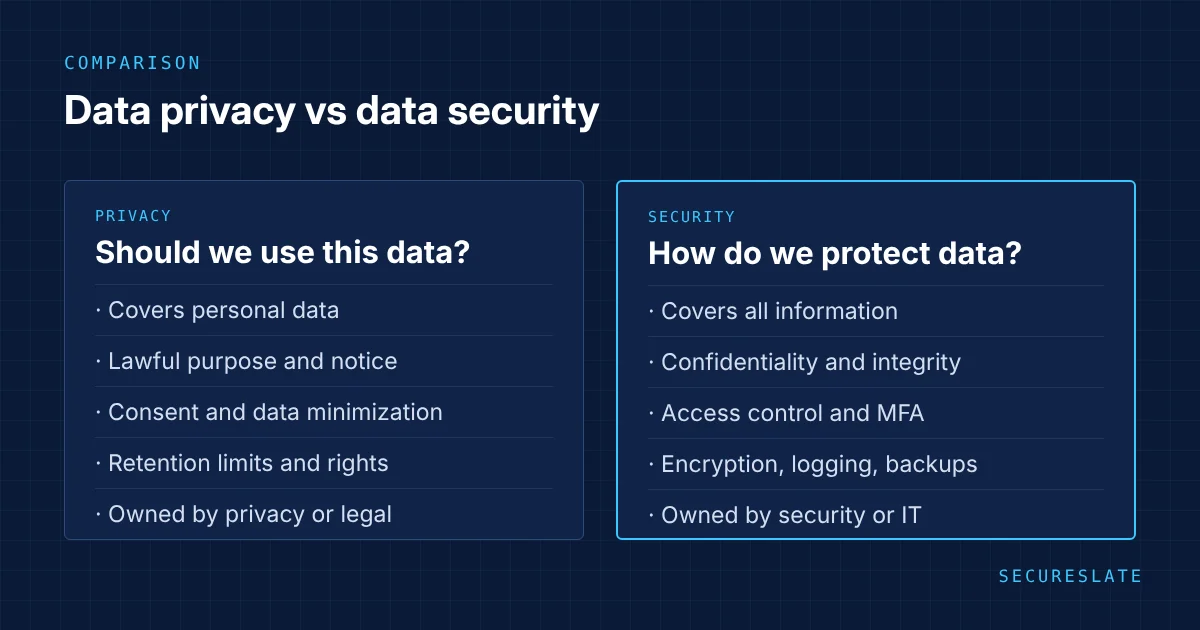
The difference is purpose: privacy governs appropriate use of personal data, while security protects data from threats.
Data privacy concerns the rights of individuals and the obligations of organizations that handle their personal data. It covers questions such as: Do we have a lawful reason to collect this? Did we tell people? Do we keep it longer than needed? Can a person see, correct or delete it? Who do we share it with?
Data security concerns the confidentiality, integrity and availability of information. It covers controls such as access management, encryption, logging, vulnerability management, backups and incident response. Security applies to any valuable data, whether or not it identifies a person.
A useful shorthand: privacy is a policy question about people, security is a control question about systems. Most real problems need both answers.
Data privacy vs data security side by side
The two disciplines share tools and data, but they differ in goals, scope and the people who own them.
| Dimension | Data privacy | Data security |
|---|---|---|
| Main question | Should we collect, use or share this personal data? | How do we protect this data? |
| Scope | Personal data and data about individuals | All information assets |
| Main threats | Over-collection, misuse, unlawful sharing, lack of transparency | Attackers, insider misuse, errors, outages |
| Typical controls | Notices, consent, data minimization, retention limits, rights handling, vendor terms | Access control, MFA, encryption, logging, patching, backups |
| Common frameworks | GDPR, CCPA, HIPAA Privacy Rule, ISO/IEC 27701, NIST Privacy Framework | ISO 27001, SOC 2, HIPAA Security Rule, NIST CSF, PCI DSS |
| Typical owner | Privacy officer, DPO or legal | CISO, security or IT lead |
| Failure looks like | Using patient data for marketing without consent | A stolen laptop with unencrypted records |
Can you have security without privacy?
Yes, and the reverse is also true, which is why neither is enough on its own.
| Scenario | Privacy | Security | What went wrong |
|---|---|---|---|
| A health app stores location history in an encrypted, access-controlled database but never told users it was collected | Fails | Passes | No transparency or lawful purpose |
| A clinic has clear consent forms and a strong privacy notice, but staff share one admin password | Passes | Fails | Weak access control |
| An analytics vendor gets full patient records when it only needs counts | Fails | Partly | Over-sharing and no minimization |
| Old customer records are kept forever in a well-protected archive | Fails | Passes | No retention limit |
| A misconfigured storage bucket exposes support tickets | Fails | Fails | A security failure becomes a privacy breach |
The last row shows the strongest link. Most privacy breaches that make the news start as security failures, and most security incidents involving personal data trigger privacy notification duties.
How do GDPR, HIPAA and the CCPA treat privacy and security?
Each law treats security as part of privacy compliance, but they structure it differently.
GDPR. The GDPR lists "integrity and confidentiality" as one of its principles in Article 5(1)(f), and Article 32 requires appropriate technical and organizational measures, such as pseudonymization and encryption where appropriate. Article 25 adds data protection by design and by default, which brings privacy thinking into system design.
HIPAA. HIPAA splits the topics into two rules. The Privacy Rule governs uses and disclosures of protected health information in any form, including paper and spoken. The Security Rule applies only to electronic protected health information and requires administrative safeguards, physical safeguards and technical safeguards. For HealthTech companies acting as business associates, both rules shape contracts and daily operations.
CCPA. The California law is mainly a privacy law, built around consumer rights and notices, but it also requires reasonable security, and consumers have a private right of action for certain breaches caused by a failure to maintain reasonable security.
How do privacy and security work together in an incident?
In an incident, security contains the threat and privacy decides who must be told, so both teams need to be in the room from the first hour.
Security leads detection, containment, investigation and recovery. Privacy works out whether personal data was involved, which laws apply and whether notification duties are triggered. The deadlines are tight. Under GDPR Article 33, a controller must notify the supervisory authority without undue delay and, where feasible, within 72 hours of becoming aware of a personal data breach, unless the breach is unlikely to result in a risk to individuals. Under the HIPAA Breach Notification Rule, covered entities must notify affected individuals without unreasonable delay and no later than 60 calendar days after discovery.
Those clocks depend on facts that only the security investigation can supply, such as which records were accessed and whether the data was encrypted. That is why the best incident plans name both a security lead and a privacy lead, and agree in advance how findings pass between them.
Who owns privacy and who owns security?
Usually different people, working from shared information.
In smaller companies, one person often holds both roles, such as a head of security who also acts as privacy lead. As companies grow, privacy tends to sit with legal or a dedicated privacy officer, and security with a CISO or security lead. Under the GDPR, some organizations must appoint a data protection officer. Under HIPAA, covered entities must designate both a privacy official and a security official.
What matters most is shared inputs. Both teams need the same data inventory, the same list of vendors and the same incident process. When those are kept separately, they drift apart, and gaps open up between them.
Checklist: running privacy and security together
- Keep one data inventory that records personal data, sensitive data and the systems that hold it.
- Run one risk register with privacy and security risks side by side.
- Review vendors once for both security posture and privacy terms. See our guide to data processing agreements.
- Use privacy by design reviews for new features, with a security review in the same step.
- Build one incident response plan that covers technical containment and breach notification timelines.
- Apply retention schedules and delete data on time, which reduces both privacy and security exposure.
- Train staff on both topics, using real examples from your products.
- Map shared controls across frameworks so the same evidence supports GDPR, HIPAA, SOC 2 and ISO 27001.
How SecureSlate helps
SecureSlate helps teams run privacy and security from one control set instead of two disconnected programs.
- Multi-framework control mapping across built-in GDPR, HIPAA, SOC 2, ISO 27001, ISO 42001 and more, so one control and its evidence can serve several requirements.
- Risk management for a shared privacy and security risk register.
- Vendor risk management to review vendors for security and privacy in one workflow.
- Access reviews, agentless read-only cloud integrations and a device agent for security evidence.
- Custom frameworks and controls for privacy laws without a built-in framework, such as US state privacy laws.
FAQ
Is data protection the same as data privacy?
The terms overlap. In the EU, "data protection" is the legal term used by the GDPR and covers both privacy principles and security. In the US, "data privacy" is more common for the legal side.
Which comes first, privacy or security?
Privacy decisions come first, because they set what data you hold and why. Security then protects that data. In practice the two run in parallel.
Is encryption a privacy control or a security control?
It is a security control that supports privacy. The GDPR names encryption as an example of an appropriate measure, but encrypting data does not make an unlawful use lawful.
Does a SOC 2 report prove privacy compliance?
Not on its own. SOC 2 can include a Privacy criteria category, but many reports cover only Security. Privacy laws such as the GDPR and CCPA have their own requirements.
Do small HealthTech companies need separate privacy and security officers?
HIPAA requires covered entities to designate both a privacy official and a security official, and business associates must designate a security official. One person can hold both roles if they have the time and skills.
Disclaimer (legal note)
This article is for general information only and is not legal, regulatory, or professional advice. Requirements vary by framework, industry, and jurisdiction. Consult qualified advisors for your specific obligations.
Need compliance without the complexity?
SecureSlate automates ISO 27001, SOC 2, GDPR, HIPAA, and more. Built for growing teams. See it in action.
Find compliance gaps in 30 seconds