
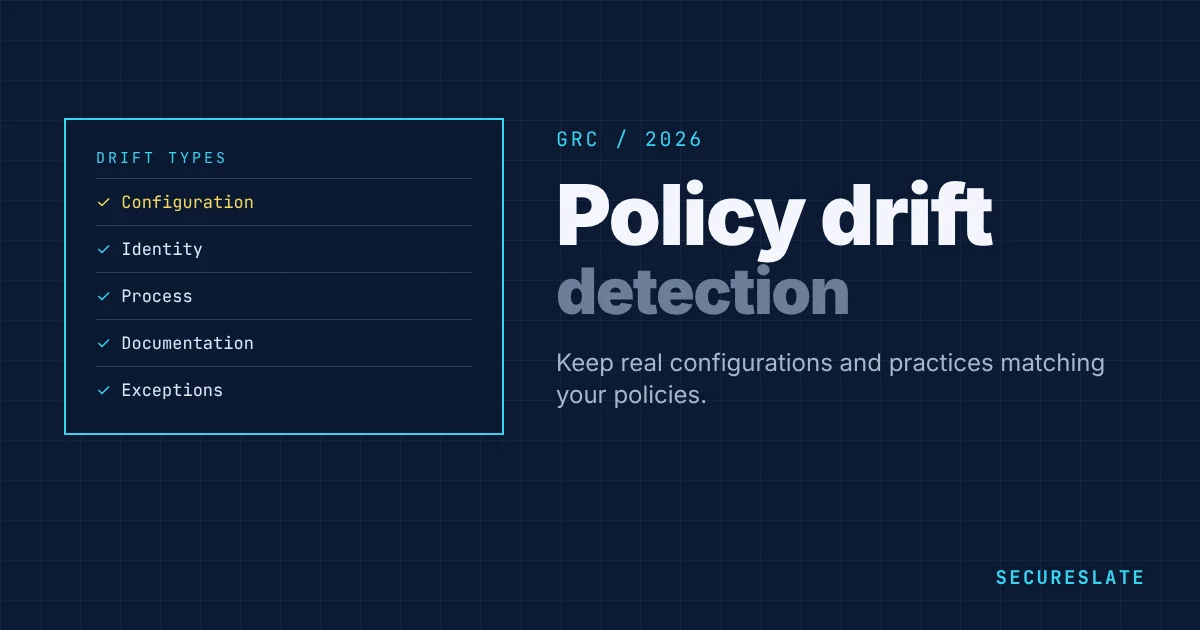
Policy drift detection is the practice of continuously checking that what your systems and people actually do still matches what your policies say. Policy drift happens when written rules and real-world controls slowly diverge: MFA is required on paper but a new app bypasses SSO; the policy says leavers lose access the same day, but contractors linger for weeks; encryption is mandatory, but a new storage bucket is created without it. Drift is one of the most common reasons companies fail audits or suffer avoidable breaches. This guide explains the types of drift, how to detect it and how to stop it coming back.
Related guides: Compliance as code and policy as code · Document control procedure · Security posture best practices · Cloud security audit · GRC policy management
Key takeaways
- Policy drift is the gap between documented policy and actual practice or configuration.
- It comes from change: new tools, new people, new infrastructure, quick fixes and exceptions that never expire.
- Point-in-time audits miss drift that appears between audits.
- Detect drift with continuous control monitoring, infrastructure as code drift checks and regular reviews.
- Fix drift at the root: automate guardrails so the compliant path is the easy one.
Types of drift
| Type | What drifts | Example |
|---|---|---|
| Configuration drift | System settings move away from the approved baseline | Security group opened for debugging and never closed |
| Identity drift | Access grows beyond policy | Engineers keep admin rights after a project ends |
| Process drift | People skip or change steps | Access reviews completed late or rubber-stamped |
| Documentation drift | Policies no longer describe reality | Policy references a tool the company stopped using |
| Vendor drift | Third parties change practices | A vendor's certification lapses unnoticed |
| Exception drift | Temporary exceptions become permanent | Exception approved for 30 days still active a year later |
Why drift matters
- Breaches. Attackers find the one bucket left public or the one admin without MFA.
- Audit exceptions. SOC 2 Type 2 auditors test controls across the whole period, so drift in month four shows up as an exception.
- False assurance. Leadership and customers believe controls are in place when they are not.
- Regulatory risk. Laws such as GDPR require appropriate measures to be maintained, not only designed.
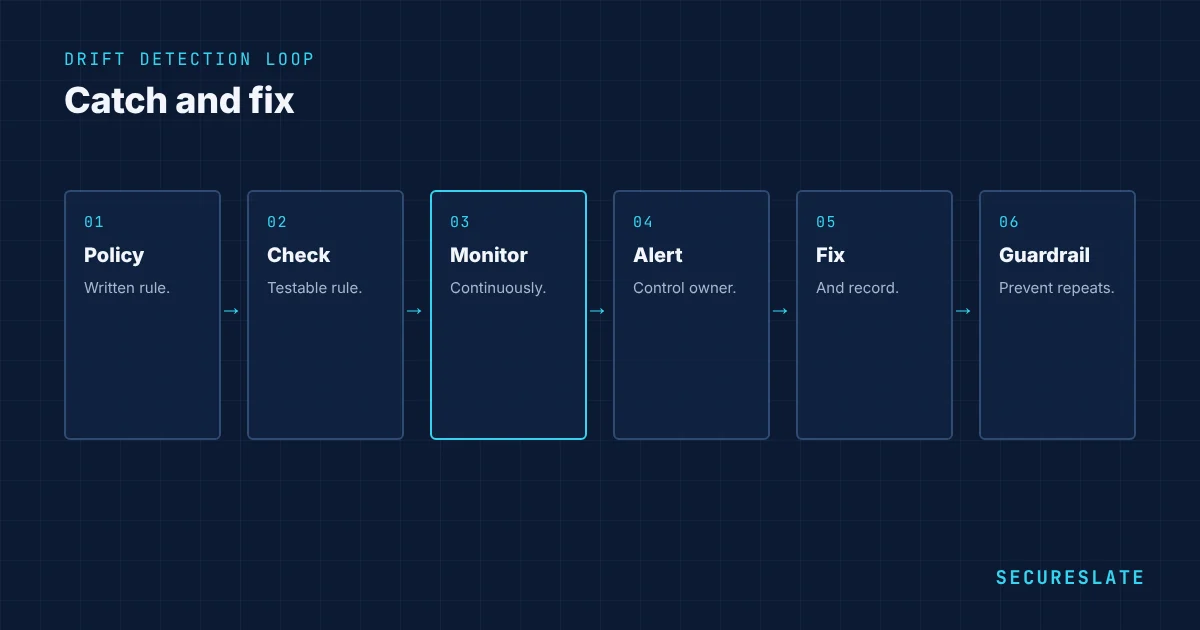
How to detect policy drift
1. Translate policies into testable rules
For each policy statement, write a check: "MFA required for all users" becomes "every active user in the identity provider has MFA enrolled and enforced." "Production data encrypted at rest" becomes "every database and storage resource has encryption enabled."
2. Monitor continuously
Use compliance automation platforms, cloud security posture management and identity tools to run those checks daily or in real time and alert on failures.
3. Detect infrastructure drift
If you use infrastructure as code, run drift detection that compares deployed resources with the code, for example a scheduled plan in Terraform or provider tools such as AWS CloudFormation drift detection. Manual console changes show up quickly.
4. Watch identity changes
Alert on new admin grants, MFA disabled, new applications connected to SSO, and accounts inactive past policy thresholds.
5. Review processes on schedule
Track recurring tasks such as access reviews, vendor reviews and training with due dates. Late or missing tasks are process drift.
6. Review documents against reality
At each policy review, compare the policy to how teams actually work, and update one or the other.
7. Track exceptions
Keep exceptions in a register with expiry dates and automatic reminders.
Mapping policy statements to checks
| Policy statement | Automated check | Frequency |
|---|---|---|
| MFA is enforced for all users | Identity provider users without MFA | Daily |
| Admin access is limited and approved | Count and list of admins compared with approved list | Daily |
| Leavers lose access on their last day | HR terminations matched to disabled accounts | Daily |
| Data is encrypted at rest | Unencrypted storage, databases and volumes | Continuous |
| Logs are retained for one year | Logging enabled and retention settings | Daily |
| Devices are encrypted and updated | Device agent reports | Daily |
| Critical vulnerabilities fixed within 15 days | Open critical findings past SLA | Daily |
| Access reviews are quarterly | Review task completion dates | Quarterly |
| Critical vendors reviewed yearly | Vendor review due dates | Monthly |
Fixing drift so it does not return
- Guardrails over guidance. Use service control policies, organization policies and admission controllers to block noncompliant changes.
- Policy as code. Codify rules in tools like Open Policy Agent, so pipelines reject noncompliant infrastructure before it is deployed.
- Golden paths. Provide templates and modules that are compliant by default, so engineers do not have to think about it.
- Automation of lifecycle tasks. HR-driven provisioning and deprovisioning prevent identity drift.
- Root cause analysis. When drift appears, ask why the process allowed it and fix the process.
- Ownership. Assign every control to an owner who receives alerts.
Drift detection and audits
Continuous detection changes the audit experience. Instead of discovering drift during fieldwork, you see it the day it happens, fix it and keep a record of detection and correction. Auditors view quickly corrected drift with evidence very differently from drift that persisted unnoticed for months. For ISO 27001, monitoring and measurement (clause 9.1) and corrective action (clause 10.2) are directly supported by drift detection records.
Metrics
| Metric | What it shows |
|---|---|
| Number of failing control checks | Current drift |
| Mean time to fix drift | Responsiveness |
| Drift events per month by area | Where processes are weak |
| Expired exceptions still active | Exception discipline |
| Policies past review date | Documentation drift |
Example: catching drift in practice
A SaaS company's encryption policy requires every production database to be encrypted at rest. During a late-night incident, an engineer restores a database snapshot into a new instance to recover data, and the restore uses default settings without encryption. With quarterly manual checks, the unencrypted database might run for months and appear as a finding in the next SOC 2 report. With continuous detection, the compliance platform flags the unencrypted instance within hours, alerts the database owner, and the team migrates the data to an encrypted instance the next day. The detection, alert and fix are all recorded with timestamps, which the auditor reviews as evidence that the control and monitoring work.
Drift detection maturity
| Level | Practice |
|---|---|
| None | Drift found only during audits or incidents |
| Periodic | Manual checks before audits or each quarter |
| Automated detection | Daily automated checks with alerts to owners |
| Prevention | Guardrails and policy as code block most drift before it happens |
| Self-healing | Automated remediation for well-understood drift, with records |
How SecureSlate helps
SecureSlate is built to catch policy drift. It turns policy requirements into continuous tests across AWS, Google Cloud, identity providers, code repositories, devices and HR systems, alerts control owners when something drifts, records when it was fixed, and tracks recurring tasks such as access reviews and vendor reviews. The result is audit evidence that covers the whole period, at a price designed for SMBs.
FAQ
What is policy drift?
The gradual divergence between an organization's documented policies and its actual configurations, access and processes.
What is the difference between policy drift and configuration drift?
Configuration drift is one type of policy drift where system settings move away from an approved baseline. Policy drift also includes identity, process, vendor and documentation drift.
How do you detect policy drift?
Translate policies into testable checks and monitor them continuously with compliance automation, cloud posture tools, infrastructure as code drift detection and task tracking.
Why does policy drift cause audit failures?
Auditors test whether controls operated throughout the period. Drift during the period shows up as exceptions in the report.
How can drift be prevented?
Use guardrails, policy as code, compliant-by-default templates and automated lifecycle processes, and assign owners to every control.
Is policy drift the same as noncompliance?
Not always. Drift becomes noncompliance when the gap breaks a requirement. Catching drift early lets you fix it before it becomes an audit finding or incident.
Disclaimer (legal note)
This article is for general information only and is not legal, regulatory, or professional advice. Requirements vary by framework, industry, and jurisdiction. Consult qualified advisors for your specific obligations.
Need compliance without the complexity?
SecureSlate automates ISO 27001, SOC 2, GDPR, HIPAA, and more. Built for growing teams. See it in action.
Find compliance gaps in 30 seconds