
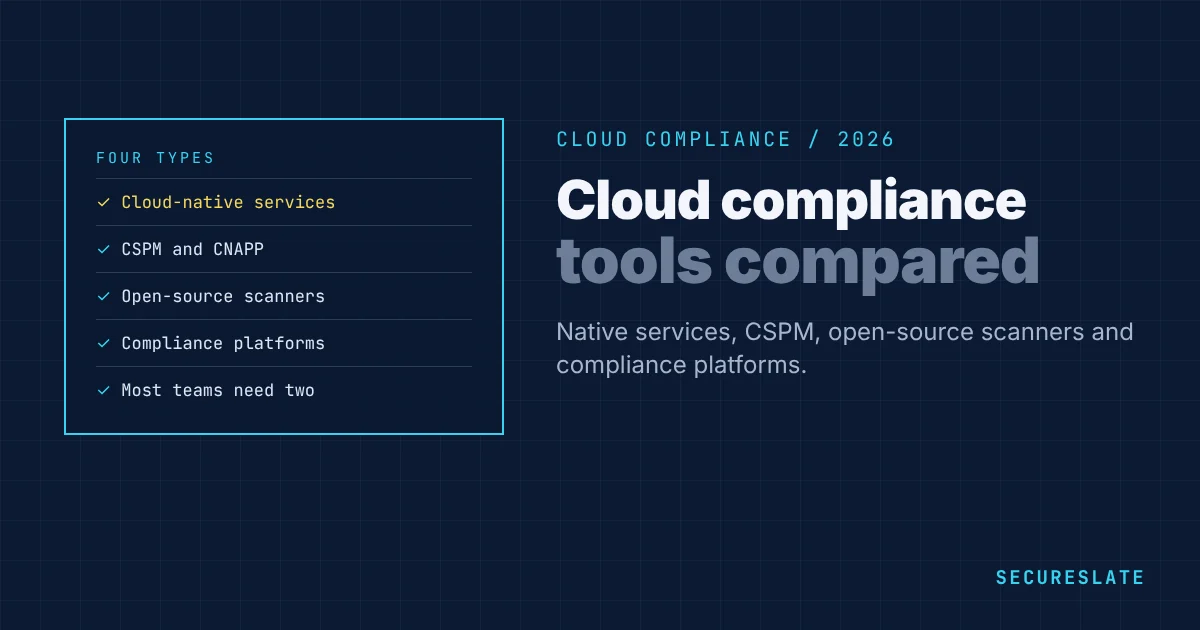
Cloud compliance tools check that your AWS, Azure or Google Cloud environment meets the security standards customers and regulators ask for, such as SOC 2, ISO 27001, HIPAA, PCI DSS and CIS Benchmarks. They find misconfigurations, map them to framework controls and keep evidence for auditors. This guide explains the main types of cloud compliance software, the best options in each, the features that matter and how to choose for your team.
Related guides: Best CSPM solutions · Best compliance software for SaaS · Continuous control monitoring · CIS Controls
Key takeaways
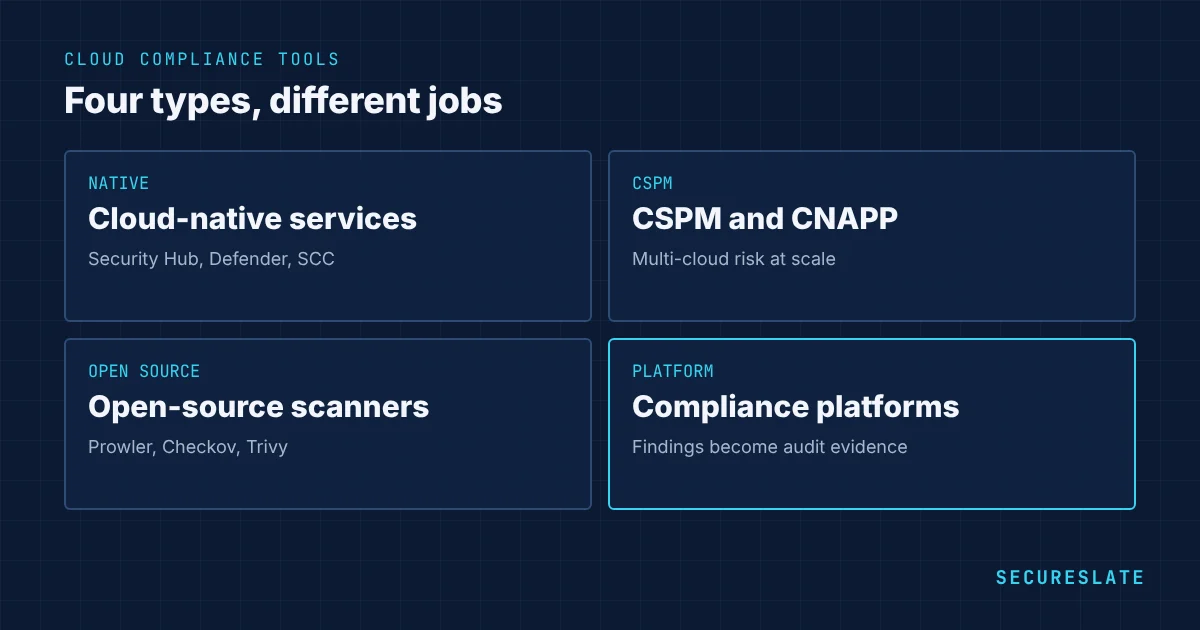
- Cloud compliance tools fall into four groups: cloud-native services, CSPM and CNAPP platforms, open-source scanners and compliance automation platforms.
- Scanners find misconfigurations. Compliance platforms turn those findings into audit evidence alongside policies, people and vendor controls.
- Most small teams need one scanner plus one compliance platform, not five tools.
- Look for multi-cloud coverage, framework mappings, continuous checks and evidence your auditor accepts.
What is a cloud compliance tool?
In the shared responsibility model, your cloud provider secures the infrastructure and you secure how you configure and use it. Most cloud breaches come from your side: public storage buckets, overly broad IAM roles, unencrypted databases, disabled logging. A cloud compliance tool reads your cloud configuration through read-only APIs, compares it with a set of rules mapped to frameworks, and shows what passes, what fails and how to fix it.
Types of cloud compliance tools
| Type | Examples | Strengths | Limits |
|---|---|---|---|
| Cloud-native services | AWS Security Hub and AWS Config, Microsoft Defender for Cloud and Azure Policy, Google Security Command Center | Built in, deep coverage of one cloud, low setup | One cloud each; no policies, HR or vendor controls |
| CSPM and CNAPP platforms | Wiz, Orca Security, Prisma Cloud, Microsoft Defender for Cloud (multi-cloud) | Multi-cloud, risk prioritization, workload and identity context | Priced for larger teams; not a full compliance program |
| Open-source scanners | Prowler, Checkov, Trivy, Cloud Custodian | Free, transparent rules, CI/CD friendly | You run and maintain them; reporting is basic |
| Compliance automation platforms | SecureSlate, Vanta, Drata, Secureframe, Sprinto | Map cloud checks to SOC 2, ISO 27001, HIPAA and more, plus policies, people and vendor evidence | Cloud depth varies by platform |
The best cloud compliance tools by need
- Best free starting point: Prowler. An open-source scanner for AWS, Azure, Google Cloud and Kubernetes with hundreds of checks mapped to CIS, SOC 2, ISO 27001, HIPAA, PCI DSS and more.
- Best for an AWS-only team: AWS Security Hub with AWS Config. Native checks against the AWS Foundational Security Best Practices and CIS benchmarks, with conformance packs for common frameworks.
- Best for Azure: Microsoft Defender for Cloud. Regulatory compliance dashboards for many standards, and it can also cover AWS and Google Cloud.
- Best for Google Cloud: Security Command Center. Native misconfiguration and threat findings with compliance reporting.
- Best for large multi-cloud estates: a CNAPP such as Wiz, Orca or Prisma Cloud, when you need attack-path analysis across thousands of resources.
- Best for audit readiness: a compliance automation platform that connects to your cloud and turns findings into SOC 2 or ISO 27001 evidence.
- Best for infrastructure as code: Checkov or Trivy in your pipeline, so misconfigurations are caught before they reach production.
Features that matter
| Feature | Why it matters |
|---|---|
| Multi-cloud coverage | Most companies use more than one cloud or plan to |
| Framework mappings | Findings tied to SOC 2, ISO 27001, HIPAA, PCI DSS and CIS controls |
| Continuous checks | Daily or real-time scans, not a quarterly snapshot |
| Clear remediation | Exact resource, risk and fix steps for engineers |
| Evidence export | Dated results an auditor can sample |
| Read-only access | Least-privilege connection with no write permissions |
| Exceptions workflow | Record accepted risks with owner and expiry |
| Integrations | Ticketing, Slack and your identity provider |
How to choose cloud compliance software
- List the frameworks you need now and in 12 months. A tool that only maps to CIS will not satisfy a SOC 2 auditor on its own.
- Count your clouds and accounts. One AWS account and a few services is very different from multi-cloud with hundreds of accounts.
- Decide who fixes findings. If engineers own fixes, prioritize clear remediation and ticket integrations.
- Check how evidence reaches your auditor. Compliance platforms package it; scanners need exports.
- Compare total cost including setup, seats and time spent maintaining open-source tools.
For most SaaS companies under 200 people, the most efficient setup is a compliance platform with built-in cloud scanning, plus native cloud tools for deeper alerts.
Common cloud compliance gaps
- Storage buckets or snapshots shared publicly
- Root or admin accounts without MFA
- Logging such as CloudTrail disabled in some regions
- Databases and volumes without encryption at rest
- Security groups open to the internet on admin ports
- Access keys that are never rotated
- No alerting on high-risk changes
Native cloud tools compared
| AWS | Microsoft Azure | Google Cloud | |
|---|---|---|---|
| Main service | AWS Security Hub with AWS Config | Microsoft Defender for Cloud with Azure Policy | Security Command Center |
| Built-in standards | AWS Foundational Security Best Practices, CIS, PCI DSS, NIST | Microsoft cloud security benchmark, CIS, many regulatory standards | CIS and other compliance reports |
| Covers other clouds | No | Yes, with connectors for AWS and Google Cloud | Limited |
| Best for | AWS-only teams | Azure-first or Microsoft-heavy organizations | Google Cloud teams |
Native tools are a strong baseline and often cheap at small scale. Their gap is everything outside the cloud: policies, HR onboarding and offboarding, vendor reviews and the audit workflow itself.
A practical cloud compliance stack for a small SaaS team
- Turn on native logging and security services in every account and region, such as AWS CloudTrail, GuardDuty and Security Hub.
- Scan infrastructure as code in your pipeline with an open-source tool so misconfigurations never reach production.
- Connect a compliance platform that reads your cloud, identity provider, code repository and HR system, and maps everything to your frameworks.
- Route findings to engineers through your ticketing tool with owners and due dates.
- Review exceptions monthly and keep evidence for your auditor in one place.
How SecureSlate helps
SecureSlate connects to AWS and Google Cloud with read-only access, runs continuous configuration checks built on Prowler, and maps every finding to SOC 2, ISO 27001, HIPAA and PCI DSS controls, alongside policies, people and vendor evidence through multi-framework mapping.
FAQ
What is cloud compliance?
Cloud compliance means configuring and operating your cloud environment so it meets the security and privacy requirements of the standards and laws that apply to you, and being able to prove it.
Are cloud-native tools enough for SOC 2?
They help with technical controls, but SOC 2 also covers policies, onboarding, access reviews, vendor management and incident response. A compliance platform covers those and collects evidence.
What is the difference between CSPM and a compliance platform?
CSPM tools find and prioritize cloud misconfigurations. Compliance platforms map those findings to framework controls and manage the rest of the audit, from policies to evidence.
Is Prowler free?
Yes. Prowler is open source and free to run, with a paid hosted version. You maintain the scanning and reporting yourself.
How often should cloud compliance be checked?
Continuously, or at least daily. Cloud configurations change constantly, and a monthly or quarterly scan misses most of the time a problem is exposed.
Do cloud compliance tools need write access to my cloud?
No. Good tools use read-only roles. Write access should only be granted to automated remediation you have reviewed and approved, if at all.
Can one tool cover AWS, Azure and Google Cloud?
Yes. Multi-cloud CSPM platforms, open-source scanners such as Prowler, and many compliance platforms support more than one cloud. Native tools are strongest in their own cloud.
What is the cheapest way to start with cloud compliance?
Turn on your cloud provider's native security services and run an open-source scanner such as Prowler. Add a compliance platform when you need audit evidence for SOC 2 or ISO 27001.
Disclaimer (legal note)
This article is for general information only and is not legal, regulatory, or professional advice. Requirements vary by framework, industry, and jurisdiction. Consult qualified advisors for your specific obligations.
Need compliance without the complexity?
SecureSlate automates ISO 27001, SOC 2, GDPR, HIPAA, and more. Built for growing teams. See it in action.
Find compliance gaps in 30 seconds