
Data loss prevention software (DLP) helps organizations find sensitive data and stop it from leaving through the wrong channels, whether by accident or on purpose. DLP tools inspect data in email, cloud apps, endpoints, networks and AI tools, apply policies such as "block customer card numbers from being sent to personal email," and alert security teams. Modern DLP has moved from heavy on-premises systems to cloud and endpoint services that fit remote, SaaS-heavy companies. This guide explains how DLP works, the main types, examples of tools and how to choose and roll out DLP without disrupting work.
Related guides: Data classification policy · Data governance policy · PII vs PHI vs PCI · Identity risk
Product details change often. Confirm features with each vendor.
Key takeaways
- DLP discovers, classifies, monitors and controls sensitive data across channels.
- Main types are endpoint, network, email, cloud (CASB and SaaS) and data discovery.
- DLP works best on top of a clear data classification policy.
- Start in monitor mode, tune rules, then block the highest-risk actions.
- Many companies already have DLP features in tools like Microsoft 365 or Google Workspace.
How DLP works
DLP tools follow a cycle:
- Discover where sensitive data lives, such as file shares, cloud storage, databases and endpoints.
- Classify data using patterns (card numbers, national ID numbers), keywords, exact data matching, document fingerprints, labels or machine learning.
- Monitor data in use, in motion and at rest.
- Enforce policies by allowing, warning, encrypting, quarantining or blocking.
- Report incidents to security and compliance teams for investigation.
Types of DLP
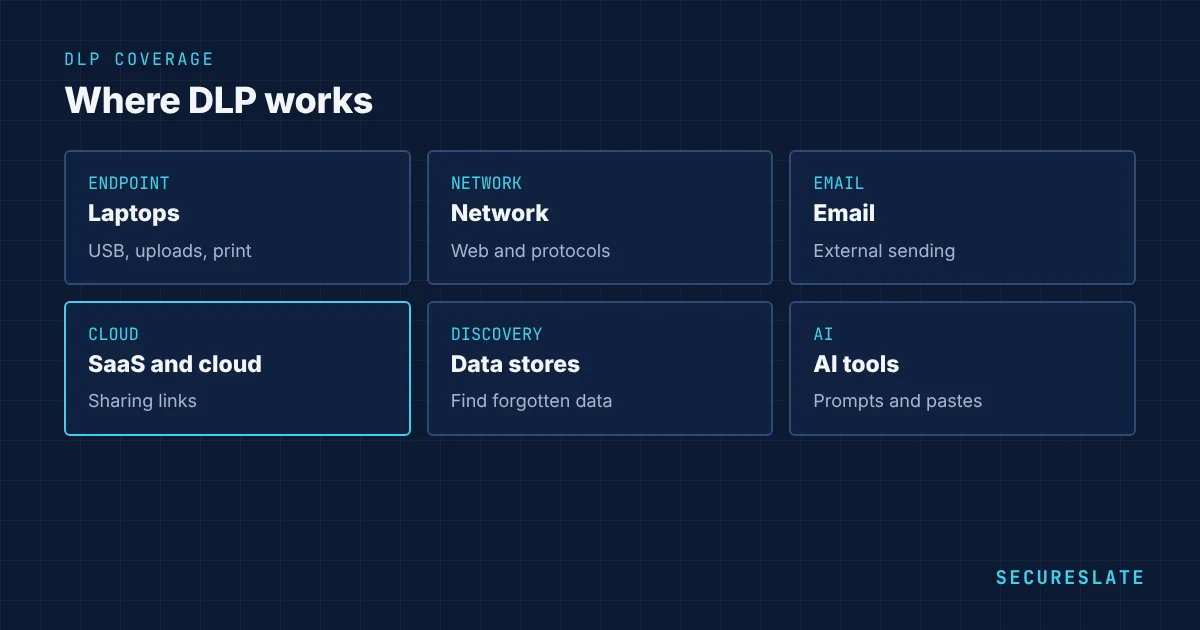
| Type | Where it works | Examples of what it stops |
|---|---|---|
| Endpoint DLP | Laptops and desktops | Copying sensitive files to USB, uploading to personal cloud, printing |
| Network DLP | Network traffic and web gateways | Sensitive data sent over web uploads or unapproved protocols |
| Email DLP | Email systems | Customer data sent to external recipients without encryption |
| Cloud DLP and CASB | SaaS apps and cloud storage | Public sharing links on sensitive files, downloads to unmanaged devices |
| Data discovery | Data stores | Finding forgotten sensitive data in buckets, shares and databases |
| Generative AI controls | AI chat and assistant tools | Pasting source code or customer data into unapproved AI tools |
Examples of DLP tools
| Tool | Type | Notes |
|---|---|---|
| Microsoft Purview Data Loss Prevention | Endpoint, email, cloud | Built into Microsoft 365 plans that include it; strong for Microsoft-centric companies |
| Google Workspace DLP and Sensitive Data Protection | Email, Drive, cloud | Built into Google Workspace editions and Google Cloud |
| Netskope | Cloud and web, CASB, endpoint | Security service edge platform with DLP |
| Zscaler | Cloud and web, endpoint | Security service edge platform with inline DLP |
| Forcepoint DLP | Enterprise DLP across channels | Long-established DLP vendor |
| Symantec DLP (Broadcom) | Enterprise DLP across channels | Long-established DLP vendor |
| Proofpoint | Email, endpoint, insider risk | Combined information protection and insider risk |
| Nightfall | Cloud and SaaS, AI tools | API-based DLP for SaaS and AI apps |
| Cyberhaven | Endpoint and data lineage | Tracks data movement based on origin |
Choosing DLP
| Question | Why it matters |
|---|---|
| Where does our sensitive data live? | Pick coverage for the channels that matter |
| Do we already own DLP features? | Microsoft 365 and Google Workspace may include enough to start |
| Which regulations apply? | PCI DSS, HIPAA and GDPR drive what you must detect |
| How many people can manage alerts? | Small teams need low-noise, well-tuned tools |
| Are devices managed? | Endpoint DLP needs device management |
| Do we need AI tool controls? | Many teams now need to govern data shared with AI |
| How does it integrate? | SIEM, ticketing and identity integration reduce manual work |
DLP rollout plan
- Define what to protect. Use your data classification policy to list sensitive data types.
- Discover. Scan data stores to find where sensitive data sits.
- Start with monitoring. Turn on policies in audit mode to understand normal behavior.
- Tune. Reduce false positives by refining patterns and exceptions.
- Educate. Use warnings that explain the rule and offer a safe alternative.
- Enforce selectively. Block high-risk actions such as external sharing of Restricted data.
- Respond. Set up a process to investigate alerts and track outcomes.
- Review. Revisit policies quarterly and when new tools or data types appear.
Common DLP policies
- Block sending payment card numbers outside the company
- Warn when files labeled Confidential are shared externally
- Block uploads of source code to personal cloud storage
- Prevent public links on files containing personal data
- Block copying Restricted files to USB drives
- Prevent pasting sensitive data into unapproved AI tools
Challenges
- False positives that annoy users and overwhelm small teams
- Encrypted traffic that some network DLP cannot inspect without decryption
- Unmanaged devices that endpoint DLP cannot cover
- Privacy concerns about monitoring employees, which require clear policies and, in some regions, worker consultation
- Shadow IT where data moves through apps not covered by DLP
DLP and compliance
| Framework | Relevant requirement |
|---|---|
| ISO 27001:2022 | Annex A 8.12 Data leakage prevention |
| SOC 2 | Confidentiality criteria C1.1 and C1.2; CC6.7 restricts transmission and movement of information |
| PCI DSS v4.0.1 | Protect stored account data and restrict where it flows |
| HIPAA | Safeguards to protect ePHI from improper disclosure |
| GDPR | Appropriate measures to protect personal data |
DLP for generative AI
Employees increasingly paste code, customer emails and documents into AI assistants. DLP and security service edge tools can now detect sensitive data in prompts and block or warn before it reaches unapproved AI services. Combine these controls with an AI acceptable use policy, approved enterprise AI tools that do not train on your data, and training that shows examples of what not to share.
Measuring DLP effectiveness
| Metric | What it shows |
|---|---|
| Policy matches per week by channel | Where sensitive data moves |
| True positive rate after investigation | Rule quality |
| Blocked high-risk actions | Prevented incidents |
| User overrides with justification | Business needs that may require policy changes |
| Time to investigate alerts | Team capacity |
| Sensitive data found in unapproved locations | Discovery and cleanup progress |
Example rollout for a 100-person company
A software company with Google Workspace and a few cloud apps starts by turning on Workspace DLP in monitor mode for payment card numbers, national ID numbers and documents labeled Restricted. After two weeks, it tunes out false positives from test data, then blocks external sharing of Restricted files and warns on external email containing personal data. It adds endpoint controls only for the finance and support teams who handle the most sensitive data. Within a quarter, alerts are low and meaningful, and auditors see working controls for ISO 27001 Annex A 8.12.
How SecureSlate helps
SecureSlate complements DLP by making sure the basics are in place and evidenced: data classification and acceptable use policies with employee acknowledgment, continuous checks for public storage, unencrypted data stores and device encryption through the device agent, secrets detection in code and vendor risk for where data goes. Evidence maps to ISO 27001 Annex A 8.12 and SOC 2 confidentiality criteria.
FAQ
What is data loss prevention software?
Software that discovers sensitive data and monitors and controls how it is used and shared to prevent leaks.
What are the main types of DLP?
Endpoint, network, email, cloud or CASB, data discovery and, increasingly, controls for generative AI tools.
Does Microsoft 365 include DLP?
Microsoft Purview DLP is included in certain Microsoft 365 plans and available as an add-on for others.
Is DLP required for ISO 27001?
ISO 27001:2022 includes Annex A 8.12 Data leakage prevention. If it applies to your risks, you need measures to prevent leakage, which may include DLP tools.
Is DLP worth it for a small company?
Often yes in a light form: use built-in DLP features in your productivity suite and cloud tools, focused on your most sensitive data.
Disclaimer (legal note)
This article is for general information only and is not legal, regulatory, or professional advice. Requirements vary by framework, industry, and jurisdiction. Consult qualified advisors for your specific obligations.
Need compliance without the complexity?
SecureSlate automates ISO 27001, SOC 2, GDPR, HIPAA, and more. Built for growing teams. See it in action.
Find compliance gaps in 30 seconds